Baked salmon meatballs with avocado sauce is a modern fusion dish that combines the ancient tradition of fish balls and meatballs with the more recent culinary trend of pairing salmon with avocado. This dish emerged in the early 21st century as chefs and home cooks sought healthier, low-carb alternatives to traditional meatballs.
As a popular and versatile fish, salmon is prepared in many ways across the globe. The baked variety reflects a more recent focus on low-fat, oven-cooked meals. The creamy avocado sauce paired with salmon meatballs is a modern culinary invention. It differs from traditional guacamole, often incorporating ingredients like Greek yogurt or sour cream to create a tangy, creamy consistency.
The combination of salmon and avocado is celebrated as a ‘perfect pairing’ due to their complementary characteristics. Both are rich in ‘good fats’ that provide a similar luxurious, creamy mouthfeel.
Print Recipe
Baked Salmon Meatballs w/ Avocado Sauce
Votes: 1
Rating: 5
You:
Rate this recipe!
|
|
Votes: 1
Rating: 5
You:
Rate this recipe!
|
Instructions
Salmon Meatballs
Preheat oven to 350 F. Coat a large baking sheet with spray.
Place salmon in the bowl of a food processor. Pulse until finely chopped, scraping down sides as necessary. Transfer to a large bowl.
Add onion, breadcrumbs, cilantro, egg white, garlic, salt, pepper, paprika & oregano. Using a fork, stir to combine.
Using a 2 Tbsp scoop, portion the salmon mixture to form meatballs. Place salmon balls on the prepared baking sheet, spacing evenly.
Bake until the salmon balls are firm to the touch & cooked through, 15-18 minutes. Serve with avocado sauce.
Avocado Sauce
In a food processor, add all sauce ingredients making sure you discard any black spots on the avocado flesh or the sauce will be bitter.
Process the avocado sauce on high speed until smooth. Serve on the side or spoon over the salmon balls.
Recipe Notes
• You will note in my blog picture I rolled the salmon balls in the avocado sauce so they would be evenly covered, just personal preference. I also cut them in half for the sake of the picture to show the insides of the balls.

CELEBRATING CANADA DAY!
In Canada, July 1st marks the day for Canadians to reinforce national unity, sovereignty, and shared values against external economic pressures and to mark the 60th anniversary of the flag. It acts as a unifying force against trade tensions, protects our identity from being absorbed by larger neighbors, and boosts morale.
Today, Canadian pride and sense of belonging have reached their highest levels in years. Being Canadian brings pride through a strong commitment to multiculturalism, inclusivity, and freedom, alongside a reputation for politeness, resilience, and a high quality of life.
From coast to coast the country’s birthday is marked with various events. Barbecues are definitely the preferred choice of food event for the day. Of course, the staple at most barbecues, tailgates and picnics is the classic burger. But a burger doesn’t have to be just a burger. The surf and turf burger is a variation of the surf and turf dish, typically made with minced meat and marine products like lobster, shrimp, or crab.
The concept of ‘surf and turf’ is reported to have originated in the US as a dining trend in the mid-20th century. It refers to a dish that combines both seafood (surf) and meat (turf) in a single meal. While the idea of pairing seafood and meat together has been around for centuries in various forms, the modern surf and turf combination gained popularity in the 1960s and 1970s. The surf and turf burger is a creative twist on this classic concept.
Brion & I thought this was truly a gourmet meal burger in a bun. Much more than just a delicious meeting of ocean and prairie.
Print Recipe
Surf & Turf Burgers
Votes: 1
Rating: 5
You:
Rate this recipe!
|
|
Votes: 1
Rating: 5
You:
Rate this recipe!
|
Instructions
Burgers
In a bowl, combine all seasonings & add ground beef & beaten egg. Lightly combine without overmixing. Form into 4 burger patties. Set aside in refrigerator.
Shrimp
Peel & devein shrimp. Rinse in cold water & dry with paper towel. Toss shrimp in olive oil & Old Bay seasoning. Set aside in refrigerator.
Avocado Steak Sauce
In food processor, add all sauce ingredients. Process on high speed until smooth. Remove from processor & place in a glass dish. Cover with plastic wrap & refrigerate.
Other Ingredients
Slice tomato & red onion. Slice or shred cheese. Very lightly butter hamburger buns.
Cooking / Assembly
Heat a griddle to medium-high & cook shrimp until they are just done, about 1-2 minutes per side. Set them aside.
Place burgers on the griddle & cook them until done or to your liking.
Assemble surf & turf burgers as follows: roll, burger, cheese, arugula, tomato & onion, generous amount of avocado steak sauce, shrimp & top of roll.
-

I realize raspberry season in our part of the country is still a number of months away. I still see nothing wrong with using some of those frozen ones from last year’s crop. If there’s one thing I love, it’s an easy dessert that is still totally delicious. Combining raspberries and cream cheese is a match made in heaven.
Vividly pink and exquisitely perfumed makes raspberries so hard to resist. I think I’ve tried to use them in everything imaginable. For one company event some years ago, I was trying to come up with a sauce that would take my cream puffs to the ‘next level’. I decided to put some Chambord raspberry liqueur in it. Chambord is created using black and red raspberries, vanilla, citrus peel, honey and hints of fragrant herbs. I definitely could say I think I ‘nailed it’ with that raspberry drizzle.
Although the red raspberries seem to be the most popular and well known, I have tasted the gold ones as well. Fall Gold raspberries ripen in the late part of the season, becoming very large and sweet. If you get a chance, they are certainly worth trying.
It seems strange that raspberries are actually a member of the rose ‘family’ and not considered a true berry. Regardless, they are certainly delicious to eat and always give such great eye appeal to everything they are used in. Cheesecake has become such a global favorite, you might say, it’s a work of art that comes easily.
Print Recipe
Raspberry Cheesecakes
Votes: 1
Rating: 5
You:
Rate this recipe!
|
|
Votes: 1
Rating: 5
You:
Rate this recipe!
|
Instructions
Base
Preheat oven to 350 F. Have 2 mini 12-cup cheesecake pans available (the ones with the removable bottoms) OR use a 12 count cupcake pan with cupcake liners. Set aside.
In a small mixing bowl, combine the graham cracker crumbs, sugar & melted butter. Mix until a crumby mixture forms. Evenly distribute the mixture into either 24 mini cheesecake pan cups or 12 regular paper lined cupcake cups & press firmly into an even layer.
Bake the graham cracker crusts for 5 minutes. Remove the baked crusts from the oven & let cool while you make the filling.
Filling
Add the frozen raspberries to a medium saucepan. Let the berries simmer for about 5 minutes, stirring occasionally, until the berries break & begin to dissolve into a syrup.
Remove from the heat & strain the berries to remove the seeds. Allow the syrup to chill in the refrigerator until ready to use.
In a large mixing bowl, beat the cream cheese & sugar until smooth. Add the sour cream, vanilla & raspberry syrup (reserve a small amount to use when decorating baked cheesecakes if you wish). Mix until completely combined.
Add the eggs & mix again just until combined.
Evenly distribute the cheesecake filling into pans of choice. Bake for 20-25 minutes, or until the centers are still slightly jiggly but not runny.
Remove from the oven & allow to cool at room temperature. Move to the fridge & let them chill for at least 2 hours before removing from pans & papers.
If desired, top with whipped cream, some reserved syrup & fresh raspberries before serving.

Leeks are an edible plant used in many different cuisines. Closely related to onions, garlic, and scallions, the edible parts of leeks are the tightly bound leaf sheaths that form stalk-like bases, which transition into flat leaves. Leeks are quite mild which makes them perfect to pair with simple veggies in the spring like asparagus and peas, and heartier veggies in the fall like winter squash and potatoes.
When leeks are grown, soil is piled up around them, so that more of the leek is hidden from the sun, and therefore lighter in color and more tender. What produces a beautiful leek, a long pale body, also results in sand and dirt being lodged deep inside the leek.
Leeks straddle the line between aromatic and fresh vegetables, with the seasoning qualities of ‘the gourmet’s onion’ and the delicate flavor and texture of ‘the poor man’s asparagus’.
Leeks can be used interchangeably with onions in most recipes for soups, casseroles, and stews to add a subtle, more complex flavor. One way to showcase this flavorful onion is to make it the star of the show as I’ve done here in this leek dish with salmon in mustard sauce.
Print Recipe
Coho Salmon & Leeks Baked In Mustard Sauce
Votes: 1
Rating: 5
You:
Rate this recipe!
|
|
Votes: 1
Rating: 5
You:
Rate this recipe!
|
Instructions
Salmon / Leeks
Clean & remove skin from salmon fillet. Wash leeks & remove thicker outer layer, which can remain a bit tough. Cut the leeks into pieces approximately 1 1/2-inches in length. In the microwave steam dish, cook leek for 8 minutes until al dente. Drain & set aside.
Whisk all sauce ingredients together in a small saucepan over low heat. Warm through for 2-3 minutes, but do not boil.
Sauce
Whisk all sauce ingredients together in a small saucepan over low heat. Warm through for 2-3 minutes, but do not boil.
Assembly / Baking
Place salmon fillet in the center of a large baking dish. Surround with pre-cooked leeks & spread mustard sauce carefully over all.
Bake for about 20 minutes or until salmon flakes easily. Serve with orzo or mashed potatoes.

Today, March 28th, marks the date of my mother’s birth. Although she left this earth 48 years ago, her memory remains crystal clear. She was a wonderful mother who made our lives so much better in ways we never realized. She set a good example just by the way she lived the ‘best version of herself’.
When this date rolls around each year, I like to post something on the blog that I think she would have enjoyed making. Baking was a ‘job’ she really seemed to enjoy, and our family certainly reaped the benefits of that.
Carrot cake is considered a spring dessert primarily due to its strong association with Easter celebrations, the bright, vibrant color of carrots representing the season. With Easter being just a week away I thought it would be a fitting recipe for today’s blog.
While it’s difficult to pinpoint the exact first instance of carrot cake being made in Canada, it’s likely that it became popular in the mid-20th century, alongside its rise in popularity in the United States. In the 1970’s, carrot cake was perceived as being ‘healthy’ due to the fact that carrots, raisins and nuts are all ‘good for us.’ Then along came that glorious cream cheese frosting that forever bonded the pair. While raisins are undoubtedly the oldest compliment to carrots, pineapple, apples or applesauce as well as walnuts have all become modern day add-ins of choice.
Today’s blog recipe for layered pineapple carrot cake is moist, not too sweet and filled with crushed pineapple and pecans. I’ve used a fluffy, pineapple cream cheese frosting for the filling as well as topping for this decadent dessert.
Print Recipe
Pineapple Carrot Cake
Votes: 1
Rating: 5
You:
Rate this recipe!
Ingredients
Pineapple Cream Cheese Frosting
Ingredients
Pineapple Cream Cheese Frosting
|
Votes: 1
Rating: 5
You:
Rate this recipe!
|
Instructions
Cake
Place crushed pineapple in a fine mesh sieve over a bowl & push down on pineapple with a spoon to eliminate excess moisture. Set aside.
Preheat oven to 325 F. Line three 8” round cake pans with parchment paper then spray with nonstick cooking spray WITH FLOUR or grease and flour pans.
In a large bowl, mix all of the dry ingredients together. In a separate bowl, gently whisk eggs then stir in remaining wet ingredients, including drained pineapple, just until combined. DON'T OVERMIX.
Stir wet ingredients into dry ingredients just until moistened, then stir in 2 ½ cups grated carrots until evenly combined, being careful NOT TO OVERMIX.
Divide batter equally between prepared pans. Gently tap the pans a few times on the counter to get rid of air bubbles. Bake for 30-40 minutes, or until toothpick inserted into center comes out clean & the cakes begin to pull away from sides of pans.
Let cakes cool in pans on wire racks for 15 minutes then invert onto wire racks to cool completely.
Pineapple Cream Cheese Frosting
Using an electric mixer, beat the cream cheese & butter until creamy. Beat in the sour cream, vanilla & salt. Gradually beat in powdered sugar until the desired consistency is reached. Mix in pineapple preserves.
Assembly
Place a small dollop of frosting in the center of the cake stand to keep the cake from moving and top with one leveled cake.
Top cake with ¾ cup frosting & spread evenly. Top with a second cake & spread evenly with ¾ cup frosting. Top with remaining cake.
Create Crumb Layer by scooping 1 cup of frosting into a smaller bowl. Frost cake starting with the top and working down until the cake is evenly frosted, removing any excess frosting. Refrigerate cake 30 minutes or until crumb layer has set. Refrigerate remaining frosting until ready to use.
Frost the outside of cake with the remaining frosting. Decorate as you wish. Serve cake cold or at room temperature.
Recipe Notes
As you may have noticed in the blog picture, I divided the batter into thirds. We gifted a friend with a 2 layer cake & Brion & I kept 1 layer for us.
For the decorations, I simmered some dried apricots in the extra pineapple juice for a few minutes then sliced them & added some pepita seeds as well as black sesame.

When it comes to desserts, I’ve always liked the idea of the mini sizes or smaller amounts. Small batch recipes have become popular because they align with modern lifestyle needs for portion control, reduced food waste, flexibility, and the desire for fresh, homemade quality.
For single people, couples, or small families, large recipes often yield more food than needed. Smaller portions mean you can try a wider range of recipes without being stuck eating the same dish for days, allowing individuals and small households to enjoy freshly baked goods and diverse meals without the commitment or excess of a full-sized recipe.
One small batch recipe that really appeals to me is this one for these nostalgic little caramel sour cream buns. Baked in a caramel sour cream sauce, these buns are a specific type of caramel roll with origins tied to German and Scandinavian immigrants. The cream provides moisture and a rich, distinct flavor that differentiates these from other sticky buns or cinnamon rolls, which might use different kinds of syrup or frosting.
A defining characteristic of these baked goods is how they are prepared: the caramel sour cream sauce is placed at the bottom of the pan before baking. After baking, the pan is immediately inverted, so the gooey, self-saucing caramel topping cascades over the top of the finished rolls.
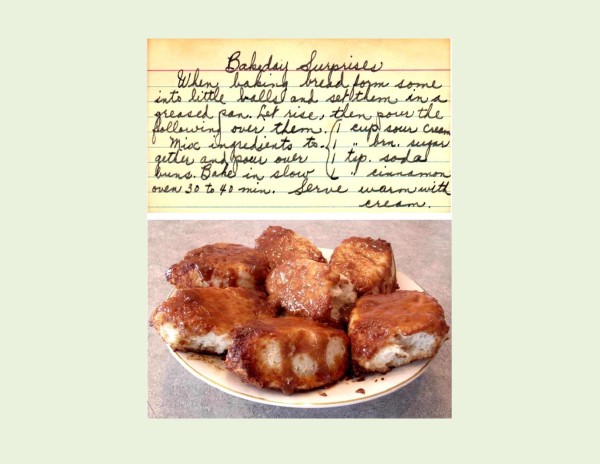
In today’s post, I would like to share a recipe my mother called ‘Bake Day Surprises’. I remember this dessert being so incredibly good. Since she baked bread once a week, an extra treat stemming from that bread dough was something we could always count on. Since there are just the two of us, it’s nice to be able to try and replicate this special dessert without having to make a large pan of them (that we really don’t need, right!)
Print Recipe
Small Batch Caramel Sour Cream Buns
Votes: 1
Rating: 5
You:
Rate this recipe!
|
|
Votes: 1
Rating: 5
You:
Rate this recipe!
|
Instructions
Caramel Sour Cream Sauce
In a small bowl combine all sauce ingredients; pour into a small round baking dish. Set aside.
Bun Dough
In a bowl, combine water , yeast & sugar. Allow to proof for 5 minutes. Add oil, flour, salt & egg. With a fork or a wooden spoon, mix into a shaggy dough.
Turn dough out onto a floured surface & knead for 5 minutes.
Divide the dough into 4 equal pieces & shape into balls. Place balls on top of sour cream sauce mixture in small round baking dish, cover with a towel & let rise for 40 minutes.
-
Bake for about 20-25 minutes. Remove from oven & immediately invert pan over a serving platter. Be VERY CAREFUL that the HOT sauce does not burn your hands when inverting the pan.

Persimmons are definitely a fruit that’s underrated. If you haven’t used them before, now is a good time to give them a try. Where we are, here in Canada, you start seeing them in the grocery stores around October. A bit pricey at first but they get better as the winter rolls along. Persimmons are in season between November and February. Mildly sweet and juicy with a slight crunch reminiscent of a cross between a peach and a pear. Since there is only a short window in which you can enjoy this exotic fruit, persimmons make up for it by working well in both sweet and savory recipes. Treat them like you would an apple and turn them into jams, puree, tarts and cakes. Paired with pork adds a nice fruity and caramelizing sweetness.
The persimmon is Japan’s national fruit. The most commonly found varieties are the ‘Hachiya’, round with a slightly elongated, pointed base and the ‘Fuyu’, smaller and more tomato shaped. When ripe, both have a red-orange skin and flesh, creamy texture and a tangy-sweet, vanilla like flavor. Persimmons are usually sold unripe, so leave them on the counter for a day or two until the skin deepens to a rich sunset orange.
Classic apple pie gets a seasonal, honey sweet twist when mixed with fresh persimmons and a crunchy topping in this apple persimmon crumble pie.
Print Recipe
Persimmon Apple Crumble Pie
Votes: 1
Rating: 5
You:
Rate this recipe!
|
|
Votes: 1
Rating: 5
You:
Rate this recipe!
|
Instructions
Pastry
Remove the dough disk from refrigerator & roll out onto a lightly floured surface into a 12" round about ⅛" thick.
Gently transfer the rolled dough into a deep dish 9" pie pan, leaving a 1-2" overhang all the way around.
Tuck the edge underneath itself to form a ring around the edge of the pie plate. Flute the edges by pinching the dough between your thumb & pointer finger on one hand & your pointer finger knuckle on the other. Place the pie shell in the freezer to keep chilled while you prepare the filling.
Filling
Peel & core the apples & persimmons, then cut into ⅛"- ¼" slices. Place in a large mixing bowl & toss with the lemon juice, sugars, & spices. Set aside for at least 15 minutes so the juices begin to release from the fruit.
-
Crumble Topping
Combine the cold butter cubes, flour, sugars, oats, almonds, salt & cinnamon together in a large bowl. Use your hands to work the butter into the other ingredients until coarse crumbles the size of peas form.
Assemble/Bake
Pour the apple filling into the bottom shell, forming a mound that is taller in the center of the pie.
Whisk the egg & water until blended. Gently brush the exposed, fluted edges of the pie with the egg wash. Sprinkle the crust with coarse sugar. Top pie evenly with crumble topping.
Bake at 400 F. for 20 minutes, then lower the temperature to 375 F. & bake for another 30-40 minutes, rotating the pan halfway through. Bake until the filling is bubbly and the crumble topping turns a deep golden color, you may need to cover the edges and or/tent the pie to keep from over-browning. The fruit should be just soft when poked with a toothpick. Allow to cool on a rack for at least 1-3 hours before serving.
Cream Topping
Whip together sour cream & vanilla sugar.
Serve with your choice of 'cream topping', vanilla ice cream or whipped topping.

With only 13 days left until Christmas day there are probably numerous gatherings you will still need to prepare for. Hors d’ oeuvres are part of the holiday party tradition. I think that the best appetizers are ‘finger foods’ that you can eat easily and with very little mess. It seems every culture has its own collection of favorite appetizer recipes which have evolved over the years.
In North America, frozen puff pastry has become the ‘go-to’ when it comes to party fare. Puff pastry is so magical. It looks just like regular dough, but it doesn’t contain yeast, baking powder, or baking soda. Nevertheless, it puffs in the heat of the oven into flaky golden layers. Probably the big plus is that you can buy it frozen and have great success without it being labor intensive.
Not only do puff pastry appetizers make for a chic presentation, but they also make it easy to time your guests’ arrival with taking the appetizers out of the oven if you are serving them hot. Most recipes require a short cooking time, which allows you to pop them in the oven half an hour before your guests arrive and serve a warm appetizer as soon as they walk through the door.
Combining pears, gorgonzola cheese, and red onion in puff pastry appetizers creates a delightful blend of sweet, savory, and tangy flavors. Certain flavor pairings are so underrated and pear and gorgonzola are definitely one of them.
Gorgonzola is an Italian, blue-veined cheese, made from cow’s milk. It can be creamy, firm, or crumbly. Neither Brion nor I like the taste of traditional blue cheese, but we really enjoy the dolce gorgonzola (the milder and creamier version).
This combo of pears, red onion and gorgonzola is very versatile in that you can use it to make appetizers as well as topping for pizza dough.
Print Recipe
Pear, Red Onion & Gorgonzola Tart
Votes: 1
Rating: 5
You:
Rate this recipe!
|
|
Votes: 1
Rating: 5
You:
Rate this recipe!
|
Instructions
Nuts
-
Chop nuts & roast them in a dry skillet until golden brown. Spread them on a plate & allow to cool.
Pastry
Place the sheet of puff pastry on a large piece of parchment paper. Score each edge with a sharp knife about 3/4" in from outer edge making sure not to cut all the way through. Beat the egg & brush the EDGE of the pastry with it. If you prefer, sprinkle a very small amount of sea salt on the EDGE.
Caramelized Onions
Heat 1 Tbsp olive oil in skillet until hot. Add red onion & sprinkle with salt. Cook & stir about 15 minutes or until moisture is evaporated & onion is soft. Reduce heat; sprinkle with vinegar. Cook & stir until golden. Stir in brown sugar; cook & stir until caramel brown in color.
Remaining Fillings
Peel & seed pear. Cut into thin slices. Strip the thyme leaves from the sprigs & crumble gorgonzola.
Assembly/Baking
Brush sour cream over inside of the pastry (NOT on the edge). Top the pastry with pear slices, gorgonzola & the red onion. Sprinkle thyme over all. Sprinkle with freshly ground pepper if you wish.
Bake the tart for about 20 minutes or until golden brown on bottom & edges. Sprinkle with nuts (if using).
Cut in whatever size you wish. Serve for hors de oeuvres or as pizza with a simple tomato-arugula salad.

Speculoos, also known as speculaas in Dutch, spéculoos in French, and Spekulatius in German, is a type of spiced short crust biscuit.
Speculoos originated from the County of Flanders, which encompasses present-day Belgium, France, and the Netherlands. The Dutch crafted speculoos using wheat flour, brown sugar, butter, and traditional speculaas spices, including cinnamon, nutmeg, cardamom, cloves, and ginger. These spiced biscuits are usually flat and often molded with traditional images, especially around the feast of St. Nicholas (Dutch: Sinterklaas).
While historically associated with holiday treats like Dutch Windmill Cookies, Biscoff Cookies, and German Spekulatius Spice Cookies its versatility extends beyond these traditional uses. There are several ways to incorporate speculoos spice into your culinary creations such as:
- Add a touch of speculoos spice to your classic chocolate chip cookie recipe.
- Toss whole almonds with melted butter, sugar, and a generous sprinkle of speculoos spice then roast them in the oven until golden and fragrant for a tasty snack or edible gift.
- Stir a pinch of speculoos spice into your favorite warm beverages.
- Sprinkle speculoos spice over waffles, pancakes, or French toast.
- Create a no-churn ice cream by infusing your base with speculoos spice. Enjoy it on its own or as a delightful topping for apple pie, crepes, or other seasonal desserts.
In this recipe the rhubarb and nectarine pair wonderfully with the warm, spiced flavors of speculoos creating a decadent tart.
Print Recipe
Rhubarb Speculoos Tarts
Votes: 1
Rating: 5
You:
Rate this recipe!
|
|
Votes: 1
Rating: 5
You:
Rate this recipe!
|
Instructions
Base
Preheat oven to 320 F. Line a baking sheet with parchment paper.
Place the speculoos in the bowl of a food processer & process until finely ground. Add the salt, process once or twice then turn into a medium-sized bowl & mix in the melted butter until you have a sort of dough.
Place six 3-inch (7.5cm) metal rounds on the baking sheet & press equal amounts of the dough into each one, using a metal soup spoon to press them so they are even around the edges. Make a slight indentation in the center. Place in the center of the pre-heated oven & bake about 15 minutes. Remove and let cool.
Rhubarb
Place the water, sugar, ginger, vanilla in a medium saucepan & bring to a boil over medium-high heat. Reduce the heat so the syrup is boiling, whisking from time to time, until the sugar is dissolved. Add the rhubarb, stir gently so it is mixed with the syrup & return the syrup to a low boil. Shake the pan & watch the rhubarb as it cooks & stir if necessary. Depending on its texture, the rhubarb will cook in about 1-1/2 minutes, though it can take up to 5 minutes.
Remove from the heat. With a slotted spoon remove rhubarb carefully to a plate. Whisk in 1 Tbsp of cornstarch . Continue whisking until cornstarch is dissolved & syrup is thickened. Remove from heat & cool for a couple of minutes the gently stir in rhubarb. Allow rhubarb to cool until ready to assemble.
Cream
Whisk the sour cream with the vanilla sugar.
Assemble
Carefully remove tart bases from rings. Lay equal numbers of nectarine slices atop the crust with the skin out to the edge. Top with sour cream/vanilla sugar. Refrigerate for 30 minutes to one hour.
To serve, top with rhubarb sauce & serve immediately.

Swedish meatballs are more than just food; they represent a piece of Swedish heritage that has found its way into kitchens and restaurants globally.
The Swedish word for meatball, ‘Kottbullar’, first appeared in print around 1754. They are traditional Swedish ‘old-world’ fare at Smorgasbords and other festive occasions. Initially Swedish meatballs were only enjoyed by upper class Swedes but the increased availability of wood stoves and meat grinders in the 1850’s made meatballs accessible to the middle class as well. In northern Scandinavian countries beef was considered a luxury item, which meant meatballs were highly prized.
The meat content can vary based on geography. In southern Sweden, they are most often a 50/50 mix of beef and pork whereas further north in Sweden 70/30 of beef to pork is typical. Likely other options would be veal, venison, lamb or moose. Size-wise, they are smaller than those of Italy or Germany, typically not larger than a golf ball or smaller than ¾-inch across.
Traditional Swedish meatballs are seasoned with a hint of nutmeg, that adds warmth and depth to the meatballs, along with allspice that complements the nutmeg as well as salt & pepper. This blend of spices gives them their distinctive flavor.
In America, Swedish meatballs were very popular in the beginning of the 20th century and again in the 1950’s-1960′. But as is with many dishes, they continue to be re-invented into new concepts such as this Swedish meatball noodle bake. They are cherished for their rich blend of flavors and are a testament to the intersection of history, culture, and cuisine.
Print Recipe
Swedish Meatball Noodle Bake
Votes: 1
Rating: 5
You:
Rate this recipe!
|
|
Votes: 1
Rating: 5
You:
Rate this recipe!
|
Instructions
Meatballs
Preheat oven to 375 F. Line a baking sheet with foil & spray with baking spray.
In a bowl, combine all meatball ingredients & form into balls. Place on foil lined baking sheet & bake for 10 minutes or until cooked. Remove from oven & place on paper towel to drain off any excess drippings.
Cook noodles until al dente. Drain & set aside.
Sauce
In a saucepan, melt butter. Cook the onions & mushrooms until tender, approximately 3-5 minutes. Mix in flour & cook for one minute. Slowly whisk in the beef broth & Worcestershire sauce. Heat to simmer & cook until thickened. Reduce heat to low & add sour cream & heavy cream. Season with salt & pepper.
Add the noodles, sauce & meatballs to a prepared baking dish. Bake for 20-30 minutes, or until sauce is thickened & bubbling.
Garnish with sliced green onion. Nice to serve with roasted cherry tomatoes on the side.
Recipe Notes
- You will probably notice I haven't used the traditional spices (nutmeg & allspice). Brion & I love Swedish meatballs but with a different combo of spices. Feel free to use what works for you.