Unusual fruit chutneys are growing in popularity with our developing taste for condiments that contain less sweet and more spice. Chutney, pronounced ‘chuht-nee’, refers to a family of condiments from South Asian cuisine. While Chutneys are most often associated with India, they’re also popular in Africa and the Caribbean islands.
They can be fresh or cooked and are made from a wide variety of ingredients usually from some concoction of fruits and/ or vegetables and spices. They range in flavor from sweet or sour, spicy or mild, or any combination of these, while their texture can be thin or chunky. Some compare chutneys to a relish and others to a jam. Chutney is most often used to balance a dish and may be on the sweet and tart side or provide a spicy and hot flavor. To add to the confusion, many times chutney is also mistakenly called a relish (and vice versa) but there are subtle differences between the two. Relishes tend to be a bit sweeter, while Chutneys are more on the savory side. Chutneys are cooked slowly, are more likely to be chunkier and have a consistency that is much like preserves while relishes are barely cooked, rarely use any sugar and are crunchier.
This simple to prepare chutney makes for a tasty, tart counterpart to the richness of pork.
Print Recipe
Roast Pork Tenderloin w/ Blackberry RhubarbChutney
Votes: 1
Rating: 5
You:
Rate this recipe!
Ingredients
Blackberry-Rhubarb Chutney
Ingredients
Blackberry-Rhubarb Chutney
|
Votes: 1
Rating: 5
You:
Rate this recipe!
|
Instructions
Risotto
In a heavy saucepan, heat butter & oil over medium heat then add 1 clove garlic & the mushrooms. Season with salt & pepper & sauté until mushrooms are golden brown & tender, about 6 minutes; remove from pan. Toss mixture together with parsley; set aside.
Heat broth in a microwave-safe bowl until hot. Cover & set aside. Heat remaining oil over medium-high heat in a heavy saucepan. Add onion & remaining garlic; cook, stirring until aromatic & softened, about 3 minutes. Add barley & cook, stirring to coat in oil. Stir in wine & cook until almost completely evaporated, about 3 minutes. Stir in 1/2 cup hot broth; continue stirring until stock has been absorbed, about 4 minutes. Reduce heat to medium & continue adding hot broth until broth has been absorbed & barley is tender, about 30 minutes.
Stir in cream & cheese, stirring until creamy. Remove from heat; stir in reserved mushroom mixture; set aside until ready to stuff tenderloin.
Risotto can be prepared ahead, once cooked, cover & refrigerate for up to 3 days.
Tenderloin
-
Cut tenderloin down the center, lengthwise, stopping when you are about 1/2-inch from the bottom of roast. Open the tenderloin like a book. Season inside surface lightly with salt & pepper.
Spoon risotto down the center of the tenderloin. Bring the 2 sides of the tenderloin up & around the filling to almost meet. Use wooden skewers to join the meat together, spacing the skewers apart at 2-inch intervals. Use butcher twine to 'lace up' the roast by weaving between the skewers (like lacing a shoe).
Place the tenderloin on a rack in a shallow pan. Stick thermometer into the exposed pork around the risotto. Rub pork with 1 Tbsp oil & lightly season with salt & pepper. Oven sear roast for 10 minutes.
Reduce heat to 300 F. Stuffed pork tenderloin should reach an internal temperature of 145°F. To prevent it from drying out, remove the pork from the oven when it reads 135°F to 140°F, cover loosely with foil let it rest for 5 minutes, as the carryover heat will bring it to the final safe temperature.
Chutney
Combine all chutney ingredients in a medium saucepan. Bring to a boil over high heat, then reduce heat to low & simmer, uncovered, for 45 minutes to an hour, stirring frequently, until thick. Set aside until ready to serve with stuffed tenderloin.

BIRTHDAY WISHES!
The small pleasures of life are found in the little things. In people who make us smile, in the people who understand us even without words.
The little pleasures in life lie in the things we almost always take for granted, just assuming they will always be there. As we grow older, it has become very clear to me there are so many ‘little’ things to appreciate and be grateful for daily and what a special privilege it is to simply have each other to share life with. The little everyday things seem to take on much greater importance. Maybe it’s the state of our world at this time that has made it very clear not to take anything for granted. Throughout our married life Brion has always gone above and beyond to look after us. I am grateful to have the privilege of such a loving and caring husband.
I find this quote from Steven Aitchison so fitting, ‘If I could give you one special ability in life it would be the gift of seeing yourself through the eyes of someone who loves you …. then you would realize just how amazing you truly are’.
HAPPY BIRTHDAY BRION, WITH LOVE!
Print Recipe
Raspberry Custard Cinnamon Rolls
Votes: 1
Rating: 5
You:
Rate this recipe!
Ingredients
Cream Cheese Drizzle, optional
Raspberry Glaze, optional
Ingredients
Cream Cheese Drizzle, optional
Raspberry Glaze, optional
|
Votes: 1
Rating: 5
You:
Rate this recipe!
|
Instructions
Dough
Whisk the warm milk, 2 Tbsp sugar & yeast together in a bowl. Allow mixture to sit for about 5 minutes or until foamy on top.
With a handheld mixer, beat in the remaining 3 Tbsp sugar & softened butter until it is slightly broken up. Add eggs, vanilla & salt. Beat at a medium speed until combined. The butter won’t really be mixing into the mixture, so don’t be concerned if it stays in pieces.
Using the mixer, add 1 cup of flour making sure it’s fully incorporated, then using a fork add the remaining 3 cups, mixing the dough by hand. It should only take about 3 minutes until the dough comes together & pulls away from the sides of the bowl. Dough will be soft.
Knead on a lightly floured surface for 5 full minutes. If the dough becomes too sticky during the kneading process, sprinkle 1 teaspoon of flour at a time on the dough or on the work surface/in the bowl to make a soft, slightly tacky dough. Do not add more flour than you need because you do not want a dry dough. After kneading, the dough should still feel a little soft. Poke it with your finger—if it slowly bounces back, your dough is ready to rise.
Lightly grease a large bowl with oil or use nonstick spray. Place the dough in the bowl, turning it to coat all sides in the oil. Cover the bowl with plastic wrap & a clean kitchen towel. Allow the dough to rise in a relatively warm place for 2 hours or until double in size.
Butter the bottom & sides of a 9×13-inch baking dish.
Punch down the dough to release the air. Place dough on a lightly floured work surface & using a lightly floured rolling pin, roll dough into a 12×18-inch rectangle. Make sure the dough is smooth & evenly thick.
Filling
In a medium bowl, toss the frozen raspberries with sugar & cornstarch. Spread the cold sugared raspberries evenly over the dough. Tightly roll up the dough to form an 18-inch long log. With an extra sharp knife or an unscented piece of floss, cut into 18 even rolls. Arrange in a buttered 9 x 13” glass baking pan.
Cover the rolls with a buttered piece of plastic wrap & a tea towel. Allow to rise until puffy, about 20 minutes. The berries will release their juice at the bottom of the pan—this is OK.
Custard
In a medium mixing bowl, whisk the eggs until the yolks & whites are fully combined. Add the whole milk, heavy cream, brown sugar, vanilla, cinnamon & salt. Whisk until the brown sugar is dissolved & the mixture looks smooth & evenly speckled with cinnamon.
Slowly pour the custard over the rolls in the glass baking dish, making sure to cover all the pieces so they soak up the custard. Gently press down any pieces that sit too high, so everything is lightly moistened.
-
Let the dish rest on the counter for 30 minutes to allow the rolls to start absorbing the sweet mixture. This short soak helps the casserole bake up custardy rather than dry.
Place the dish on the center rack of the preheated oven & bake for 30–40 minutes, or until the top is puffed & golden brown & the custard is set in the center. A knife inserted in the middle should come out mostly clean, with no liquid custard clinging to it.
Remove the casserole from the oven & let it cool for about 10 minutes. If using, top rolls with cream cheese drizzle followed by the raspberry glaze.
Cream Cheese Drizzle
In a small blender, place all ingredients & blend until smooth & of drizzle consistency.
Raspberry Glaze
Place all glaze ingredients in a small saucepan. Cook while stirring until mixture is clear & bubbling. Remove from heat
Store any leftovers covered in the refrigerator for up to 3 days & reheat gently in a low oven or microwave before serving.
-
Recipe Notes
• If you prefer a custard with a slightly lighter texture, replace the heavy cream with additional whole milk & reduce the brown sugar to ¼ cup.
• Cream cheese drizzle & raspberry glaze are purely optional. Since none of the components of the rolls are not overly sweet, adding the extra toppings still works if you choose to use them.

Most people think of any creamy soup when they hear the word bisque, but it really refers to seafood soup. It originated in France in the region of Brittany, which is known for its seafood. The word ‘bisque’ comes from the Bay of Biscay —a gulf that lies off Europe’s west coast, bordering between France and Spain.
Authentic recipes for bisque actually ground the shells of the crustacean into a fine paste, using that to thicken the soup. Nowadays, it is more common to use flour or rice as a thickener. Although a bisque and a chowder are both cream-based soups and most often feature seafood, it is their consistency that defines them and makes them quite different from each other. Whereas a bisque is smooth, a chowder is chunky, chock full of hearty pieces of ingredients such as potato and clams or corn. We also see bacon as an important ingredient in a chowder when it would not be featured in a bisque.
The first reference to bisque as a soup dates back to the 17th century. It was originally a fisherman’s dish designed to extract the most flavor from whatever seafood ingredients were readily available. So, while today bisque is often considered a ‘fancy’ soup, its humble origins lie in practicality and resourcefulness.
Today’s bisque recipe is a simplified procedure using prepared broth but still gives you the depth of taste and the sumptuous, creamy consistency that makes it a wonderful choice on a cool day.
Print Recipe
Crab & Shrimp Seafood Bisque
Votes: 1
Rating: 5
You:
Rate this recipe!
|
|
Votes: 1
Rating: 5
You:
Rate this recipe!
|
Instructions
Heat olive oil in a large pot over medium heat. Sauté onion, celery & carrot until softened, about 5 minutes. Add garlic & cook for an additional minute.
Stir in tomato paste, paprika, Old Bay seasoning & season with salt and pepper to taste. Cook for 2 minutes, stirring constantly.
Sprinkle flour over the mixture, stirring until well combined. Cook for another minute.
Gradually add broth, stirring continuously to prevent lumps. Simmer on low heat for 10 minutes, stirring occasionally.
Puree the soup until smooth using an immersion blender, or transfer to a standard blender in batches.
Mix in the heavy cream & simmer for 10 more minutes, until slightly thickened.
Add crab meat & shrimp. Simmer for 5 minutes or until seafood is heated through, keeping the heat low to avoid curdling the cream.
Adjust seasoning with salt & black pepper if needed.
Serve hot, garnished with fresh herbs.

Somewhere along the way, I became interested in the iconic Old Bay Seasoning. It seemed I was forever looking for that special something that would elevate seafood dishes from basic to ‘wow’ that’s good! Once I tried Old Bay seasoning it became a pantry staple for me.
Old Bay seasoning is a blend of herbs and spices that is currently marketed by McCormick & Company, and produced in Maryland, USA. It is produced in the Chesapeake Bay area where it was developed by German immigrant Gustav Brunn in the 1940s, and where the seasoning is very popular to this day. At that time, crabs were so plentiful that bars in Baltimore, Maryland offered them free and seasonings like Old Bay were created to encourage patrons to purchase more beverages.
Old Bay Seasoning is named after the Old Bay Line, a passenger ship line that sailed the waters of the Chesapeake Bay from Baltimore to Norfolk, Virginia, in the early 1900s. Gustav Brunn’s company became the Old Bay Company, producing crab seasonings in the unique yellow can container until the company was purchased by McCormick & Co around 1990.
Old Bay is known for its savory, aromatic, quite salty, and reasonably spicy flavor. The presence of warm, slightly sweet spices balanced by the fairly modest amount of heat from red pepper and dry mustard harmonizes beautifully with the distinct flavor of celery seed.
While it was initially marketed as a seasoning for seafood, specifically crab, Old Bay has since become a versatile ingredient in a wide range of dishes, including poultry, meats, vegetables, soups, stews, and snacks. It adds depth of flavor and a touch of nostalgia to recipes, evoking memories of summertime seafood boils. Its versatility has made it a staple in kitchens worldwide.
It definitely adds some flavor to these stuffed shells I’m making today.
Print Recipe
Creamy Seafood Stuffed Shells
Votes: 1
Rating: 5
You:
Rate this recipe!
|
|
Votes: 1
Rating: 5
You:
Rate this recipe!
|
Instructions
Pasta
Cook pasta according to package directions.
Filling
Melt 2 Tbsp butter and oil in a large skillet over med-low heat and sauté onions until tender. Stir in the clam juice and chicken broth and bring the mixture to a boil.
Once boiling, add in the shrimp, scallops, crab meat & 1/4 tsp. Old Bay seasoning. Return to a boil, then reduce heat & let simmer for 4-5 minutes until the seafood is cooked through (shrimp is pink & scallops opaque). Drain the seafood, reserving the liquid. Set aside.
Sauce
Set a large saucepan over med-low heat & melt the remaining 1 cup butter. Stir in the flour & mix until smooth. Gradually add in the milk & reserved liquid while continuously stirring. Sprinkle in 1 tsp of the seasoning. Bring the sauce to a boil & cook, continuing to stir, for about 2 minutes until thickened.
Remove from the heat; stir in cream and half of the cheese. Stir 3/4 cup white sauce into the seafood mixture.
Assembly/Baking
-
Drain and rinse pasta. Spread 1/2 cup white sauce in a 13x9-in. baking dish. Fill each of the shells with the seafood mixture & place in rows over the sauce. Top with remaining sauce & cheese. Sprinkle with the remaining seafood seasoning.
Bake, uncovered, until golden brown & bubbling, about 30 minutes. If desired, top with additional chopped green onions.

The aroma. The sizzle. The crackle. The taste. Bacon is a staple of so many menus, from diners to fine dining. Commonly featured in breakfast dishes and sandwiches, bacon has expanded its reach into our main course, desserts, cocktails and hors de oeuvres as well.
Bacon has a unique ability to evoke strong sensory memories. The aroma of sizzling bacon sizzling in the pan triggers a sense of comfort and anticipation, reminiscent of weekend breakfasts or family gatherings. The sound of bacon crackling in the pan and the sight of its golden-brown color further enhance the sensory experience. These sensory cues, combined with the indulgent taste, create a nostalgic connection for many people, reinforcing their love for bacon.
Bacon’s distinctive flavor is one of the primary reasons why people love it so much. The combination of smokiness, saltiness, and overall essence creates a taste sensation that is hard to replicate. The crispy texture adds a great crunch, while the fat contributes to its mouthwatering juiciness. Its ability to enhance both sweet and savory dishes makes it a go-to ingredient for cooks of all experience levels.
This bacon chicken Alfredo lasagna roll is a unique and indulgent twist on the classic pasta dish. This recipe features layers of lasagna noodles, shredded chicken, chard, alfredo sauce, and cheese, all wrapped in crispy bacon. The bacon adds a smoky and savory flavor to the lasagna, while keeping it moist and tender. This decadent dish is perfect for special occasions or when you’re craving something extra delicious.
Print Recipe
Bacon Chicken Alfredo Lasagna Roll
Votes: 1
Rating: 5
You:
Rate this recipe!
|
|
Votes: 1
Rating: 5
You:
Rate this recipe!
|
Instructions
Over a long sheet of saran wrap, lay 8 of the bacon strips down back to back. Lifting up every other strip, fold about 1-inch (2 cm) the bacon back on itself. Lay another slice of bacon perpendicular to the strips & fold the flaps back over the horizontal strip of bacon. Repeat with the rest of the bacon until a tight weave has formed. Set aside in the fridge.
In a medium saucepan, add the butter & garlic over medium heat, cooking until aromatic, about 30 seconds.
Add the cream, and bring to a boil. Add in the Parmesan, parsley, salt, & pepper, stirring constantly until the cheese has melted & there are no lumps remaining.
Pour half of the mixture over the shredded chicken, reserving the other half to use a sauce in the end. Mix the chicken with the sauce until thoroughly combined.
On a separate sheet of saran wrap, lay down the lasagna noodles, overlapping them slightly. Spread the chicken mixture over the noodles, making sure that you leave about a 1-cm (½ inch) gap at the bottom so the noodles have room to roll on themselves.
-
Sprinkle the grated cheese evenly across the chicken, then spread the broccoli over the grated cheese.
Lift the saran wrap up and over, causing the noodles to roll on themselves. Make sure to roll tightly until the entire thing has come together into a neat rolled bundle.
Transfer the lasagna roll to the bottom of the bacon weave, & repeat the saran wrap rolling process until the bacon has tightly & completely wrapped the lasagna roll. Unwrap & transfer to a baking tray.
Bake for about 25 minutes until the bacon is starting to get crispy but not too dark.
Cool for about 15 minutes, then transfer the roll to a cutting board. Slice generous 1-inch (2 cm) thick portions, then serve with the remaining alfredo sauce.

Swedish meatballs are more than just food; they represent a piece of Swedish heritage that has found its way into kitchens and restaurants globally.
The Swedish word for meatball, ‘Kottbullar’, first appeared in print around 1754. They are traditional Swedish ‘old-world’ fare at Smorgasbords and other festive occasions. Initially Swedish meatballs were only enjoyed by upper class Swedes but the increased availability of wood stoves and meat grinders in the 1850’s made meatballs accessible to the middle class as well. In northern Scandinavian countries beef was considered a luxury item, which meant meatballs were highly prized.
The meat content can vary based on geography. In southern Sweden, they are most often a 50/50 mix of beef and pork whereas further north in Sweden 70/30 of beef to pork is typical. Likely other options would be veal, venison, lamb or moose. Size-wise, they are smaller than those of Italy or Germany, typically not larger than a golf ball or smaller than ¾-inch across.
Traditional Swedish meatballs are seasoned with a hint of nutmeg, that adds warmth and depth to the meatballs, along with allspice that complements the nutmeg as well as salt & pepper. This blend of spices gives them their distinctive flavor.
In America, Swedish meatballs were very popular in the beginning of the 20th century and again in the 1950’s-1960′. But as is with many dishes, they continue to be re-invented into new concepts such as this Swedish meatball noodle bake. They are cherished for their rich blend of flavors and are a testament to the intersection of history, culture, and cuisine.
Print Recipe
Swedish Meatball Noodle Bake
Votes: 1
Rating: 5
You:
Rate this recipe!
|
|
Votes: 1
Rating: 5
You:
Rate this recipe!
|
Instructions
Meatballs
Preheat oven to 375 F. Line a baking sheet with foil & spray with baking spray.
In a bowl, combine all meatball ingredients & form into balls. Place on foil lined baking sheet & bake for 10 minutes or until cooked. Remove from oven & place on paper towel to drain off any excess drippings.
Cook noodles until al dente. Drain & set aside.
Sauce
In a saucepan, melt butter. Cook the onions & mushrooms until tender, approximately 3-5 minutes. Mix in flour & cook for one minute. Slowly whisk in the beef broth & Worcestershire sauce. Heat to simmer & cook until thickened. Reduce heat to low & add sour cream & heavy cream. Season with salt & pepper.
Add the noodles, sauce & meatballs to a prepared baking dish. Bake for 20-30 minutes, or until sauce is thickened & bubbling.
Garnish with sliced green onion. Nice to serve with roasted cherry tomatoes on the side.
Recipe Notes
- You will probably notice I haven't used the traditional spices (nutmeg & allspice). Brion & I love Swedish meatballs but with a different combo of spices. Feel free to use what works for you.

Strawberries — loved for their sweet taste and heart shape, have symbolized purity, perfection, love and passion throughout the ages. It is very common for us to give little thought to where our food comes from and the back breaking labor that it took to get it to our various parts of the country.
Travel can always be filed under the category ‘learning experience’. I find it so important to set oneself outside our ‘bubble’ to fully understand and not become complacent about the many things we take for granted.
Over the years, Brion and I have spent many holiday hours travelling along the Big Sur coast of California, USA. While there we would use Monterrey as our ‘home base’ and make little day trips to the surrounding area. Just inland from Monterrey is the agricultural jewel known as the Salinas Valley. This is one of the major valleys and most productive agricultural regions of California. Having a unique coastal environment with its western ocean exposure (less than 10 miles away) provides moderate temperatures year-round. Warm sunny days and cool foggy nights are the perfect combination for growing strawberries.
I find myself going back to those years I was raised on the farm when Brion & I were driving along looking at the fields of produce growing. I have often felt much appreciation and compassion for the farm workers standing, bent over in the heat of the blazing sun for hours tending these crops.
I have many memories of my own parents working long, hard hours to provide for us on our family farm. I am grateful to have learned to appreciate the efforts of others that make life good.
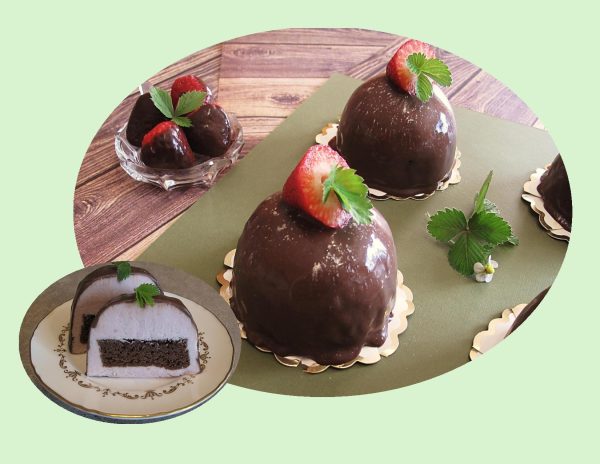
These strawberry mousse ‘domes’ celebrate those wonderful strawberries as well as satisfying the chocolate lover.
Print Recipe
Chocolate Covered Strawberry Mousse Domes
Votes: 1
Rating: 5
You:
Rate this recipe!
|
|
Votes: 1
Rating: 5
You:
Rate this recipe!
|
Instructions
Brownie
-
Lightly butter a 9 x 5-inch loaf pan & line with a 9-inch strip of parchment paper (the two short ends will be uncovered); lightly butter parchment.
Melt butter in a medium saucepan. Remove from heat & add chopped chocolate, stirring until smooth (the residual heat from the pan should be plenty to melt the chocolate.)
Stir in sugar; mixture should be lukewarm, no longer hot to the touch. If it's still pretty warm, let it cool for a minute or two.
Whisk in eggs until batter is smooth & shiny.
Sift together flour, cocoa powder, baking powder & salt in a small bowl. Sprinkle over chocolate mixture & fold with a spatula until just incorporated.
Pour batter into prepared pan & spread into an even layer. Bake for about 20 minutes or until top is set & a toothpick inserted near the middle comes out with moist crumbs (not gooey batter). Set pan on a wire rack & let cool completely. The brownie layer can be made a day ahead of time; once cool, cover pan tightly and refrigerate overnight until ready to use.
Lift the cooled brownie out of the pan using the parchment overhang as handles. Cut off the edges, then cut into six 2-inch squares.
Strawberry Mousse
Place water in a small dish; sprinkle gelatin over top & set aside to bloom for at least 5 minutes.
Heat milk in a small saucepan set over low heat until it just starts to steam (try not to let it boil).
Mix together egg yolk & sugar in a bowl until it forms a thick paste. Slowly spoon some of the hot milk into the yolk mixture, whisking constantly until the paste thins out a bit. Drizzle in the remaining milk & whisk until smooth.
Return mixture to the saucepan & return to low heat & cook, stirring & scraping the bottom of the pan consistently, until the mixture thickens slightly to coat the back of a spoon.
Remove from heat & whisk in gelatin until smooth. Transfer to a medium-large bowl & set aside.
Meanwhile, purée strawberries & lemon juice in a blender or food processor until smooth. Transfer to a liquid measuring cup (you should have about 1/2 cup purée, if you have more than that save the excess for another use). Whisk strawberry purée into lukewarm custard mixture, then place bowl in refrigerator while you whip the cream.
In a clean bowl or the bowl of a stand mixer, beat heavy cream until it holds soft peaks. Add 1/3 of cream to the cooled strawberry mixture & fold to lighten, then add remaining cream & fold until fully incorporated & no white streaks or lumps remain.
To assemble your cakes, spoon or pipe the mousse into 5- (4 oz) silicone dome molds (they’re just over 3 inches in diameter), about 2/3 of the way full. Gently press a brownie square into the top of each mousse-filled mold. Scrape with an offset spatula to make the top perfectly level with the top of the mold. Freeze at least 3 hours or overnight until completely firm.
Before you make the glaze, remove cakes from molds and place on a frozen cookie sheet lined with parchment paper. Return to freezer until just before glazing.
Glaze
Place chopped chocolate in a medium-sized, heat-proof bowl and set aside.
Heat cream & corn syrup in a small saucepan until it just starts to bubble (do not let it boil).
Pour over chopped chocolate & let sit for 30 seconds, then gently whisk, starting in the center & moving in gentle concentric circles until an emulsion forms, then working your way out to the edges until the entire mixture is smooth & emulsified.
Remove cakes from freezer & place on a cookie sheet, elevated off the sheet using small jars or cookie cutters (ideally something smaller in diameter than the cake itself so the glaze can drip off). You may also want to cut out small rounds of parchment to place under each cake to make them easier to transfer.
Pour glaze generously over cakes, taking care to ensure there are no bare spots left. Gently scrape the edges to remove any remaining drops, then carefully transfer cakes using a small offset spatula to cardboard cake rounds or small pieces of cardboard for easy movement. Any leftover glaze can be scraped up & refrigerated in an airtight container for another use.
Glazed cakes will keep in the refrigerator for up to 3 days. Let come to room temperature before serving.

Onion rings are a North American classic so why not kick it up a notch? Instead of just rings, use half an onion, tender roasted with bacon wrapped around it in a tasty creamy asiago sauce!
Asiago Cheese has been one of my personal favorite kinds of cheese for many years. Coupled with a rich history and unique flavor profile, asiago cheese is incredibly versatile and ranges from smooth and silky to crumbly and brittle.
Asiago cheese has a characteristically sweet and mildly nutty taste. However, the flavors develop as it ages, getting sharper, more intense, and piquant. As it matures, the cheese develops a slightly acidic and tangy undertone and a fruity appeal. The scent of the cheese is aromatic, with a floral smell that gets deeper with maturity.
A semi-hard cow’s milk cheese, asiago originated in Italy and takes its name from the famous plateau located in the north-eastern part of the peninsula.
Because this cheese features so much variety the everyday cheese lover might know they like asiago but not really be able to describe exactly what it tastes like. Asiago is actually considered one of the best cheeses to use for cooking due to its mild but noticeable flavor.
Onions are used in so many recipes as a seasoning or base flavor that I think we forget that they can be a side dish such as something to stuff, roast or bake with cheese on top.
Print Recipe
Creamy Asiago Bacon Wrapped Roasted Onions
Votes: 1
Rating: 5
You:
Rate this recipe!
|
|
Votes: 1
Rating: 5
You:
Rate this recipe!
|
Instructions
Pre-cook the bacon until until it’s starting to get cooked but it’s still soft & pliable. Set aside on paper towels to cool.
Wrap the onion halves with bacon, optionally pinning it on with toothpicks. Place them in a baking dish before drizzling them with oil & seasoning with thyme, salt & pepper to taste.
-
Pour the mixture of broth, cream, garlic & Worcestershire around the onions & roast until the onions are nice and tender, about 30-45 minutes depending on how thick they are. (You may need to cover with foil if the edges of the bacon start to get too dark to prevent burning.)
Sprinkle the cheese on top & bake just until it has melted.

Pasta-who doesn’t love it? When many of us think of pasta, we typically think of the more popular styles such as spaghetti, penne or linguine, but there are actually dozens of different types of pasta shapes, each with their own special flavor profile, culinary application and even regional origin.
If you think ravioli is only the stuff from Chef Boyardee, think again.
Ravioli, those little pillows of dough served in upscale restaurants filled with ingredients as diverse as butternut squash (with a burned sage butter) and artisan cheeses (with a wild mushroom ragout), while others feature duck liver ravioli with a brown butter and balsamic sauce.
The origin of this popular pasta shape is somewhat obscure, but legend has it that the Lombardy region in Italy, played a big role in spreading its popularity. Ravioli, a dish of stuffed pasta, is a humble but important dish in Italian cooking traditions. Humble in its ingredients of cheese and meat or vegetables found in a particular region, and special in that it is often prepared with loved ones for the feast table at Christmastime or for a family celebration.
Fresh seafood and pasta are a match made in heaven! A simple bowl of pasta with garlic cream sauce is homey and rustic. Top the same bowl with some shrimp and scallops, add a mix of zucchini, mushrooms and garlic, and you instantly elevate it to something special.
Although this delectable Italian food is widely considered to be the main course, it can be also served as an appetizer or a side dish as well.
Print Recipe
Four Cheese Ravioli w/ Seafood & Veggies in Garlic Cream Sauce
Votes: 1
Rating: 5
You:
Rate this recipe!
|
|
Votes: 1
Rating: 5
You:
Rate this recipe!
|
Instructions
Cook ravioli according to package directions & set aside.
In a large saucepan, heat oil & add zucchini & mushrooms. Sauté 1-2 minutes, add garlic & a bit of salt & pepper. Sauté until garlic is fragrant.
Add broth, stir well. Add cream, Worcestershire sauce, pressed garlic, salt & pepper; stir well.
Add shrimp & scallops; cook until shrimp starts to turn pink then flip shrimp & scallops. Add ravioli, carefully stir in & cook until shrimp is done.
Stir in parmesan & cheddar & cook for another minute. Serve immediately.
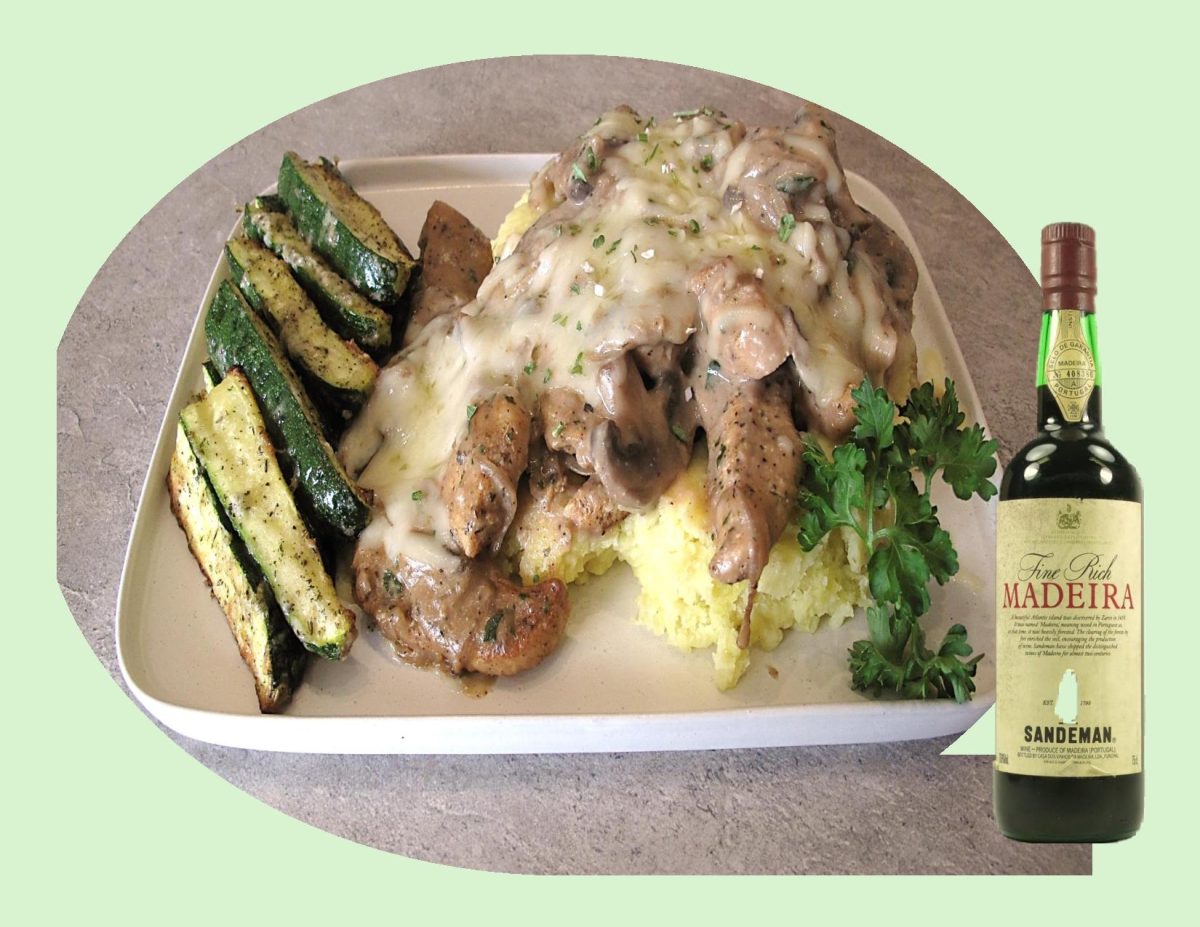
Wine is not just a beverage with dinner, but can also be a key ingredient in dinner. Madeira wines are known for their versatility. Madeira perfectly complements all sorts of ingredients because of its vast range of wines. It not only adds flavors, but also dimension to the dishes. From soups to stews to desserts, it packs quite a punch and has an intense impact on the final product.
Madeira wine evolved on the island of the same name on the coast of Portugal. It presents different characteristics to all other types of fortified wine due to its specific winemaking process, since it is obtained by intentional heating, and characterized by a distinct ‘baked’ bouquet.
Madeira is classified according to several designations, including vintage, grapes used, and sweetness. There are a few variations on the production method, but Madeira must be oxidized and heated (a process called “maderization,” named after the wine). This makes for a fortified wine that can last for centuries.
Madeira has several taste profiles, but most will have flavors of caramel, walnut oil, peach, hazelnut, orange peel, and burnt sugar.
The first thing to check before cooking a Madeira based dish is what kind of wine does the dish require? It is always safe to use an average blended Madeira. Choose the safest- Finest or Rainwater type. These are packed with flavors and aromas and are typically inexpensive.
A good example is Sandeman Madeira Rainwater. It is light in body but full of flavor. It has a light amber color with golden highlights, as well as clean, nutty aromas. Its flavor is nutty and lightly complex, with a clean finish. This Madeira makes a wonderful accompaniment to a variety of foods and is also a fabulous cooking wine that can be used in various traditional dishes. ‘Rainwater Madeira’ was so named in the 18th century because it is as soft as rainwater and the color of straw, glistening after a shower of rain.
Print Recipe
Chicken Madeira
Votes: 1
Rating: 5
You:
Rate this recipe!
|
|
Votes: 1
Rating: 5
You:
Rate this recipe!
|
Instructions
In a large saucepan melt 2 tablespoons of butter. Add 1 tablespoon of oil then add the mushrooms to the pan. Cook the mushrooms for about 5 minutes until they become soft.
Add the onions to the pan & cook them along with the mushrooms for about 2-3 minutes. Add garlic & parsley to the pan & sauté them for a minute or two. Then, transfer this mixture to a plate.
Slice the chicken breast in lengthwise strips. Season with garlic powder, Italian seasonings, paprika, salt & pepper.
In the saucepan, melt a tablespoon of butter. Add a tablespoon of oil as well & let the butter foam. Add the chicken breast to the pan & cook it on both sides for 3-4 minutes each until golden brown. When it is cooked, transfer it to the plate with the mushrooms.
In the same pan, pour in the Madeira wine & bring it to a boil. When it has reduced to almost half its volume, add the beef stock & boil it for about 10 minutes until only ¼ of the original volume remains.
Add the heavy cream to the pan & simmer it for 2-3 minutes until it thickens. Sprinkle a pinch of salt & pepper into the pan to add flavor & stir.
Return the cooked chicken to the pan along with the mushrooms. Top it with the shredded mozzarella cheese. Place the pan in the oven broiler and broil it for 2-3 minutes until the cheese has completely melted.
Remove the pan from the oven. Place chicken on a serving platter & garnish with some parsley. Nice served with mashed potatoes.