How about upside down cake turned into cookie form? What makes these peach upside-down cookies special is that they capture the essence of a summer peach. Soft & chewy with a bottom layer of soft peaches coated in brown sugar and topped with a dusting of powdered sugar.
The concept of upside-down ‘cakes’ dates back to the Middle Ages, when Europeans made some cakes by topping batter with fruit — usually apples or dried fruit — and cooking it over a fire (or baking it), then flipping it over for serving.
In 1925 the Hawaiian Pineapple Company sponsored a contest calling for (canned) pineapple recipes. They received a flood of 60,000 submissions of which an alleged 2,500 were for pineapple upside-down cake. No surprise then that the winning entry was—yes, a pineapple upside-down cake! The company built a major advertising campaign around the winning recipe and by the mid-1930s pineapple upside-down cake was probably the most popular home-baked cake in North America.
These ingenious inverted cakes were no doubt the precursor to the upside-down cookie idea. The ‘classic’ upside down cake is often thought to be made with pineapple. I think these cookies are a great way of enjoying whichever fruits are plentiful, fresh and in season.
Print Recipe
Peach Upside-Down Cookies
Votes: 1
Rating: 5
You:
Rate this recipe!
|
|
Votes: 1
Rating: 5
You:
Rate this recipe!
|
Instructions
Preheat oven to 350 F. Line muffin tin with foil-lined muffin paper cups.
In each muffin cup, place 1/2 tsp brown sugar & 1 full slice of peach.
Cream butter & remaining sugars until fluffy. Add egg & vanilla. Mix well. Whisk together flour, baking soda, salt, cornstarch & cinnamon. Gradually add to wet ingredients.
Divide dough into 12-14 portions & roll each into a ball. Place a cookie dough ball on top of each peach slice in the muffin cups..
Bake for 12–15 minutes. Cool 5 mins, then gently flip cookies out & remove paper cups. Serve peach side up warm, chilled or at room temperature. Store in airtight container.

Today, March 28th, marks the date of my mother’s birth. Although she left this earth 48 years ago, her memory remains crystal clear. She was a wonderful mother who made our lives so much better in ways we never realized. She set a good example just by the way she lived the ‘best version of herself’.
When this date rolls around each year, I like to post something on the blog that I think she would have enjoyed making. Baking was a ‘job’ she really seemed to enjoy, and our family certainly reaped the benefits of that.
Carrot cake is considered a spring dessert primarily due to its strong association with Easter celebrations, the bright, vibrant color of carrots representing the season. With Easter being just a week away I thought it would be a fitting recipe for today’s blog.
While it’s difficult to pinpoint the exact first instance of carrot cake being made in Canada, it’s likely that it became popular in the mid-20th century, alongside its rise in popularity in the United States. In the 1970’s, carrot cake was perceived as being ‘healthy’ due to the fact that carrots, raisins and nuts are all ‘good for us.’ Then along came that glorious cream cheese frosting that forever bonded the pair. While raisins are undoubtedly the oldest compliment to carrots, pineapple, apples or applesauce as well as walnuts have all become modern day add-ins of choice.
Today’s blog recipe for layered pineapple carrot cake is moist, not too sweet and filled with crushed pineapple and pecans. I’ve used a fluffy, pineapple cream cheese frosting for the filling as well as topping for this decadent dessert.
Print Recipe
Pineapple Carrot Cake
Votes: 1
Rating: 5
You:
Rate this recipe!
Ingredients
Pineapple Cream Cheese Frosting
Ingredients
Pineapple Cream Cheese Frosting
|
Votes: 1
Rating: 5
You:
Rate this recipe!
|
Instructions
Cake
Place crushed pineapple in a fine mesh sieve over a bowl & push down on pineapple with a spoon to eliminate excess moisture. Set aside.
Preheat oven to 325 F. Line three 8” round cake pans with parchment paper then spray with nonstick cooking spray WITH FLOUR or grease and flour pans.
In a large bowl, mix all of the dry ingredients together. In a separate bowl, gently whisk eggs then stir in remaining wet ingredients, including drained pineapple, just until combined. DON'T OVERMIX.
Stir wet ingredients into dry ingredients just until moistened, then stir in 2 ½ cups grated carrots until evenly combined, being careful NOT TO OVERMIX.
Divide batter equally between prepared pans. Gently tap the pans a few times on the counter to get rid of air bubbles. Bake for 30-40 minutes, or until toothpick inserted into center comes out clean & the cakes begin to pull away from sides of pans.
Let cakes cool in pans on wire racks for 15 minutes then invert onto wire racks to cool completely.
Pineapple Cream Cheese Frosting
Using an electric mixer, beat the cream cheese & butter until creamy. Beat in the sour cream, vanilla & salt. Gradually beat in powdered sugar until the desired consistency is reached. Mix in pineapple preserves.
Assembly
Place a small dollop of frosting in the center of the cake stand to keep the cake from moving and top with one leveled cake.
Top cake with ¾ cup frosting & spread evenly. Top with a second cake & spread evenly with ¾ cup frosting. Top with remaining cake.
Create Crumb Layer by scooping 1 cup of frosting into a smaller bowl. Frost cake starting with the top and working down until the cake is evenly frosted, removing any excess frosting. Refrigerate cake 30 minutes or until crumb layer has set. Refrigerate remaining frosting until ready to use.
Frost the outside of cake with the remaining frosting. Decorate as you wish. Serve cake cold or at room temperature.
Recipe Notes
As you may have noticed in the blog picture, I divided the batter into thirds. We gifted a friend with a 2 layer cake & Brion & I kept 1 layer for us.
For the decorations, I simmered some dried apricots in the extra pineapple juice for a few minutes then sliced them & added some pepita seeds as well as black sesame.

CELEBRATING ST. PATRICK’S DAY!
The term ‘green food’ can mean several things. More and more households are ‘going green’ with their menus, buying food from sustainable local sources. People who are ‘eating greener’ include those who grow their own food and compost all their waste to those who simply take a re-useable bag to the supermarket. Most of us are interested in making decisions that are better for the environment.
Others immediately think ‘green vegetables’. Then of course there are those who, especially at this time of year, may think of the color green and foods with which to celebrate St Patrick’s Day. There is so much you could do with this holiday in terms of food such as rainbows, leprechauns, shamrocks, pot of gold ………
In North America, St. Patrick’s Day is pretty much just a fun day here. Green food has been getting more and more ‘creative’ on this particular holiday. For the most part, it’s an excuse to party and drink some green beer.
In the spirit of St. Patrick’s Day, I wanted to incorporate some ‘green’ food into our day. I decided on some ‘magic’ sunflower seed cookies. These cookies are quite unique in that when you use sunflower butter combined with baking soda in the batter the bread turns green. The green color is a harmless result of natural chemical reactions and doesn’t affect the taste or safety of the cookies.
Sunflower seed butter, often called Sunbutter, naturally turns green when these two ingredients meet during baking. The alkaline baking soda interacts with the acidic chlorogenic acid, producing a green pigment called chlorophyllin. This reaction intensifies as the cookies cool down, leading to the characteristic green hue.
Nevertheless, I thought it was a fun way to put a different twist on today’s green celebrations.
Print Recipe
Green Sunflower Seed Cookies
Votes: 1
Rating: 5
You:
Rate this recipe!
|
|
Votes: 1
Rating: 5
You:
Rate this recipe!
|
Instructions
-
Mix everything together in one bowl until well combined.
Scoop the dough, roll in seeds & place onto a parchment paper lined cookie sheet. This amount will make 12 large balls or 15 small ones.
Bake 10-15 minutes. Remove from oven & cool on wire rack.
Recipe Notes
- It's definitely very important to use baking soda and make sure to mix the batter adequately to disperse the baking soda fully, otherwise the chemical reaction that produces the green color won't happen. It also needs to sit for a few minutes after baking. Some brands (or even jars) of sunflower butter do work better than others, whether it has to do with freshness, added ingredients, or what. It's the secret ingredient to the green color - any other nut butter will just be brown! Look for a jar with as few additives as possible.

This is not just an ordinary oatmeal cookie; this oatmeal cookie has a surprise ingredient. Rice cereal, which adds a crispy crunch that gives a unique texture and flavor to this soft and chewy cookie with wonderfully crisp edges.
I have given these cookies the name of ‘blueberry, oatmeal, rice chewies’ but the original idea dates back to the 1930s. It seems they went by different names at that time, such as ranger cookies, Texas ranger cookies or cowboy cookies. There are a lot of opinions, not facts, about why this delicious oatmeal cookie recipe is called a ‘ranger cookie’.
There’s no real reason for either of the names, except for possibly because the cookies kept well in saddlebags and, thanks to the eggs, oats, and cereal, provided a bit of energy for long days in the field.
Regardless of their title, these cookies were frequently shared in community cookbooks because the recipe is easy to make and always pleases a crowd. Distinguishing itself from other types of cookies, this ranger cookies recipe has a blend of oats and crispy rice cereal, giving each cookie an intriguing mix of textures: light and tender with a crisp edge and a chewy middle. With the addition of some dried blueberries and pepita seeds, it gives them a whole new dimension.
The result is a cookie with a delightful harmony of flavor in every bite. With both oatmeal and rice krispies cereal in the cookies, I think you would be justified in having these for breakfast.
Print Recipe
Blueberry, Oatmeal, Rice Chewies
Votes: 1
Rating: 5
You:
Rate this recipe!
|
|
Votes: 1
Rating: 5
You:
Rate this recipe!
|
Instructions
Whisk together flour, baking powder, baking soda & salt.
In a large bowl, beat butter & both sugars on medium speed of an electric mixer until well combined. Add eggs, applesauce & vanilla; mix well. Add flour mixture, mixing until just combined. Stir in rice krispies, oatmeal, pepitas & dried blueberries. Chill dough for 30 minutes.
Preheat oven to 350 F. Line 2 baking sheets with parchment paper.
Scoop dough onto parchment lined cookie sheets.
Bake for about 10 minutes or until lightly browned. Remove from baking sheets & cool on wire racks. Store in airtight container.
Recipe Notes
Due to the fact that I have a nut allergy, I always tend to use seeds to add some crunch. Feel free to change it up with your choice of nuts or dried fruit if you wish.

The other day I was thinking of how I could pair two food groups that I have enjoyed using over the years. One being the Japanese red adzuki beans and the other was the persimmon fruit.
The intriguing world of azuki beans has strong roots in Japanese culinary traditions as well, playing a versatile role in sweet and savory dishes.
Likewise, persimmons are a cherished aspect of the Japanese culinary culture. With their vibrant orange hue and sweet, honey-like flavor, they are a favorite autumn and winter fruit. Persimmons have been cultivated in Japan for over a thousand years and are celebrated in art, poetry, and cuisine.
Combining the two in a dessert seems only logical as the red bean paste complements persimmons so nicely, it works out real well. The red bean paste, also known as ‘anko’ in Japanese, is made from adzuki beans that are boiled with sugar. Its flavor is sweet and savory at the same time, with notes of chocolate and walnuts.
Red Bean paste comes in many shapes and forms, but one thing is constant: the ingredient is a special and meaningful component of different East Asian cultures. You can find red bean paste in many different dishes out of Japan, China, Korea and in recipes used all over the world.
Today, my recipe development is centered around two kinds of thumbprint cookies:
- Adzuki Bean Oatmeal Flax Cookies w/ Persimmon Compote
- Persimmon Oatmeal Cookies w/ Adzuki Red Bean Paste
Print Recipe
Adzuki Bean & Persimmon Thumbprint Cookies
Votes: 1
Rating: 5
You:
Rate this recipe!
Ingredients
Persimmon Compote for Adzuki Bean Cookies
Coarse Adzuki Bean Paste for Persimmon Cookies
Topping to Roll Adzuki Cookies In
Persimmon Oatmeal Cookies
Ingredients
Persimmon Compote for Adzuki Bean Cookies
Coarse Adzuki Bean Paste for Persimmon Cookies
Topping to Roll Adzuki Cookies In
Persimmon Oatmeal Cookies
|
Votes: 1
Rating: 5
You:
Rate this recipe!
|
Instructions
Persimmon Compote
Peel persimmon, dice & puree in a cup processor. Place persimmon, sugar & lemon juice in a small saucepan. Cook over a medium high heat, stirring constantly for about 5-8 minutes until mixture becomes sticky & jam like. Set aside to cool.
Adzuki Bean Cookies
Place the oats in the bowl of a food processor & pulse until it resembles coarse flour. Add flour, baking soda, cinnamon & salt & process until combined. Transfer to a large bowl.
Place the bean paste in another bowl along with the butter, 1/2 cup sugar, egg yolk & vanilla. Mix with an electric hand mixer until combined, scraping down sides of bowl.
Pour bean mixture into the oat mixture & stir by hand until almost combined; add the nuts & flaxseed & stir until just blended.
Preheat oven to 350 F. Line a baking sheet with parchment paper.
Place egg white in a small dish. Combine 1/4 cup each of ground flaxseed & brown sugar in a shallow dish. Roll slightly rounded Tbsp of dough into balls. Dip one ball at a time into egg white & then in the sugar mixture. Place 2-inches apart on prepared baking sheet. Press your thumb or index finger into the middle of each cookie. Divide persimmon compote between cookies filling each indentation.
Bake for about 16 minutes until set. Transfer to a wire rack to cool. Yield is about 32 cookies depending on the size you prefer to make them.
Persimmon Oatmeal Cookies
Place the oats in the bowl of a food processor & pulse until it resembles coarse flour. Add flour, 5-spice, baking powder, salt & ground flaxseeds & process until combined. Transfer to a large bowl.
Peel persimmon, dice & puree in a cup processor. In a separate bowl, place the persimmon puree, sugar, oil & vanilla & mix until smooth.
Pour the wet ingredients into the dry ingredients, mixing with a wide spatula just until batter begins to come together, being careful not to overwork it. Add walnuts, folding to distribute them evenly throughout.
Preheat oven to 350 F. Line a baking sheet with parchment paper.
Using a small cookie scoop, scoop out cookie dough onto prepared cookie sheet. Make a well or thumbprint shaped indent in the center of each ball of dough. Divide reserved adzuki bean paste between cookies filling each indentation.
Bake for 11-12 minutes. Don't overbake. Transfer to a wire rack to cool. Yield is about 30 cookies depending on the size you prefer to make them.

When it comes to desserts, I’ve always liked the idea of the mini sizes or smaller amounts. Small batch recipes have become popular because they align with modern lifestyle needs for portion control, reduced food waste, flexibility, and the desire for fresh, homemade quality.
For single people, couples, or small families, large recipes often yield more food than needed. Smaller portions mean you can try a wider range of recipes without being stuck eating the same dish for days, allowing individuals and small households to enjoy freshly baked goods and diverse meals without the commitment or excess of a full-sized recipe.
One small batch recipe that really appeals to me is this one for these nostalgic little caramel sour cream buns. Baked in a caramel sour cream sauce, these buns are a specific type of caramel roll with origins tied to German and Scandinavian immigrants. The cream provides moisture and a rich, distinct flavor that differentiates these from other sticky buns or cinnamon rolls, which might use different kinds of syrup or frosting.
A defining characteristic of these baked goods is how they are prepared: the caramel sour cream sauce is placed at the bottom of the pan before baking. After baking, the pan is immediately inverted, so the gooey, self-saucing caramel topping cascades over the top of the finished rolls.
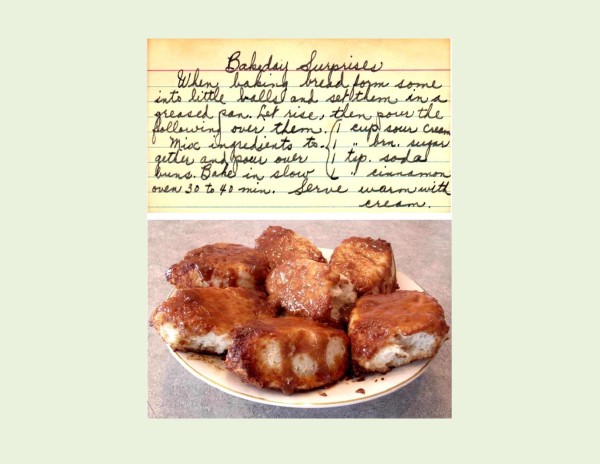
In today’s post, I would like to share a recipe my mother called ‘Bake Day Surprises’. I remember this dessert being so incredibly good. Since she baked bread once a week, an extra treat stemming from that bread dough was something we could always count on. Since there are just the two of us, it’s nice to be able to try and replicate this special dessert without having to make a large pan of them (that we really don’t need, right!)
Print Recipe
Small Batch Caramel Sour Cream Buns
Votes: 1
Rating: 5
You:
Rate this recipe!
|
|
Votes: 1
Rating: 5
You:
Rate this recipe!
|
Instructions
Caramel Sour Cream Sauce
In a small bowl combine all sauce ingredients; pour into a small round baking dish. Set aside.
Bun Dough
In a bowl, combine water , yeast & sugar. Allow to proof for 5 minutes. Add oil, flour, salt & egg. With a fork or a wooden spoon, mix into a shaggy dough.
Turn dough out onto a floured surface & knead for 5 minutes.
Divide the dough into 4 equal pieces & shape into balls. Place balls on top of sour cream sauce mixture in small round baking dish, cover with a towel & let rise for 40 minutes.
-
Bake for about 20-25 minutes. Remove from oven & immediately invert pan over a serving platter. Be VERY CAREFUL that the HOT sauce does not burn your hands when inverting the pan.

We’re entering the in between… that time when some days are super nice and the sun is shining and if you don’t look at the date on the calendar, you’d swear it’s the middle of July, and some days you need a jacket and it’s gloomy and you can feel the season changing in the air?
The time when the flowers are still blooming and the leaves are starting to change. Fall food is popping up in the stores and it’s more than just pumpkin spice everything.
So why not make a ‘root vegetable cake’? I know, you’re thinking you don’t really want anything called root vegetable cake. But keep an open mind because it’s just a cake with carrots, parsnips and some beets. They’re all shredded and combined with warm spices to make a hearty cake, dotted with dried apricots and pepita seeds. The spice and earthiness of the cake are complemented by the rich sweetness and subtle tang of the ginger cream cheese frosting. Altogether, it’s pretty much the perfect bite – while the root veggies keep this cake soft and add a subtly sweet, earthy flavor; the apricots and pepita seeds add texture. Then it’s topped off with the luxurious creaminess of the ginger frosting. What’s not to love!
Print Recipe
Root Vegetable Apricot Cake
Votes: 1
Rating: 5
You:
Rate this recipe!
Ingredients
Ginger Cream Cheese Frosting
Ingredients
Ginger Cream Cheese Frosting
|
Votes: 1
Rating: 5
You:
Rate this recipe!
|
Instructions
Cake
Preheat oven to 350 F. Grease the base & sides of a 8-inch round cake pan with a little oil. Line the base with parchment paper.
Peel & grate the carrots, beets & parsnips into a large bowl. Zest an orange & add to the vegetables.
Pour in the syrup, eggs & olive oil, then mix to combine. Next, fold in the flour, spices, baking powder, baking soda & salt.
Finely dice the apricots, then add them to the bowl along with the seeds, then mix everything until just combined but DO NOT OVERMIX.
Pour the mixture into the prepared cake pan & bake for 30 to 35 minutes, rotating the tin after 20 minutes, until the top is a light pink-golden tone. The cake should bounce back when pressed lightly, & a skewer inserted into the center will come out clean when fully cooked. Remove from the oven & leave to cool in the pan.
Ginger Frosting
Place room temperature cream cheese, ginger & butter into a mixing bowl. Using an electric mixer. beat until creamy & smooth. Slowly add the powdered sugar until all is incorporated.
Assembly
When the cake is completely cool, transfer to a plate, then finish with the icing, smoothing it over the sides & top of the cake. Decorate as you wish slice & serve.
Recipe Notes
If you are like me, maple syrup is not something I usually have on hand. Here's a good substitute ... 1/2 cup brown sugar, 1/4 cup water & 1/4 tsp maple extract. Place the sugar & water in a small saucepan. Simmer on low heat, stirring frequently, until sugar is dissolved & mixture thickens slightly, 3-5 minutes. Stir in maple extract (adjust to taste). Allow to cool before using (mixture thickens as it cools).

I’ve probably posted at least twenty different kinds of scones on the blog over the years, but I had yet to make scones using chai ‘liqueur’.
There are many recipes using chai spices such as cinnamon, ginger, cardamom, cloves, nutmeg and anise. I wanted to incorporate the actual liqueur in these scones as well to pop up the flavor a bit more.
And while most fruits pair well with chai, some may have a delicate flavor that won’t taste great with the various spices in chai. When selecting these fruits, always go for dried options such as raisins, prunes, dates, apricots, figs, and peaches.
These scones make an excellent choice for breakfast or as an afternoon snack this time of year.
Print Recipe
Apricot Chai Liqueur Scones
Votes: 1
Rating: 5
You:
Rate this recipe!
|
|
Votes: 1
Rating: 5
You:
Rate this recipe!
|
Instructions
Scones
Preheat oven to 375 F. Line a large baking sheet with parchment paper.
In a food processor, combine flour, oats, brown sugar, baking powder, baking soda, salt, and spices. Cut in butter until mixture resembles coarse crumbs. Place in a large bowl.
In a small bowl combine egg, chai liqueur & sour cream. Add wet mixture to flour mixture along with the apricots. Stir ONLY until combined. Do NOT overmix.
Divide dough in half. Using a spatula scrape each piece of dough onto the parchment paper on the baking sheet. Dip the spatula in flour, then flatten each piece of dough to about 1-inch in height as well as forming it in a circle shape. Cut each round into 8 wedges.
Bake scones for 12 to 15 minutes or until golden brown. Remove from baking sheet. Recut the scones. Cool slightly on wire rack.
Icing
Using a mixer, combine cream cheese, butter, powdered sugar, chai liqueur & milk. Beat on low speed, gradually increasing to high until light & fluffy. Pipe over scones.
Recipe Notes
The amount of sugar used in these scones is what you prefer personally. I only used the 1/3 cup which makes them nice to serve with coffee.