Roast Pork Tenderloin w/Blackberry Rhubarb Chutney

Unusual fruit chutneys are growing in popularity with our developing taste for condiments that contain less sweet and more spice. Chutney, pronounced ‘chuht-nee’, refers to a family of condiments from South Asian cuisine. While Chutneys are most often associated with India, they’re also popular in Africa and the Caribbean islands.

They can be fresh or cooked and are made from a wide variety of ingredients usually from some concoction of fruits and/ or vegetables and spices. They range in flavor from sweet or sour, spicy or mild, or any combination of these, while their texture can be thin or chunky. Some compare chutneys to a relish and others to a jam. Chutney is most often used to balance a dish and may be on the sweet and tart side or provide a spicy and hot flavor. To add to the confusion, many times chutney is also mistakenly called a relish (and vice versa) but there are subtle differences between the two. Relishes tend to be a bit sweeter, while Chutneys are more on the savory side. Chutneys are cooked slowly, are more likely to be chunkier and have a consistency that is much like preserves while relishes are barely cooked, rarely use any sugar and are crunchier.

This simple to prepare chutney makes for a tasty, tart counterpart to the richness of pork.

Print Recipe
Roast Pork Tenderloin w/ Blackberry RhubarbChutney
Votes: 1
Rating: 5
You:
Rate this recipe!
Servings
Votes: 1
Rating: 5
You:
Rate this recipe!
Instructions
Risotto
  1. In a heavy saucepan, heat butter & oil over medium heat then add 1 clove garlic & the mushrooms. Season with salt & pepper & sauté until mushrooms are golden brown & tender, about 6 minutes; remove from pan. Toss mixture together with parsley; set aside.
  2. Heat broth in a microwave-safe bowl until hot. Cover & set aside. Heat remaining oil over medium-high heat in a heavy saucepan. Add onion & remaining garlic; cook, stirring until aromatic & softened, about 3 minutes. Add barley & cook, stirring to coat in oil. Stir in wine & cook until almost completely evaporated, about 3 minutes. Stir in 1/2 cup hot broth; continue stirring until stock has been absorbed, about 4 minutes. Reduce heat to medium & continue adding hot broth until broth has been absorbed & barley is tender, about 30 minutes.
  3. Stir in cream & cheese, stirring until creamy. Remove from heat; stir in reserved mushroom mixture; set aside until ready to stuff tenderloin.
  4. Risotto can be prepared ahead, once cooked, cover & refrigerate for up to 3 days.
Tenderloin
  1. Preheat oven to 450 F.
  2. Cut tenderloin down the center, lengthwise, stopping when you are about 1/2-inch from the bottom of roast. Open the tenderloin like a book. Season inside surface lightly with salt & pepper.
  3. Spoon risotto down the center of the tenderloin. Bring the 2 sides of the tenderloin up & around the filling to almost meet. Use wooden skewers to join the meat together, spacing the skewers apart at 2-inch intervals. Use butcher twine to 'lace up' the roast by weaving between the skewers (like lacing a shoe).
  4. Place the tenderloin on a rack in a shallow pan. Stick thermometer into the exposed pork around the risotto. Rub pork with 1 Tbsp oil & lightly season with salt & pepper. Oven sear roast for 10 minutes.
  5. Reduce heat to 300 F. Stuffed pork tenderloin should reach an internal temperature of 145°F. To prevent it from drying out, remove the pork from the oven when it reads 135°F to 140°F, cover loosely with foil let it rest for 5 minutes, as the carryover heat will bring it to the final safe temperature.
Chutney
  1. Combine all chutney ingredients in a medium saucepan. Bring to a boil over high heat, then reduce heat to low & simmer, uncovered, for 45 minutes to an hour, stirring frequently, until thick. Set aside until ready to serve with stuffed tenderloin.

Pork Roasted Tuscan Style

Tuscan food is based on the Italian idea of cucina povera or ‘poor cooking.’ A concept that started very literally. It’s about meals traditionally hearty and made with simple ingredients that are inexpensive and could easily be made in large amounts – with bread, beans and roasted meats serving as the base of most traditional Tuscan meals. Today it remains largely the same – but by choice instead of economy.

Tuscan cooking doesn’t use complicated seasonings or elaborate creations because they’re not needed. Instead, it’s made using fresh, high-quality ingredients that bring out the natural flavors in each dish, simple or not.

In Italy there is only regional Italian food. Each region offers delicious and unique dishes based on its long history and location. Tuscany’s world-renowned food is no exception! Famous for its local produce and meat and its simplicity and seasonal foods.

Today’s recipe features an easy technique for pork roasted inside a baguette with wonderful fresh herbs and of course garlic and olive oil.

Print Recipe
Pork Roasted Tuscan Style
Votes: 1
Rating: 5
You:
Rate this recipe!
Servings
Servings
Votes: 1
Rating: 5
You:
Rate this recipe!
Instructions
  1. On a work surface, mince the sage, rosemary. In a small dish combine with thyme leaves, crushed fennel, pepper, garlic, salt. Add Dijon mustard to mixture .
  2. Heat a skillet over medium high heat. Add 1 tablespoon of the oil. Cook the pork, turning occasionally, until golden on all sides, 8 to 10 minutes. Slather the entire pork with the Dijon mustard mixture.
  3. Cut the baguette in half the long way & minimally scoop out the soft insides. Brush the inside of the baguette with the remaining 3 tablespoons olive oil. Place the pork on the inside of the baguette so that the pork is completely enclosed. Tie the baguette, at 1-to 2-inch intervals, with kitchen string.
  4. Preheat an oven to 375 F. Place the pork on a baking sheet roast until done, 148 F. on an instant-read thermometer inserted into the thickest part, 25 to 30 minutes.
  5. Remove from the oven, let rest 10 minutes. Remove the strings & cut into slices. Serve.
Recipe Notes

Try to get a baguette (or French loaf) that is fairly round and not too flat in the middle because the bread has to ‘hug’ the pork as much as possible. Also try to scoop out as little bread as possible since that was the best part.
I made a thin pork gravy to serve with this meal. It made it real tasty!

Fig & Boursin Pork Wellington

HAPPY THANKSGIVING!

Here in Canada, we are in the autumn season of our year. Autumn is not to be taken lightly with its stunning foliage. It’s really quite a magical season that’s often overlooked. Ancient cultures, science and astrology have associated many aspects of this beautiful season to human life. These symbolic associations are powerful reminders that Mother Nature has an incredible influence on our lives. Soon most of the fall colors will disappear and slowly but surely, frosty white will take its place. I think it’s so important to take time to recognize these beautiful moments in our imperfect world.

For our holiday meal I am preparing a stuffed pork tenderloin. Pork tenderloin is incredibly tender since it is essentially the ‘filet’. Because there is very little fat in a tenderloin, it’s perfect to stuff with all sorts of tasty things to bring in both moisture and flavor. A little prosciutto, shallot, dried figs and fig balsamic Boursin cheese make a really delicious combination that pairs perfectly with pork tenderloin adding a unique twist to the classic recipe.

Print Recipe
Fig & Boursin Pork Wellington
Instructions
  1. In a bowl, combine green onion, figs & Boursin cheese.
  2. Cut away and discard the silver skin from the pork tenderloin. Butterfly the pork by cutting a slit down the tenderloin lengthwise, but don't quite slice it all the way through. The 2 sides should remain attached.
  3. Open the pork tenderloin flat like a book and cover it with a large sheet of plastic wrap. Lightly pound it to an even thickness. Spoon the cheese/fig mixture evenly on the cut side of the pork.
  4. Starting with a long edge, roll it up jelly-roll style. Lay out the prosciutto slices on a piece of parchment paper so that they overlap slightly on the edges. Then place the stuffed tenderloin at one end and roll the whole thing up in prosciutto.
  5. Once rolled in prosciutto, heat a large skillet to medium-high heat. Carefully add the tenderloin to the skillet & sear it all over, about 1 or 2 minutes per side, carefully turning the tenderloin. Remove from heat & set aside to cool.
  6. Preheat oven to 400 F.
  7. Place puff pastry sheet onto a large piece of parchment paper on a baking sheet. Cut out a few designs down the center then place the tenderloin at one edge of the pastry & roll it up. Start by rolling it lengthwise & then folding over any excess pastry at either end after you are done rolling. Press down gently on seams to create a good seal.
  8. Beat together egg & water to make an egg wash. Using a pastry brush, liberally cover the puff pastry.
  9. Place the wellington into the oven on the lower third rack & bake for about 40 minutes.
  10. After 35 minutes check the internal temperature using a meat thermometer. The pastry should look a nice golden brown & the thermometer should read between 150 & 160 F.
  11. Allow the wellington to sit for at least 10 minutes before slicing using a long, sharp, serrated knife. Plate & serve immediately. We really enjoyed this meat with a cranberry/raspberry sauce.
Recipe Notes
  • Simple Cranberry-Raspberry Sauce:
  • 348 ml whole cranberry sauce
  • 1 1/2 cups raspberries, fresh or frozen unsweetened
  • 1/4 cup sugar
  • 1 Tbsp orange zest
  • In a saucepan, combine whole berry sauce with raspberries, sugar & orange zest
  • Cook over medium heat, stirring often, until the sauce thicken slightly & is bubbly
  • Remove from heat & allow to cool.

Pork Tenderloin w/ Italian Sausage & Herb Stuffing

PORK, stuffed with PORK and wrapped in PORK bacon = a total delight for meat lovers!

Pork tenderloin is a wonderful cut of pork that when cooked well, produces a tender meal full of flavor.  Wrapping the pork in bacon simply enhances the flavor as, let’s face it – bacon makes everything taste great!!

Bacon wrapped sausage stuffed pork tenderloin is made with a lean pork tenderloin stuffed with spicy Italian pork sausages and herbs, wrapped in pieces of crispy bacon and a spicy pepper crust.

Although there were certain small differences in original Italian sausages, most consist of ground pork seasoned with some combination of fennel, anise, red bell peppers, paprika, garlic, and red pepper flakes. The red pepper flakes are what give the spicy varieties of Italian sausage their signature kick, while fennel is the hallmark flavor that makes Italian sausage distinct from other kinds of sausage.

This sausage typically comes as one of the following three kinds: hot, mild and sweet. The main difference between hot and mild is the addition of cayenne pepper or hot red pepper flakes. The difference between sweet and mild is the addition of sweet basil to the recipe.

All things considered, this combo should make a super good meal!

Print Recipe
Pork Tenderloin w/ Italian Sausage & Herb Stuffing
Votes: 1
Rating: 5
You:
Rate this recipe!
Servings
Votes: 1
Rating: 5
You:
Rate this recipe!
Instructions
  1. Butterfly pork tenderloin & pound flat with a meat mallet.
  2. In a saucepan, heat oil & add onion & garlic. Sauté until aromatic. Add Italian seasoning, sage & sausage meat. Cook until browned then add panko crumbs & vegetable broth. Season with salt & pepper to taste. Remove from heat & allow to cool.
  3. Place the sausage mixture on top of the pork tenderloin, leaving about 1-inch around the sides. Tightly wrap the tenderloin into a roll.
  4. Starting at one side, wrap the bacon around the stuffed tenderloin. Overlap, using the bacon to secure the tenderloin from coming apart.
  5. Preheat oven to 350 F.
  6. In a skillet over medium heat, sear the pork tenderloin roll in a pan on the stove top on all sides.
  7. Transfer bacon wrapped tenderloin into the oven & roast for about 25-30 minutes or until internal thermometer reads 145-150 F.
  8. Allow meat to rest under foil for about 10 minutes before carving.

Pork Tenderloin Stuffed w/ Boursin, Pears & Prosciutto

Today, March 21st, our family honors the memory of my father on his birth date. He passed away at the age of 92, 20 years ago. Although my father lost his sight to macular degeneration, he carried on in his life with much courage and dignity.

As a teenager, I never realized what a special privilege growing up as a farmer’s daughter really was. Coming home on the school bus and having to do ‘chores’ seemed so boring as opposed to being able to spend after school hours with your friends. As I look back on those times now, it all comes clear as to how treasured and valuable those life lessons were.

To be a successful farmer takes a tremendous amount of strength and courage. I think back to those days with great admiration and appreciation of the special man he was.

If you are old enough, you might remember an American radio broadcaster by the name of Paul Harvey. Mr. Harvey’s twice-daily soapbox-on-the-air was one of the most popular programs on radio between 1950-1990. Audiences of as many as 22 million people tuned in on 1,300 stations to a voice that had been an American institution for as long as most of them could remember. He personalized the radio news with his right-wing opinions but laced them with his own trademarks: a hypnotic timbre, extended pauses for effect, heart-warming tales of average Americans and folksy observations that evoked the heartland, family values and the old-fashioned plain talk one heard around the dinner table on Sunday.

He would always begin with a velvety voice that turned the news into narrative and entertainment each week on his famous segment ‘The Rest of the Story‘.

‘So, God Made a Farmer’ was a speech given by Paul Harvey at the 1978 Future Farmers of America convention. When I read it I thought it was a nice tribute to our Dad on his birthdate.

So, God Made a Farmer

On the eighth day, God looked down on his planned paradise and said, “I need a caretaker.”

I need somebody willing to get up before dawn, milk cows, work all day in the fields, milk cows again, eat supper and then go to town and stay past midnight at a meeting of the Farm Bureau.

 I need somebody with strong arms to wrestle a calf, yet gentle enough to deliver his own grandchild. Somebody to call hogs, tame cantankerous machinery, come home hungry and have to wait until his wife is done feeding visiting ladies, then tell the ladies come back soon.

I need somebody willing to sit up all night with a newborn colt and watch it die and then dry his eyes and say maybe next year. I need somebody who can shape an ax handle from a persimmon sprout and shoe a horse with a hunk of car tire. Who can make harness out of hay wire, feed sacks and shoe scraps. Who’s planting time and harvest season will finish his 40-hour week by Tuesday noon. Then, with the pain from tractor back, he will put in another 72.

So, God made a farmer.

God had to have somebody willing to ride the ruts at double-speed to get the hay in ahead of the rain clouds and yet stop in mid-field and race to help when he sees the first smoke from a neighbor’s place.

I need somebody strong enough to clear trees and heave bales, and yet gentle enough to wean lambs and pigs and tend the pink combed pullets. And who will stop his mower for an hour to splint the broken leg of a meadowlark.

It had to be somebody who would plow deep and straight and not cut corners. Somebody to seed, weed, feed, breed, and rake and disc and plow and plant and tie the fleece and strain the milk and replenish the self-feeder and finish a hard week’s work with a five-mile drive to church. Somebody who would bale a family together with the soft strong bonds of sharing. Who would laugh, then sigh and reply with smiling eyes… when his son says he wants to spend his life doing what Dad does!

So, God made a farmer.

For any of us growing up as farmers’ daughters or sons, I think we can relate to this article well.

Print Recipe
Pork Tenderloin Stuffed w/ Boursin, Pears & Prosciutto
Votes: 1
Rating: 5
You:
Rate this recipe!
Servings
Votes: 1
Rating: 5
You:
Rate this recipe!
Instructions
  1. Preheat oven to 350 F.
  2. Core & cut apples & pears into thin slices.
  3. Cut the pork tenderloin by making an incision over its entire length of about 1 1/2 -inches, leaving about 1 cm at each end to form a pocket.
  4. Spread the Boursin in the cut & add the apples & pears. Close the pork tenderloin by wrapping it in prosciutto.
  5. Bake 20 minutes. Cut into medallions about 1 1/2-inches wide.

Gorgonzola Stuffed Pork Tenderloin w/ Pomegranate Blueberry Sauce

Today, November 28th, our neighbors to the south in the USA, are celebrating their Thanksgiving Day. It encompasses both religious and secular aspects … being both a harvest festival and a festival of family.

Here in Canada, we have already enjoyed our Thanksgiving in October, but I thought it would be nice to acknowledge their holiday with posting a special meal.

Stuffed pork tenderloin is an amazing way to amp up a simple cut of meat. Pork tenderloin is incredibly tender since it is essentially the ‘filet’. Because there is very little fat in a tenderloin, its perfect to stuff with all sorts of tasty things to bring in both moisture and flavor.

Today I am going with a very simple stuffing of gorgonzola cheese and herbs and serving it with a pomegranate/blueberry balsamic sauce.

Pomegranate & blueberry sauce is the epitome of fruit flavors mixed with pork. Sweet, tangy, and savory! Balsamic sauce, the versatile, sweet reduction made by adding sugar to balsamic vinegar and cooking it down to thicken, arrived during a time of chicken Kievs, vol au vents and trifle, when chicken satay was still mysteriously exotic. 

Pomegranates have a bright, sweet-tart flavor that can be incorporated into all kinds of meals. The only thing is that they are a seasonal fruit, so you need to take advantage of them while they are available from October to January. There are many interesting facts about pomegranates, but here are just a few.

  • Pomegranates don’t contain any saturated fats or cholesterol.
  • In China, a picture of a ripe, open pomegranate is a popular wedding present because it represents a positive, blessed future and fertility for numerous offspring.
  • Ancient civilizations used pomegranate juice as a condiment or a meat marinade, much like we use lemon juice today.
  • Before granulated sugar, people used ‘syrup’ from pomegranates and other fruits as sweeteners for dessert dishes.
  • The word pomegranate means ‘apple with many seeds.’
  • Pomegranates botanically belong to the berry family.

If you get a chance to try this recipe I hope you enjoy it as much as Brion & I did.

Print Recipe
Gorgonzola Stuffed Pork Tenderloin w/ Pomegranate Blueberry Sauce
Votes: 1
Rating: 5
You:
Rate this recipe!
Servings
Ingredients
Tenderloin
Servings
Ingredients
Tenderloin
Votes: 1
Rating: 5
You:
Rate this recipe!
Instructions
Tenderloin
  1. Preheat oven to 375 F.
  2. Remove silverskin & any excess fat from tenderloin then butterfly it open. Cover with plastic wrap & pound with a meat mallet until about 3/4-inch thick.
  3. Add herbs to a small dish & mix in a Tbsp of water to reconstitute. Set aside. Add gorgonzola to a small saucepan & heat over medium low heat. Break apart into small chunks. Add herbs & mix well. Heat until melted & bubbly. Remove from heat.
  4. Spread the cheese & herb mixture down the middle of the tenderloin, leaving a gap around the edges.
  5. Roll up the tenderloin from the short side & secure with kitchen twine if necessary. Place pork in a baking pan, drizzle with oil & season with salt & pepper.
  6. Roast for 45 minutes or until cooked through & at least 145 F. internally.
Sauce
  1. In a saucepan, combine pomegranate juice, balsamic vinegar, brown sugar, onion, pomegranate seeds & blueberries. Cook over medium heat about 15-20 minutes the stir in cornstarch/water combo to thicken sauce slightly. If the sauce is too thick or you would like it a bit more tart, just add some more balsamic vinegar.
Serve
  1. Remove pork from oven & lay on a cutting board. Allow it to rest for 10 minutes. Slice into medallions, drizzle with the berry sauce & serve with seasonal vegetables & mashed potatoes.

Pork Medallions w/ Blackberry Bacon Sauce

It seems there has been a bacon explosion in North America, in more ways than one. Novelty bacon dishes and other bacon-related items have been popularized rapidly via the internet. Fast-food chains boast about double bacon burgers, and upscale restaurants are wrapping steaks in bacon — even adding it to chic desserts. It’s the old sweet and savory marriage of flavors that seems to work so well.

Bacon mania has made bacon the star ingredient. The movement has been traced to the late 1990s when high-protein foods became a more prominent diet focus due in part to the Atkins diet.

The huge popularity of bacon has also encouraged product introductions such as bacon salt, maple bacon donuts, baconnaise, bacon-infused vodka, bacon ice cream, bacon jerky and chocolate covered bacon just to name a few. Condiments are the unsung heroes of the culinary world. A finishing sauce can be an important part of every meal. Whether you’re serving pork tenderloin, pork chops, pork loin, or pork roast, a flavor-filled sauce will guarantee to take the meal from good to great. We found this blackberry bacon sauce to do exactly that.

Print Recipe
Pork Medallions w/ Blackberry Bacon Sauce
Votes: 1
Rating: 5
You:
Rate this recipe!
Servings
Ingredients
Servings
Ingredients
Votes: 1
Rating: 5
You:
Rate this recipe!
Instructions
Sauce
  1. In a saucepan, cook bacon until almost crisp, remove to a paper towel.
  2. To the bacon drippings, add sliced mushrooms & garlic, sauté until cooked. Remove to a plate, set aside.
  3. To the saucepan, add remaining sauce ingredients & bring to a boil. Once boiling, reduce heat to simmer & allow to simmer for about 30 minutes.
  4. Remove from heat & allow to cool slightly then place in a food processor & pulse a few times.
  5. Pour sauce through a wire sieve & press to get everything but the seeds for your sauce.
  6. Add bacon & mushroom/garlic mixture. Combine well & set aside.
Tenderloin
  1. Preheat the oven to 425 F.
  2. Slice the tenderloin into even, 1 1/2 inch thick, medallions, sprinkle with garlic & onion powder & the salt & pepper.
  3. Then, heat the olive oil and butter in a large heavy skillet, cast iron if you have one. Braise the pork tenderloin medallions, you may have to work in 2 batches. Cook for 2 - 3 minutes on each side, remove from the skillet and cook the remaining pork. Using 2 wooden skewers, thread meat first with one & then with the other. It should resemble the unsliced tenderloin but do leave a tiny bit of space between each piece.
  4. Place on a baking sheet & roast for 30-35 minutes.
  5. To serve, plate the tenderloins and spoon (reheated) sauce over them. Garnish with a few whole blackberries & serve any remaining sauce on the side.

Roasted Pork Tenderloin w/ Cranberry Lemon Couscous

Couscous can be used as a side dish, as part of a salad, added to a soup, or as a component of an entrée when combined with other hearty ingredients. Because of its ‘blank slate’ flavor profile, it is the ideal base for a wide range of seasonings, from sweet to spicy, as well as ingredients, pairing well with anything from cranberries to lemon.

Israeli or pearl couscous, is larger than traditional couscous and shaped like little pearls of pasta. As the name suggests, its origins are from Israel. When the country’s first prime minister requested a wheat-based substitute to rice, this Israeli couscous was created. It’s a very versatile ingredient that can be either boiled like pasta or toasted in a skillet pan, and it works well in both savory and sweet applications. Israeli couscous is different from the North African version, which has a more fine-grained, fluffy texture.

Over the years, Brion & I have really grown to like Israel couscous. I have tried it in numerous ways both sweet & savory. Today I’m pairing it with some roasted tenderloin which should be real good.

Print Recipe
Roasted Pork Tenderloin w/ Cranberry Lemon Couscous
Votes: 1
Rating: 5
You:
Rate this recipe!
Servings
Votes: 1
Rating: 5
You:
Rate this recipe!
Instructions
  1. Preheat oven to 375 F.
  2. Brush tenderloin with olive oil & seasoning. Place tenderloin in a 9 x 13 pan lined with foil. Roast for about 35 - 40 minutes or until just a FAINT pink color in center remains.
  3. Bring water to a boil in a small saucepan. Add couscous & simmer on low for 8 minutes. (Your couscous should be firm, not mushy). Remove pan from heat & add remaining ingredients, mixing well.
  4. Place couscous in a serving dish, cover to keep warm. Allow tenderloin to rest 10 minutes then slice & place on serving dish.

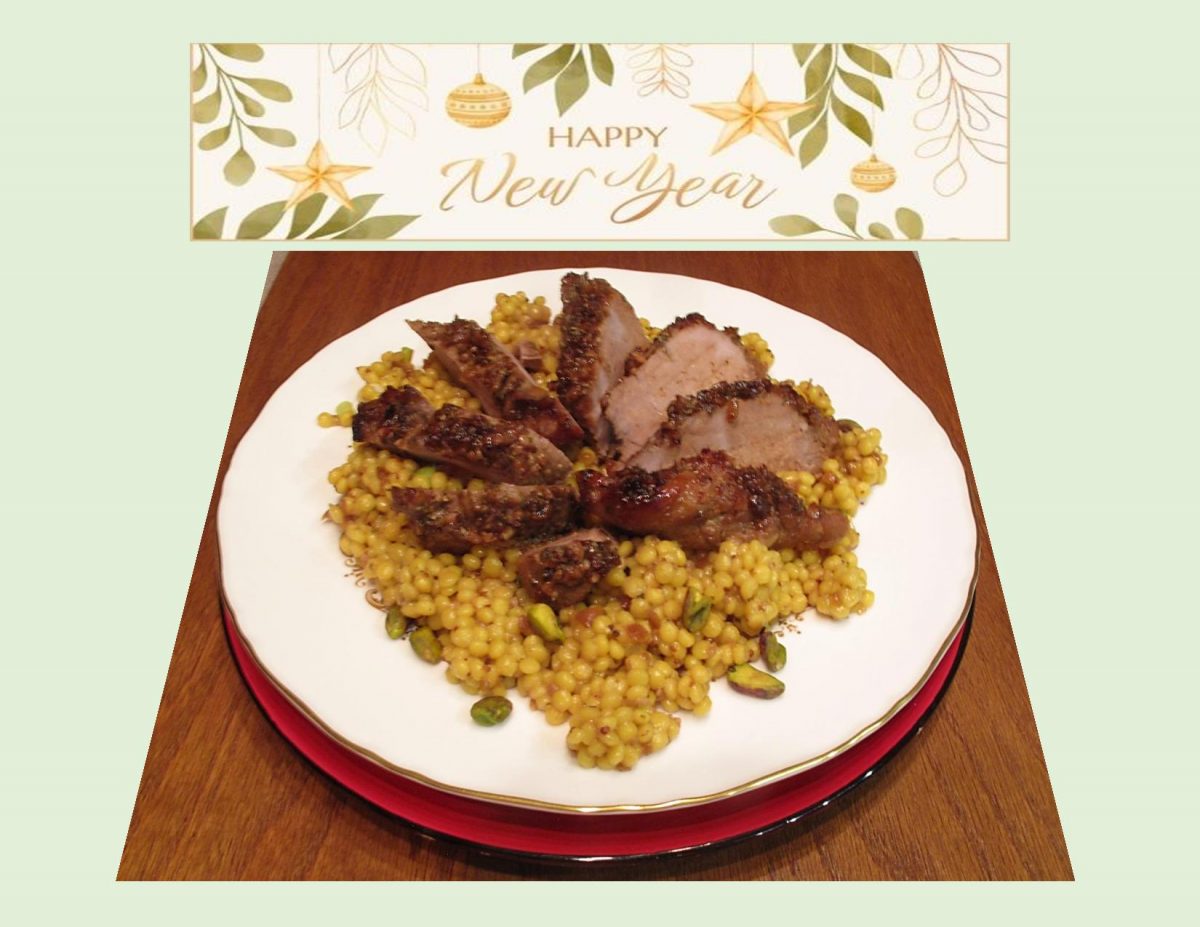
Sage-Dijon Pork Tenderloin w/ Pistachio Couscous

HAPPY NEW YEAR!

Many cultures around the world believe the key to a happy, healthy, prosperous & productive year begins with eating certain lucky foods on New Year’s Eve and New Year’s Day. The theory is ‘do good, eat good’ on the 1st day of the year, to begin the New Year right.

It hard to believe we have arrived at the end of another ‘complicated’ year and its time to reflect and assess the year it was. The word ‘new’ brings thoughts of hope and makes us realize how precious time is.

The tradition of eating pork on New Year’s dates back to …. well, no one really knows when. If your a meat eater, chose pork over chicken or beef on New Year’s Day because pigs dig with their snout, representing forward movement or progress, while chickens or turkeys scratch backward, the cows stand still. That’s it, that’s the folklore behind the tradition!

Many European countries such as Germany, Austria, Switzerland & Ireland, eat pork not only because of the belief of moving forward but because fatty meat is also symbolic of ‘fattening’ their wallets. Germans feel that pigs are so lucky that they give marzipan pigs known as ‘Glucksschwien’ or lucky pigs, as gifts to bring good luck in the coming year. They can also be given in other forms, such as little wooden or glass figurines.

With the pandemic situation that seems to be never ending, I think anything that will help in the good luck department is a good thing.

Print Recipe
Sage, Dijon Pork Tenderloin w/ Pistachio Couscous
Votes: 2
Rating: 4.5
You:
Rate this recipe!
Servings
SERVINGS
Ingredients
Pistachio Couscous
Servings
SERVINGS
Ingredients
Pistachio Couscous
Votes: 2
Rating: 4.5
You:
Rate this recipe!
Instructions
  1. Cook the couscous according to package directions. Add parsley, olive oil, salt and pepper, and pistachios. Stir to incorporate. Taste and adjust for seasonings. Cover and set aside.
  2. Preheat oven to 350º. Spray an 9” x 13” baking dish with cooking spray.
  3. Using a knife poke several holes in the tenderloin about a half-inch deep so marinade can penetrate.
  4. In a small bowl whisk together the shallots, garlic, soy sauce, mustard, honey, juice, sage, salt and pepper, and olive oil.
  5. Pour the marinade over the tenderloin.
  6. Bake uncovered for 45 minutes basting every 10-15 minutes.
  7. Transfer the tenderloin to a large cutting board and allow them to rest for 10 minutes before slicing.
  8. Slice the tenderloin and transfer to a serving dish placing atop warmed couscous. Drizzle the marinade from the pan over the sliced pork medallions & couscous.

Pepper-Peach Glazed Pork Tenderloin

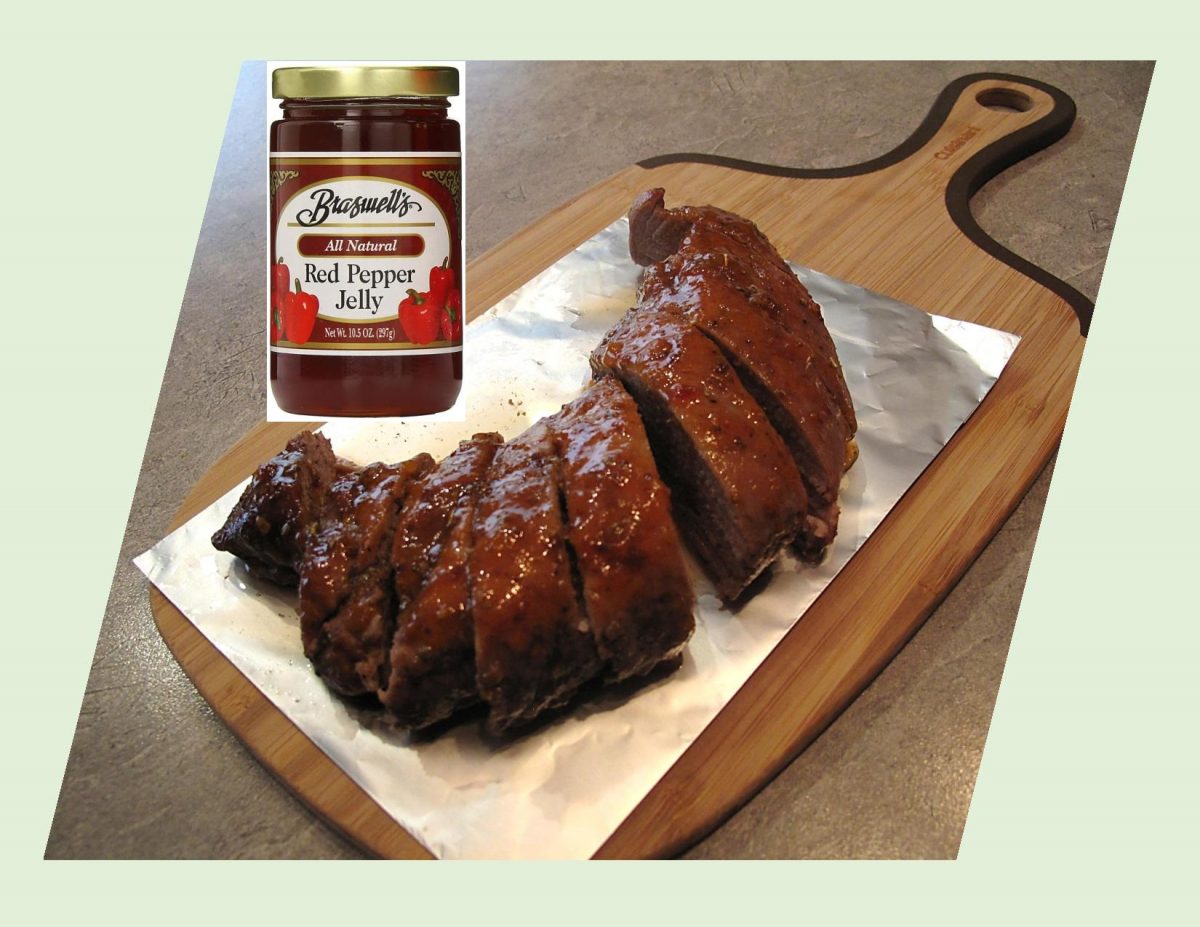
There’s something very complex about the taste of sweet and spicy. Have you ever used hot pepper jelly? If not, its a preserve in a jelly form …. somewhere between jam and jelly. The main ingredients are peppers, sugar and vinegar which are combined with pectin to form a preserve.

Hot pepper jelly is such a versatile product, that there is no limit of different ways you can use it, depending on your taste preference.

I was thinking that if this recipe appeals to you and you purchase some of this jelly, here are a few other ways you could make use of it.

  • Ham & Turkey Sandwich – use jelly instead of mustard
  • Cocktail Meatball Glaze
  • Serve on Cornbread – with or without butter!
  • Dip for Egg rolls
  • On a Bagel with Cream Cheese
  • Sauce for Hot Wings or Chicken Tenders
  • Topping for Baked Brie Cheese
  • Glaze for Baked Ham

One thing about pork tenderloin is it will never disappoint when it comes to tenderness and flavor.

Print Recipe
Savory Pork Wellington w/ Pepper-Peach Glaze
Votes: 1
Rating: 5
You:
Rate this recipe!
Servings
Votes: 1
Rating: 5
You:
Rate this recipe!
Instructions
Tenderloin
  1. Remove silver skin from tenderloin by sliding the knife tip under one end of the silver skin. Keep the blade flat (parallel to the meat) & slide the knife between the meat & the silver skin, pulling up on the sliver skin as you go. Discard silver skin. Remove any excess fat if any.
Glaze
  1. In a small saucepan, heat jelly, preserves, vinegar, mustard, brown sugar & sage to simmering over medium heat; stirring occasionally. Remove saucepan from heat.
  2. Preheat oven to 425 F.
  3. After trimming the meat, brush it all over with a generous amount of olive oil. Place the tenderloin in a skillet that has been heated to a hot temperature previously. Sear tenderloin about 1 1/2 minutes on each quarter turn.
  4. Place meat on a piece of foil paper in a roasting pan. Lightly coat the meat with some of the glaze using a brush so it will spread evenly. Roast tenderloin for about 25-35 minutes depending on the size of your tenderloin.
  5. Insert a probe thermometer into the thickest part of your meat & check the temperature. The pork will continue to cook for about 10 more degrees outside of the oven & then will stop cooking after that. Once out of the oven, Generously brush meat with remaining glaze. Allow to rest between 5 & 10 minutes before slicing.
Recipe Notes
  • I had actually doubled the glaze recipe so we would have some extra since we both enjoy pepper jelly. Strangely enough, it tasted real good not only on the meat but the mashed potatoes we had with it.