Balsamic Pork Chops w/ Peaches & Gorgonzola

CELEBRATING FATHER’S DAY!

Father’s Day is celebrated on many different dates around the world. It gives us the opportunity to thank or reflect on that special person we call ‘Dad’.

The imprint of a father remains forever on the lives of his children. For daughters, he is the standard against which she will judge all men. To a son, he is his first hero.

Fathers are some of the most unsung, unpraised and unnoticed valuable assets of our society. Growing up, I recall that wonderful feeling of being very protected by our father.

Both of our fathers are no longer with us, but we will always hold dear fond memories of them. It seems a father’s love and influence are never fully appreciated until they are no longer with you.

I think both are dads would have enjoyed this meal I’m preparing today.  Since the trendiness of balsamic vinegar in North America has only gained momentum over the past few decades, its probably not a version they would have been familiar with but liked it just the same.

Peaches and balsamic vinegar are the perfect accompaniment to pork chops. Pork chops pair so well with fruit and the natural sweetness of honey balances perfectly with the moderate, natural acidity of the balsamic vinegar.

The history of balsamic vinegar is a fascinating journey that spans centuries. Balsamic vinegar’s rise in prestige began with its medicinal use in the Middle Ages, gained royal favor and eventually became globally recognized as a highly prized product originating from the beautiful Italian regions of Modena and Reggio Emilia.

These balsamic pork chops are served with peaches, gorgonzola and a hint of thyme making them sweet and savory at the same time.

Print Recipe
Balsamic Pork Chops w/ Peaches & Gorgonzola
Votes: 1
Rating: 5
You:
Rate this recipe!
Servings
Votes: 1
Rating: 5
You:
Rate this recipe!
Instructions
  1. In a large oven-proof skillet over medium high heat, add the olive oil & let it warm up.
  2. In a medium bowl, whisk together the balsamic vinegar, honey, thyme. Add the peaches, toss to coat, & set aside.
  3. Pat the pork chops dry, and cover them in the salt & pepper.
  4. Add the pork chops to the hot oil in the pan & cook for 6 minutes on one side without moving the chops around, then flip them.
  5. Add the peach vinegar mixture to the hot pan over the pork chops. Cook for 3 minutes.
  6. Remove the pork chops from the pan & set them aside on a clean plate, leaving the peach vinegar mixture in the pan.
  7. Turn the heat up to high. Cook for 8 -10 minutes, until the peaches are soft & the sauce has reduced.
  8. Place the pork chops back into the hot pan. Spoon the peaches & sauce on top of the chops. Scatter the gorgonzola on top of the peaches & pork chops. Broil on high for 3 - 5 minutes, or until the gorgonzola has melted.

Ratatouille Panini at Pebble Beach

If you have had the opportunity to travel to California’s central coast you’ve probably heard of the 17-Mile Drive. Tucked between the seaside towns of Pacific Grove and Camel-by-the-Sea, is where you will find the famous 17-Mile Drive, an amazing trail of nature and history, all conveniently lined up along a road that skirts the coast of Monterey Peninsula. The privately managed roadway (fee to drive; biking and walking are free), takes you through a wind-sculpted forest of cypress trees to a rocky coastline dotted with beautiful homes as this is some of the most exclusive real estate in the world. 

Over the years, Brion and I have vacationed many times in the Carmel / Monterey area on the Central Coast of California. As a rule, we make Pacific Grove ‘home base’ and from there do numerous day trips. 17-Mile Drive is always one of our favorite day trips. As a matter of fact, we rented a tandem bike a couple of times just to experience it in a different way. Cycling the road gives you a whole different perspective on such awesome natural beauty.

Before 17-Mile Drive became one of California’s most celebrated scenic roads, it was merely a description. Created as a tourist attraction for Monterey’s Del Monte Hotel, the 17-Mile Drive opened in 1881 to day-trippers in horse carriages. It traced the picturesque peninsula, circling the coastline of Pacific Grove, Pebble Beach and Carmel, before returning to its starting point.

The route varied slightly depending on the driver’s preference, but the idea was to show affluent guests the spectacular forests, coastal views, and beaches between Monterey and Carmel.

Today there are a total of five gates where you can pay a toll, pick up a map, and enter the exclusive gated community of Pebble Beach that the drive cuts through. 

This winding, coast hugging journey has, coincidentally, 17 marked points of interest.  Seascapes, animal antics, cypress groves—it’s all there, with frequent turnoffs for views and for historical and natural information. The signage along the way mixes bits of history and legend with natural history; not only the look of the coastline but why this area formed a natural harbor.

China Rock, one point of interest, was named for the Chinese immigrants who made their homes in lean-tos against the rocks in the late 1800s and early 1900s. They fished and polished agates to sell to tourists to make a living.

Another interesting vista point is Bird Rock. Named for the thousands of birds that roosted there.  Bird Rock was harvested for its rich deposits of guano back in the early 1900s (bird droppings made great fertilizer!) and after the guano was gone, the seals and sea lions decided this rock seemed like a good place to lay in the sun.  So now, Brandt’s Cormorants, Western Gulls, pelicans and Ashy Petrels hang out with California Sea Lions and Harbor Seals, all vying for the perfect spot.

Fanshell Beach Overlook is a crescent-shaped, white-sand cove that is one of the primary pupping habitats for harbor seals on the Central Coast.

Probably the most famous sight along 17-Mile Drive is the famed Lone Cypress Tree.  The dramatically situated, wind-and-sea-sculpted tree lost a branch in a 2019 storm, but it still makes for a nearly too-perfect focal point in what is already a jaw-dropping setting.  Monterey Cypress trees are native to only two small areas, at Cypress Point in Pebble Beach and at Point Lobos near Carmel.  The trees in these native stands are up to 40 meters tall, 2.5 meters diameter and 300 years old.  These trees are unique because as they age, they take on a twisted, spread-out form due to the high winds that they are exposed to on the coast of California. The Lone Cypress Tree is estimated to be around 250 years old. Little wonder that it’s one of the most photographed trees in the world.

The Restless Sea directly off Point Joe, is one of the few places in the world where ocean currents meet. The result is unusual turbulence, present even on the calmest days.

On the drive, you also come upon the famous Pebble Beach Golf Links and Pebble Beach Lodge.  The lodge is open to the public, and so is the golf course.  Out of curiosity, Brion asked what the green fee for a round of golf at Pebble Beach Golf Links was currently. Answer: $675, plus a $55 cart fee per person. Definitely won’t be golfing there anytime soon but nothing says we can’t enjoy lunch at the Gallery Café that overlooks the 1st tee of Pebble Beach Golf Links.

Whenever we make the 17-mile drive trip, we have made this restaurant our lunch spot. On this trip I decided to try a ‘ratatouille panini’ and Brion had a ‘sunrise burger’. The panini consisted of balsamic roasted Portobello mushroom, squash, red bell pepper, provolone with basil pesto aioli. Brion’s burger was quite unique with Applewood-smoked bacon, Monterey jack, red onion, over-easy egg, green chili on a brioche bun. It is such a wonderful setting to enjoy lunch.

There is so much beauty to take in, I found it hard to condense it into a blog so I guess all I can say is try to experience it if you get the chance. I have added a few photos I hope you enjoy.

  • Gallery Restaurant outdoor seating overlooking the first tee at Pebble Beach Golf Links
  • 2 views of Golf Course
  • 2 views of 17-Mile Drive
  • Lone Cypress Pie
  • Bird & Seal Rock
Print Recipe
Ratatouille Panini at Pebble Beach
Instructions
Ratatouille Vegetables
  1. Preheat oven to 400 F. Line one large baking sheet with parchment. Line a second baking sheet with foil then place a wire rack over it. Set aside.
  2. Remove & discard stems & gills from mushrooms then slice in 1/2-inch slices. Spray one end of the wire rack (over the baking pan) with cooking spray. Place mushroom slices on it & drizzle with balsamic vinegar, oil & sprinkle with garlic salt.
  3. Spray a small piece of foil paper. Lay drained red roasted peppers on it & place it on the other half of the mushroom baking sheet.
  4. Peel & slice Butternut squash. Arrange on one half of the parchment lined baking sheet. Brush slices with oil & sprinkle with salt & pepper.
  5. Slice onion & place on the other half of the parchment lined sheet. Drizzle with oil & sprinkle with salt & pepper.
  6. Place the two baking sheets in the oven. Roast the mushrooms & peppers about 30 minutes. Roast the squash & onions 45-50 minutes.
Basil Aioli
  1. Combine mayonnaise, garlic, basil & lemon juice in a small bowl & whisk together. Season with salt & pepper to taste.
Assembly
  1. Slice cheese. Spread all 8 slices of bread with basil aioli. Layer 1/2 of the bread slices with a slice of provolone cheese, onions, squash, peppers & Portobello mushrooms. Top each with another slice of cheese & remaining bread slices.
  2. Spray a double-sided grill with cooking spray, cook the sandwiches until cheese has melted , the sandwiches are hot in the center & the bread is golden brown, 4-5 minutes.

Gorgonzola Stuffed Pork Tenderloin w/ Pomegranate Blueberry Sauce

Today, November 28th, our neighbors to the south in the USA, are celebrating their Thanksgiving Day. It encompasses both religious and secular aspects … being both a harvest festival and a festival of family.

Here in Canada, we have already enjoyed our Thanksgiving in October, but I thought it would be nice to acknowledge their holiday with posting a special meal.

Stuffed pork tenderloin is an amazing way to amp up a simple cut of meat. Pork tenderloin is incredibly tender since it is essentially the ‘filet’. Because there is very little fat in a tenderloin, its perfect to stuff with all sorts of tasty things to bring in both moisture and flavor.

Today I am going with a very simple stuffing of gorgonzola cheese and herbs and serving it with a pomegranate/blueberry balsamic sauce.

Pomegranate & blueberry sauce is the epitome of fruit flavors mixed with pork. Sweet, tangy, and savory! Balsamic sauce, the versatile, sweet reduction made by adding sugar to balsamic vinegar and cooking it down to thicken, arrived during a time of chicken Kievs, vol au vents and trifle, when chicken satay was still mysteriously exotic. 

Pomegranates have a bright, sweet-tart flavor that can be incorporated into all kinds of meals. The only thing is that they are a seasonal fruit, so you need to take advantage of them while they are available from October to January. There are many interesting facts about pomegranates, but here are just a few.

  • Pomegranates don’t contain any saturated fats or cholesterol.
  • In China, a picture of a ripe, open pomegranate is a popular wedding present because it represents a positive, blessed future and fertility for numerous offspring.
  • Ancient civilizations used pomegranate juice as a condiment or a meat marinade, much like we use lemon juice today.
  • Before granulated sugar, people used ‘syrup’ from pomegranates and other fruits as sweeteners for dessert dishes.
  • The word pomegranate means ‘apple with many seeds.’
  • Pomegranates botanically belong to the berry family.

If you get a chance to try this recipe I hope you enjoy it as much as Brion & I did.

Print Recipe
Gorgonzola Stuffed Pork Tenderloin w/ Pomegranate Blueberry Sauce
Votes: 1
Rating: 5
You:
Rate this recipe!
Servings
Ingredients
Tenderloin
Servings
Ingredients
Tenderloin
Votes: 1
Rating: 5
You:
Rate this recipe!
Instructions
Tenderloin
  1. Preheat oven to 375 F.
  2. Remove silverskin & any excess fat from tenderloin then butterfly it open. Cover with plastic wrap & pound with a meat mallet until about 3/4-inch thick.
  3. Add herbs to a small dish & mix in a Tbsp of water to reconstitute. Set aside. Add gorgonzola to a small saucepan & heat over medium low heat. Break apart into small chunks. Add herbs & mix well. Heat until melted & bubbly. Remove from heat.
  4. Spread the cheese & herb mixture down the middle of the tenderloin, leaving a gap around the edges.
  5. Roll up the tenderloin from the short side & secure with kitchen twine if necessary. Place pork in a baking pan, drizzle with oil & season with salt & pepper.
  6. Roast for 45 minutes or until cooked through & at least 145 F. internally.
Sauce
  1. In a saucepan, combine pomegranate juice, balsamic vinegar, brown sugar, onion, pomegranate seeds & blueberries. Cook over medium heat about 15-20 minutes the stir in cornstarch/water combo to thicken sauce slightly. If the sauce is too thick or you would like it a bit more tart, just add some more balsamic vinegar.
Serve
  1. Remove pork from oven & lay on a cutting board. Allow it to rest for 10 minutes. Slice into medallions, drizzle with the berry sauce & serve with seasonal vegetables & mashed potatoes.

Baked Chicken w/ Tomato Bacon Relish

CELEBRATING FATHER’S DAY!

Honoring your father on Father’s Day doesn’t require his physical presence. I feel what is more important is just the act of doing it. I am very grateful to have had a father who was such a strong role model in my life. Everything he did was driven by his commitment to provide and care for the family he loved.

My father passed away in 2005 and Brion’s in 2011. Both our dads loved to talk and tell stories from their lives. We often wish we could retrace that time and hear their voices again. It seems you never fully appreciate your parents until they are no longer on this earth. It is so important to appreciate every hour they are in your life.

Brion & I eat a lot of chicken, so I’m always interested in another way of serving it. This recipe gives you not only crispy chicken but a flavorful tomato bacon relish to compliment it.

If you’re a bacon lover, it probably goes without saying, but bacon goes well with everything. Tomato bacon relish sounds like it would be savory, but it’s actually pretty sweet, just like other fruit jams! However, it does have a lot more complexity thanks to the bacon and spices.

The concept may sound strange, but it tastes like caramelized tomatoes–richer, sweeter, and more mellow than their fresh counterparts, balanced by the savory and smoky flavors of the bacon and smoked paprika. A little vinegar and mustard add a subtle tang, and you’ll get a hint of heat at the end from red pepper flakes.

It’s perfect spread on toast, in an omelet or a grilled cheese sandwich, on roasted veggies, next to cheese and crackers on a charcuterie board, or spread over cream cheese or brie for a party appetizer, etc. etc.

My special meal in honor of our dad’s on this Father’s Day is baked chicken tenders with bacon tomato relish.

Print Recipe
Baked Chicken w/ Tomato Bacon Relish
Votes: 1
Rating: 5
You:
Rate this recipe!
Servings
Servings
Votes: 1
Rating: 5
You:
Rate this recipe!
Instructions
Chicken
  1. Preheat oven to 425 F.
  2. In a shallow bowl, mix bread crumbs, 2 Tbsp thyme & 1/4 tsp each salt & pepper. Place flour & egg in separate shallow bowls. Dip chicken in flour; shake off excess. Dip in egg, then in crumb mixture, patting to help coating adhere. Place chicken on a greased rack in a 15x10x1-inch baking pan. Bake about 15 minutes or until no pink remains.
Bacon Tomato Relish
  1. In a skillet, over medium high heat, fry bacon until crispy. Remove bacon to plate. Drain all but 1 Tbsp bacon drippings.
  2. In the same skillet, sauté onions in reserved bacon drippings until onion starts to soften, about 4 minutes. Add garlic during last minute of sautéing.
  3. Add bacon & all remaining ingredients; stir to combine. Increase heat & bring mixture to a boil.
  4. Decrease heat & simmer, stirring occasionally, until tomatoes are tender.
  5. Serve over baked chicken tenders.

Chicken, Potato, Boursin & Thyme Tart w/ Caramelized Onions

Our love affair with Boursin started about a year ago. Being cheese lovers I’m not sure why it took us so long to try it, but we are definitely under its spell now. Years ago, it was an imported delicacy from France, so creamy and so garlicky. Now made in Canada, and even though manufactured on an industrial scale, the garlic and herb Boursin is very similar to the French version.

It’s easy to understand why Boursin may well be the most popular flavored soft cheese in the world. More than 50 years later, the original recipe remains unchanged and food lovers in more than 35 countries have spread their passion for Boursin all around the world.

Boursin was developed by French cheesemaker Francois Boursin in 1957 in Normandy. He was inspired by a traditional fromage frais dish in which dinner guests use bowls of fine herbs to season their own cheese.

A major newspaper in France reported incorrectly that Boursin’s cheese was flavored with garlic. It was actually a competing cheesemaker who had introduced the garlic cheese. The newspaper article generated such interest and demand for garlic Boursin that the cheesemaker spent two years developing a garlic-flavored cheese—which was introduced in 1963 to quickly become a household name across France.

Not only was Boursin an excellent cheesemaker, but he also had marketing smarts. In 1968, Boursin made history as the first cheese featured in a TV ad campaign. It featured famous French comedian Jacques Duby cast in the role of the first ‘Boursinophile,’ a cheese lover unable to resist the alluring taste of Boursin whatever time of day or night. Waking in the middle of the night, he rushes to the fridge in his pajamas yelling for Boursin over and over again. You may recall seeing Boursin commercials on Canadian TV.

Today’s tart consists of a puff pastry shell encasing a layer of sweet caramelized red onion, topped with roughly broken up chunks of potato and chicken dotted with luscious Boursin. The tart is then baked in a creamy egg filling and sprinkled with a little thyme. Yum!

Print Recipe
Chicken, Potato, Boursin & Thyme Tart w/ Caramelized Onions
Instructions
  1. Heat olive oil in a heavy based pot. Add onions, salt & pepper; cook over a medium heat for 20 minutes until soft, stirring occasionally.
  2. Add balsamic vinegar & sugar, remove the lid; cook a further 10 minutes, stirring occasionally. Set aside to cool.
  3. Put potatoes in a medium pot, cover with water, season with salt & bring to a boil. Reduce heat to a simmer, cook potatoes 15-20 minutes until just able to be pierced with a knife. Drain & set aside to cool.
  4. Roll out pastry to fit a 10-inch round removable base tart tin. Pop in the freezer to chill.
  5. Preheat oven to 350 F.
  6. Layer the onion, potato and chicken into the pastry shell. Dot with Boursin cheese and thyme. If you happen to be using left-over roast chicken & have a bit of stuffing spare, pop that in too! Whisk eggs and cream and pour over filling.
  7. Bake for 35-40 minutes until the filling is set & pastry is golden.

Pulled Pork w/ Roasted Rhubarb Sauce

Slow cooked meat is definitely not a new thing. Truly authentic pulled pork is actually a barbecue dish, cooked for hours over a charcoal pit until it falls apart, ready to be easily shredded or ‘pulled’ apart to serve.

I’m sure most of us have attended a classic Hawaiian Luau at one time or another in our lives. The main course of this Hawaiian feast is always the ‘kalua’ roast pork. Kalua is a traditional Hawaiian cooking method that utilizes an ‘Imu’, a type of underground steam oven.

My experience, was that it was definitely pull-apart tender but far too greasy for my liking. It has taken a lot of years for me to want to make even a North American version of this pulled pork idea. To my surprise, it didn’t turn out greasy and was pretty tasty.

The idea that it has to be roasted in an outdoor pit is really not true. It can be made easily in a standard domestic oven. Of course the seasonings, temperatures and serving methods are all open to debate.

Pork shoulder is ideal for pulling purposes, either bone-in or boneless. It has an optimum fat content that yields to create tender, ‘melty‘ meat, but its essential to cook it slowly to allow the protein to break down properly. Using a dry rub will also help create tenderness and flavor.

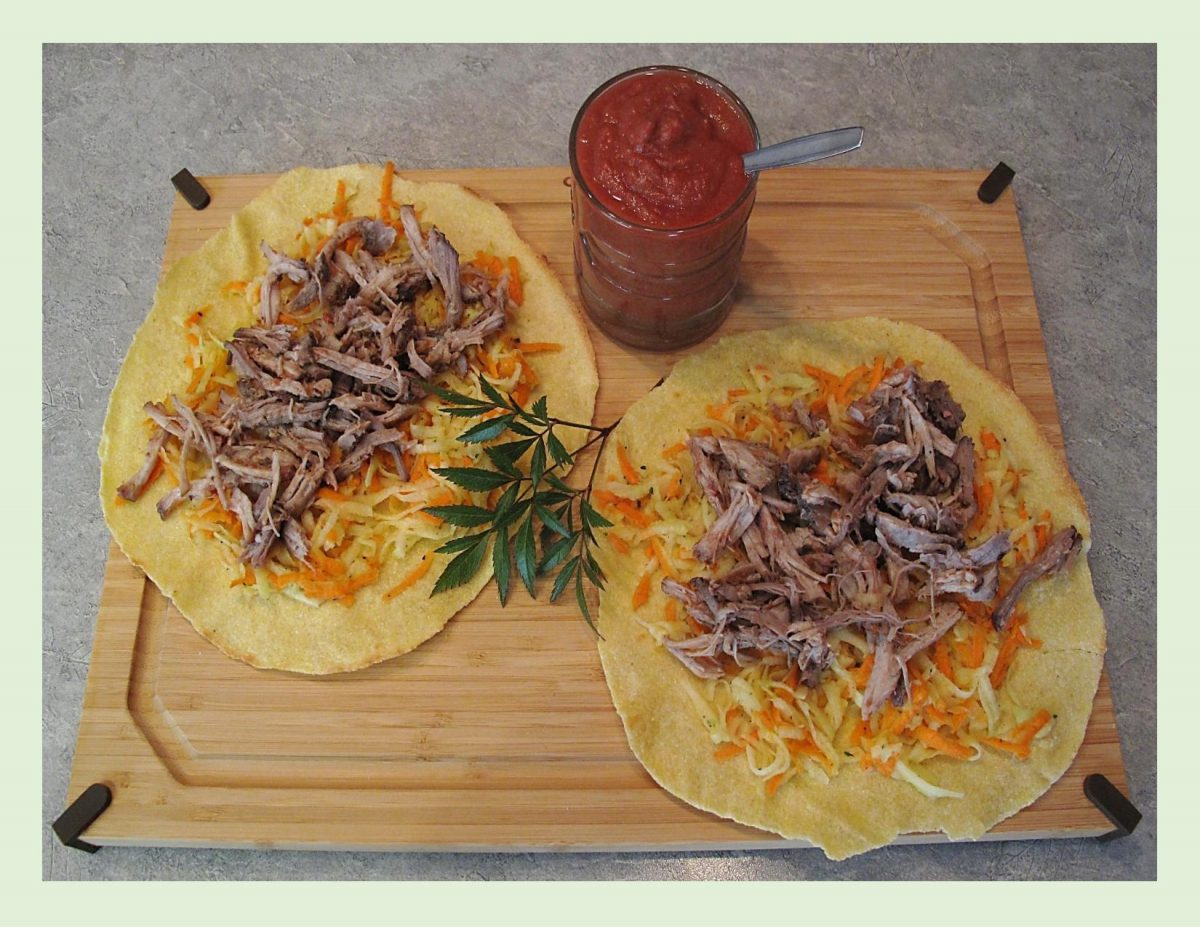
There are numerous ways you can serve pulled pork such as on some fresh brioche buns, with cornbread or in tacos. We are going to have ours in corn tortillas with some kohlrabi coleslaw and roasted rhubarb sauce.

Print Recipe
Pulled Pork w/ Roasted Rhubarb Sauce
Votes: 1
Rating: 5
You:
Rate this recipe!
Servings
Votes: 1
Rating: 5
You:
Rate this recipe!
Instructions
Pork Shoulder
  1. Drizzle pork with 2 Tbsp of oil; sprinkle with spices & orange zest & rub into meat. Place in a plastic zip-lock bag & refrigerate overnight (about 24 hours).
  2. Bring meat to room temperature. Preheat oven to 275 F. Place meat in a roasting pan & bake until thickest part registers 170 F. on a meat thermometer. Basically, roast until it's falling apart. Remove roast from oven & transfer to a large platter. Allow the meat to rest for about 10 minutes. While still warm, take 2 forks & 'pull' the meat to form shreds. Keep warm until ready to assemble tortillas.
Roasted Rhubarb Sauce
  1. Prepare sauce on the day you START to marinate meat.
  2. Preheat oven to 425 F. Line a baking sheet with foil & spray generously with non-stick cooking spray.
  3. Place chopped rhubarb & garlic cloves on the prepared baking sheet. Roast for 15-20 minutes, or until rhubarb is soft.
  4. Transfer the rhubarb & garlic to a food processor or blender. Puree with one cup of water until smooth.
  5. Pour the puree into a medium saucepan. Add remaining ingredients & mix well. Add additional water, as needed, until sauce is desired consistency.
  6. Bring to a simmer over medium-low heat. Simmer for 10-15 minutes. Cool before pouring into a small glass pitcher. Refrigerate any leftovers when meal is finished.
Kohlrabi Coleslaw
  1. Prepare dressing in a screw-top jar; combine vinegar, oil, sugar, salt & pepper. Cover & shake well. In a bowl, combine kohlrabi & carrots; drizzle with dressing.
Assembly
  1. During the roasting time of the meat, prepare kohlrabi coleslaw. When everything is ready, lay out warm tortillas, top with coleslaw & pulled pork shreds. Drizzle with prepared rhubarb sauce. Fold or roll tortilla & enjoy!
Recipe Notes
  • Instead of drizzling the rhubarb sauce, you can put your shredded pork in a bowl with some rhubarb sauce & combine. I find that distributes the sauce more evenly ... just a personal preference.

Russian Salmon & Cabbage Pie

The ‘stuffing’ principle seems very predominate in Russian cooking, from pelmeni (little meat dumplings) and vareniki (dumplings with potato & cheese) golubzi (stuffed cabbage), meat or cheese blintzes and of course, blini wrapped around lox.

Then there’s kulebiaka, the ‘grand’ oblong pie, that features several fillings. Its main distinction from any other Russian pie is that the quantity of the filling should be two or three times the quantity of pastry.

The word was derived from the verb ‘kulebyachit’ meaning to make with hands, to shape, to bend and to knead. This pie contained a flavorful mixture of salmon, rice, cabbage, mushrooms, shallots, hard-boiled eggs, dill and/or visiga — a spinal marrow of the sturgeon.

The crust was classically made with a yeast dough or puff pastry, although modern adaptations often include French crepes. In the 19th century, French chefs, who had worked in Russia, brought the recipe to France and adapted it to modern cookery.

This kulebiaka has a wonderful flavor with its many layers. I wanted to make it in the authentic oblong style but it can easily be baked in a 9-inch deep dish pie pan.

Print Recipe
Russian Salmon & Cabbage Pie
Instructions
  1. In a skillet, melt butter & saute onion about 7 minutes over medium-low heat. Stir in mushrooms, cabbage & vinegar; increase heat to medium. Cover skillet & cook 4 minutes; uncover, toss & cook 2 more minutes. Remove vegetables from skillet, season with salt & pepper to taste; set aside.
  2. Wipe out skillet, add oil & set over medium-high heat. Add salmon & season lightly with salt & pepper. Cook salmon 5 minutes per side; remove to a plate & let cool. Flake salmon into large chunks & set aside.
  3. Spread brown rice over bottom pastry. Peel & chop the hard-boiled egg, then add to pie, followed by flaked salmon. Sprinkle with cheese, then bread crumbs. Mound vegetable mixture on top. Sprinkle with fresh dill.
  4. Preheat oven to 375 F. Roll out remaining sheet of puff pastry on a lightly floured surface until it is large enough to cover pie. Brush edge of bottom pastry with egg wash & place second sheet of pastry directly on top. Use a fork to crimp down edges so sheets of pastry will adhere. Cut a few small slits in the top of pie to allow steam to escape. Brush pastry with remaining egg wash. Bake 35-40 minutes until pastry is puffed & golden.

Angel Cake Roll w/ Lemon Cream & Balsamic Strawberries

Angel Food cake is definitely a nostalgic dessert for many of us. I have always been intrigued by the experience of nostalgia, an emotion defined as, ‘a wistful desire to return in thought or in fact to a former time in one’s life, to one’s home or homeland, or to one’s family and friends; a sentimental yearning for the happiness of a former place or time’.

Growing up on a farm where chickens and eggs were part of the equation, angel food cake with fresh fruit was a special summertime treat.

The crown jewel of cakes when it comes to a light, and fluffy texture. Butter-less, oil-less and yolk-less, this cake is a fat-free marvel ( of course, don’t mention the sugar calories, if that matters ).

I recall my mother’s angel food cake, amazingly tall and light as a feather. It had its own special pan and was always cooled, precariously balanced upside down on the kitchen counter.

It seems that the earliest print evidence for commercial angel food cake MIX was around 1942. The brand was called EZY Angel Cake Mix produced by a company called Blair Inc. from Atchison, Kansas in the USA. In 1949 a full page ad promoting this product stated:

‘all you have to do is add water … For ease in preparation, the ingredients have been divided into two separate plastic bags. One contains the mix of egg whites, flavoring slice, salt and sugar; the other contains the special flour mixture. Contents of the first bag, with the addition of water, are beaten to the proper stiffness and the contents of the second bag are then folded into the mixture. The batter is poured into a tube pan and baked in a hot oven. It’s just that simple! Results have proven to be uniform in all cases, enabling anyone to make an angel food cake of such airy, snowy goodness that it delights the most particular tastes. The mix comes in two sizes — a large 14-egg package and a medium sized 8-egg package. Once you have tried it, you won’t want to be without it. Your family will love it…”.

Brion has always loved angel food. I was thinking since his birthday is getting close, it was a good time to make some in a cake roll style with lemon filling and balsamic strawberries. If you feel like trying this recipe, its your choice to either use a mix or do it from scratch. I’m sure it will be great either way.

Print Recipe
Angel Cake Roll w/ Lemon Cream & Balsamic Strawberries
Votes: 2
Rating: 4
You:
Rate this recipe!
Course dessert
Cuisine American
Servings
Ingredients
Angel Food Cake Roll
Lemon Cream Filling
Balsamic Strawberries
Course dessert
Cuisine American
Servings
Ingredients
Angel Food Cake Roll
Lemon Cream Filling
Balsamic Strawberries
Votes: 2
Rating: 4
You:
Rate this recipe!
Instructions
Angel Cake Roll
  1. Preheat oven to 350 F. Line a 15 X 10-inch jelly roll pan with parchment paper, set aside. Crack the eggs & separate the whites into a mixing bowl. Set whites aside to warm to room temperature.
  2. Measure flour, cornstarch & 1 cup powdered sugar carefully into a large bowl. Whisk together; SIFT the flour mixture into another large bowl then SIFT mixture back into first bowl and then again into the second bowl ( you are sifting the mixture 3 times ). Set aside.
  3. Whip the egg whites with a mixer on medium speed until foamy. Add the cream of tartar & salt; continue whipping on high speed until soft peaks form. While continuing to whip on medium-high speed, add the 1/2 cup powdered sugar slowly - about 2 Tbsp at a time - until fully incorporated. Increase the speed to high & whip until hard peaks form, adding the extracts as it whips.
  4. Using a wire whisk, fold the flour mixture into the whipped egg whites about 1/4 cup at a time, making sure to fold very gently & slowly, so as not to deflate the egg whites. This is a critical step, so take your time.
  5. Pour batter into prepared pan & smooth out top carefully. Bake for 25-30 minutes or until cake springs back when touched lightly in center. Cool cake for 5 minutes in pan; turn out onto a dish towel dusted with powdered sugar. Carefully peel off parchment paper, cool for 1 minute & cut off crisp edges of cake. Starting at narrow end, roll up cake & towel together. Place seam side down, on a wire rack & cool for 5 minutes.
Lemon Cream Filling
  1. WHILE CAKE IS BAKING, combine the pudding mix & milk together in a bowl. Chill to set up for 20 minutes. In another bowl, beat together cream cheese & lemon zest until smooth. Stir in the 'set' pudding & chill again until cake is ready to fill.
Balsamic Strawberries
  1. Slice the strawberries & place in a bowl. Add balsamic vinegar, extract (or Chambord liqueur), honey & salt. Combine & set aside.
Assembly & Serving
  1. Carefully unroll cake & spread the filling over entire cake. Again roll up as tight as you can; place on a piece of plastic wrap & roll up tightly. At this point you can either place your cake roll in the freezer overnight or chill it in the refrigerator for a few hours before cutting & serving. Top with some balsamic strawberries.
Recipe Notes
  • If time is short, prepare a one-step angel food cake mix instead of the 'scratch' cake.

Blueberry Perogies

Perogies are of virtually untraceable Central or Eastern European origin although speculation has it the recipe could have been brought from the Far East.

Thinking beyond potatoes and cheddar — who knew that perogies could be filled with fruit?! Although the most traditional fruit filling is plum, many fruits will work. Summer perogies are often filled with apricots, sweet or sour cherries and apples. At Christmas, sweet poppy seed filling is a popular choice. This simple food turns into a wonderful dessert when served with orange sauce, lemon curd, a basic chocolate ganache or even a raspberry or strawberry coulis.

I realize we are not quite into summer yet but blueberries are great anytime. What makes berries so attractive as a filling is their size and texture. Perogies need only a short time to cook – a few minutes each in water than in the frying pan so the berries will break down sufficiently in this amount of time.

While savory perogies are often fried, baked or even deep fried after being boiled, most fruit perogies are served without frying, lending a delicate texture to the more delicate flavor of the fruit.

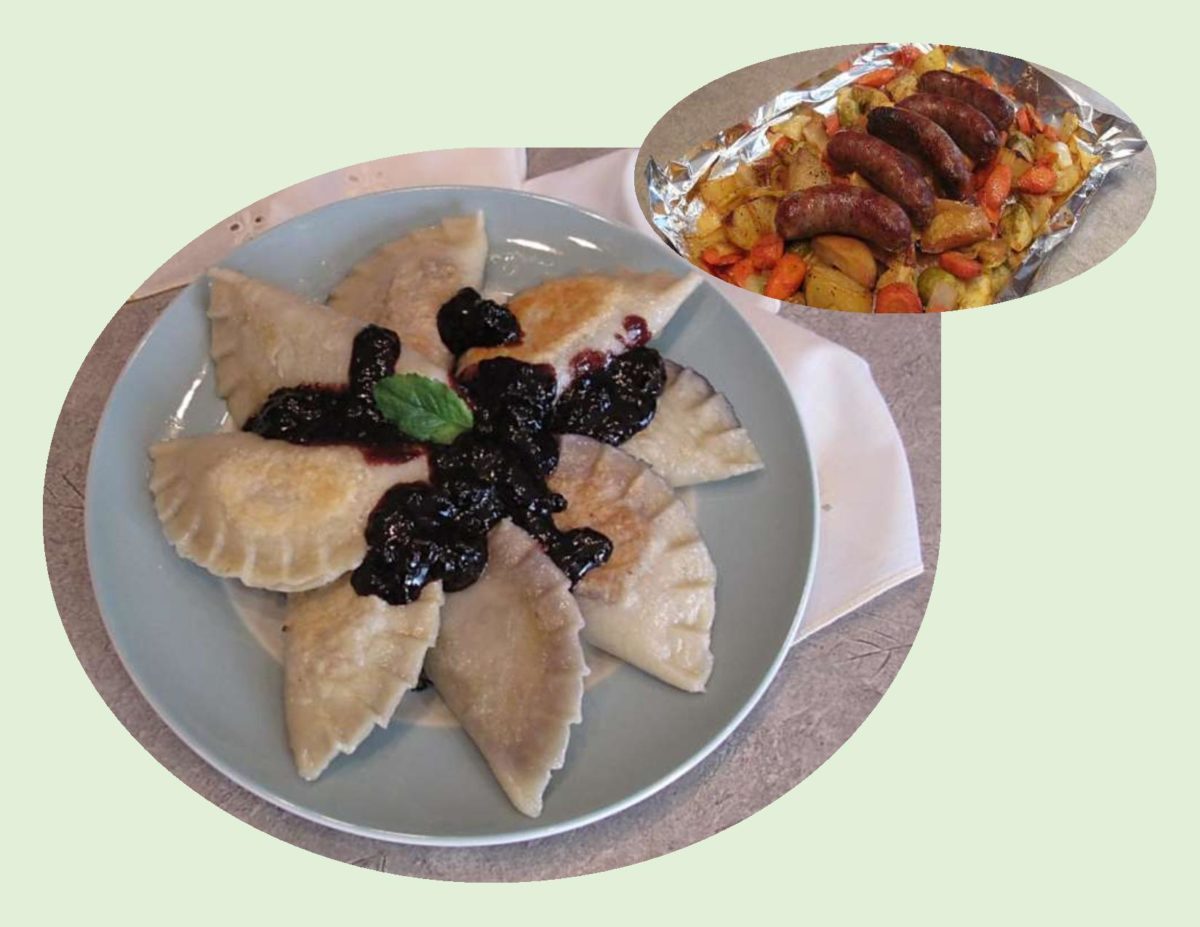
Since I wanted to serve these blueberry perogies as a compliment to our roasted bratwurst and veggies, we preferred them slightly fried and topped with a sweet/savory balsamic blueberry sauce. It made a great combo!

Print Recipe
Blueberry Perogies
Votes: 1
Rating: 5
You:
Rate this recipe!
Servings
Ingredients
Balsamic Wild Blueberry Sauce
Blueberry Filling for Perogies
Perogy Dough
Servings
Ingredients
Balsamic Wild Blueberry Sauce
Blueberry Filling for Perogies
Perogy Dough
Votes: 1
Rating: 5
You:
Rate this recipe!
Instructions
Balsamic Sauce
  1. In a small saucepan over low heat, place blueberries, garlic & honey; stir until mixture begins to boil & thicken. Stir in balsamic vinegar. Bring sauce to a boil & allow to reduce slightly to become the consistency of honey. Set aside, keeping warm until ready to serve.
Blueberry Filling
  1. Wash & dry blueberries; set aside. In a small dish, combine cornstarch & sugar; set aside.
Perogy Dough
  1. In a large bowl, whisk together flour & salt. In a separate bowl, whisk together egg, sour cream & oil until well mixed. Add liquid ingredients to dry mixture & gently combine. Before the dough is completely mixed, transfer to a lightly floured work surface. Knead dough 7 or 8 times to form a soft ball. Do NOT over-work dough.
  2. Roll out dough to 1/8-inch thickness. Using a 3 1/2-inch cutter, cut circles out of the dough or if you prefer to just cut same size pieces from dough ball. Stretch each to a 'perogy' size. Place about 1 tablespoon of berries on each round of dough. Sprinkle 1/4 teaspoon of the sugar/cornstarch mixture over berries. Moisten the edge of each dough circle with a little water & fold the dough over filling. Pinch the edges firmly to create a tight seal.
  3. Place perogies on a baking sheet lined with parchment paper while preparing them. Keep covered with a slightly moist towel until ready to cook.
  4. Fill a large pot with about 8 cups of water. Add 1 teaspoon of salt (+ 1 tsp oil if you wish), cover & bring to a boil. Cook perogies in batches. Stir gently until perogies float, cook about 2-3 minutes. Do not over cook or dough will be tough.
  5. Serve perogies with warm balsamic wild blueberry sauce.

Grilled Chicken Breast with Fresh Cherry Chutney

That great little cherry tree of ours just keeps on giving. Since we have a water fountain in our yard, the birds are definitely around but there seems to be well enough cherries for them and us. As I’ve mentioned in earlier blogs, this fruit is not the sweetness of the well-known Bing cherry but more a semi-sweet flavor. It is just perfect for baking, jams, jellies or in a cherry liqueur.

Over the years, I have come to really enjoy the flavor of chutneys. I realize it gets a little murky when you bring up the subject of salsa, relish or chutneys. Here’s a mini clarification just for interest.

Salsa is usually mixtures of raw vegetables and/or fruits. Sometimes they contain onions, herbs and chili peppers or with just fruit and various seasonings.

Relish has the ingredients usually cut finer and are cooked with a good quantity of sweetness.

Chutney is almost always cooked and can contain fruit and vegetables. They most often are made with aromatics like ginger root, cinnamon, cloves, chilies and herbs.

All are served cold or at room temperature. Their uses are endless such as an accompaniment to grilled foods, fillings in burritos, toppings for salads or served with cheese, corn chips, pitas or crisp breads.

The flavor and gorgeous color of the cherries made a real nice chutney for these grilled chicken breasts. 

We thought it might be nice to share some of the seasonal beauty we enjoyed in our yard this season. I hope you will enjoy looking at our pics. You can also view them in a larger size by going to our Facebook site: Good Food And Treasured Memories.


Print Recipe


Grilled Chicken Breast with Fresh Cherry Chutney

Votes: 1
Rating: 5
You:
Rate this recipe!

Servings

Votes: 1
Rating: 5
You:
Rate this recipe!


Instructions
  1. In a saucepan, combine cherries, red onion, basil, balsamic vinegar, honey & salt. Bring to a gentle simmer & cook for about 3-5 minutes. Stir in cornstarch/juice mixture & simmer until slightly thickened. Remove from heat & set aside.

  2. Between 2 sheets of plastic wrap, gently pound chicken breasts to uniform thickness. Brush both sides of breasts with olive oil; season with salt & pepper. Grill on BBQ or in a saucepan on the stove until nicely browned on each side & cooked through. Serve with Cherry Chutney.