Char Siu has been around for many years and was generally roasted over a fire. Nowadays, you can BBQ it, pan fry, bake or broil/grill it. No matter which way you choose to cook char siu, the shiny red glaze gives it a very unique look and flavor. Char siu doesn’t have a lot of fancy ingredients or complicated procedures. Instead, it pairs a tasty marinade with a lean cut of quality meat for a super good meal.
Char siu chicken is a sweet and savory dish of chicken that’s marinated and cooked in the style of the traditional Chinese barbecue pork dish, char siu. The chicken is marinated and placed on wooden skewers. It’s cooked until tender but not falling apart. The use of the skewers changes how the meat cooks. It should heat slowly and evenly from all sides.
The char siu marinade is very distinctive in its flavor … classic Chinese. It has a lovely depth of flavor, it’s sweet and savory, and a hint of Chinese Five Spice Powder flavor that makes this distinctly Char Siu.
Print Recipe
Char Siu Chicken
Votes: 1
Rating: 5
You:
Rate this recipe!
|
|
Votes: 1
Rating: 5
You:
Rate this recipe!
|
Instructions
Place marinade ingredients in a large Ziplock bag & mix to combine.
Cut chicken into bite size or leave as individual large pieces & thread onto skewers. Carefully place chicken in bag & seal, turning to coat chicken. Marinade for 3 – 24 hours. Soak bamboo skewers prior to using.
-
Remove skewers (reserve marinade) from Ziplock bag & lay across a foil lined, rimmed baking sheet. Roast for 10 minutes then remove from oven & baste with some of the excess marinade. Return to oven to continue roasting, basting another couple of times before chicken is completely cooked. Be sure not to overcook thighs so they are nice & moist.
Prepare rice while chicken is roasting. When chicken is cooked, transfer rice & chicken to a serving plate & sprinkle with green onions.
Recipe Notes
• Alternately you can grill the chicken over medium-high heat for about 6-7 minutes per side. Watch carefully as they can easily burn due to the sugar in marinade.

The original Peachy Chicken recipe has been printed on the back of the Heinz Malt Vinegar bottle for many years. Peaches paired with chicken just go together extremely well. The chicken cooked in peach sauce just melts in your mouth and the sauce itself has a sweet & sour flavor that is just amazing.
Malt vinegar transforms simple baked chicken into something incredibly special! Made from malted grains of barley, malt vinegar has a tart flavor and can help to enhance the flavors of other foods it is paired with. It is best known for topping fish and chips.
Malt vinegar is produced from the same grains that are used for making beer, and so it has a similar lemony, nutty, and caramel flavor profile as malted ale. It can range in color from light to dark brown while some distilled varieties are clear.
Usually found in condiment or bakery aisles at the grocery store, it’s become a culinary mainstay in British and Canadian cuisines.
Print Recipe
Peachy Chicken
Votes: 1
Rating: 5
You:
Rate this recipe!
|
|
Votes: 1
Rating: 5
You:
Rate this recipe!
|
Instructions
In a large skillet, brown the chicken thighs, onion & garlic in the oil.
Combine the reserved peach juice, orange juice concentrate, vinegar, brown sugar, red pepper flakes (if using), basil, salt, cloves, cinnamon & pepper. Pour over browned chicken mixture. Cover & simmer 25-30 minutes or until chicken is cooked through.
Add peaches; heat. Combine cornstarch & water; stir into sauce. Heat, stirring, until sauce is thickened.
Serve chicken & sauce over rice.
Recipe Notes
• If malt vinegar is not available, try using apple cider vinegar as a substitute.

Yaki Udon is a wok-fried Japanese udon noodle dish. Born from postwar ingenuity, Yaki Udon (literally ‘fried udon’) is a celebrated Japanese stir-fry dish with a history rooted in the resourcefulness of the mid-1940s.
The dish’s creation is widely attributed to a small restaurant named Darumado in Kokura (modern-day Kitakyushu), shortly after World War II. In 1945, food was scarce across Japan. The owner of Darumado wanted to serve yakisoba (fried buckwheat noodles), but proper soba noodles were unavailable due to rationing and shortages, so he decided to use dried udon noodles (which were more readily available) as a substitute for the missing soba.
The improvised dish, stir-fried with meat and vegetables in a soy-based sauce, was an instant hit with locals and eventually became a staple of the region.
While the original version used dried noodles, modern yaki udon is typically made with thick, chewy fresh or frozen udon noodles. Over the decades, it evolved from a ‘desperation’ meal into a popular Japanese pub snack and a standard festival street food.
Shrimp yaki udon is a staple of Japanese comfort food and a global favorite primarily because of its combination of fast, one-pan preparation, addictive textures, and a savory, rich flavor profile that is both comforting and customizable.
Just recently I’ve started incorporating these unique udon noodles into some of our meals and we really have enjoyed them.
Print Recipe
Yaki Udon w/ Shrimp
Votes: 1
Rating: 5
You:
Rate this recipe!
|
|
Votes: 1
Rating: 5
You:
Rate this recipe!
|
Instructions
Shrimp
Marinate shrimp in a bowl & set aside.
Sauce
Whish together stir-fry sauce ingredients in a small bowl & set aside.
Udon Noodles
Place udon noodles in a bowl & fill it with hot or boiling water. Let noodles sit until they are easy to detangle. Then drain & set aside.
Cooking
Preheat half of the vegetable oil in a saucepan over medium heat. Sear the shrimp until they are cooked through (5-8 minutes depending on the size). Remove them from the pan & set aside.
Add more oil to the pan & sauté garlic & green onions until fragrant. Add the cabbage, carrots, mushrooms & peas. Sauté until vegetables start to soften.
Add the udon noodles, cooked shrimp & stir-fry sauce to the pan, Toss & sauté for another 2-3 minutes. Serve.

French toast is a breakfast staple for the ages. It has a long history and is eaten in many forms all over the world. It is often enjoyed much like we usually serve it, but many countries give it a local twist. In India, savory French toast with spices, green chili, chopped onions, and salt is popular. Scottish French toast is often served with sausage between two slices like a sandwich. In Hong Kong, French toast doubles as a decadent peanut butter sandwich. New Zealand French toast is enjoyed with bananas, bacon, cinnamon, and maple syrup. Creole French toast kicks it up a notch — the milk and egg soaking mixture is spiked with alcohol, often whiskey.
When you hear the word ‘cornbread,’ what comes to mind? The next question is ‘have you ever tried cornbread French toast’? Over the years I’ve made a lot of different versions of French toast and cornbread, but I’ve never combined the two. Although cornbread might be considered simple and dated, it is the cornerstone of soul food. I’ve always been a cornbread fan. Undeniably, I love it! The smell and taste of fresh cornbread are definitely nostalgic for me.
Traditional cornbread is a quick bread leavened with baking powder, but this loaf is leavened with yeast. It works like all other yeast breads, mixed and kneaded by hand or a stand mixer, and left to rise and ferment before being shaped and eventually baked.
Unlike traditional quick bread, this yeast-based version rises beautifully, creating a light yet sturdy loaf with a golden crust.
Using cornbread for making French toast today, turned out to be amazing! There’s something so comforting about thick slices of egg-soaked bread cooked on a hot griddle, making the outside golden and crispy while its custard-like inside stays soft and rich.
Whether you’re in the mood for a simple slice of toast or a sandwich loaded with your favorite meats and vegetables, this bread will elevate your meal, believe me.
Print Recipe
Cornbread French Toast
Votes: 1
Rating: 5
You:
Rate this recipe!
|
|
Votes: 1
Rating: 5
You:
Rate this recipe!
|
Instructions
Cornbread
In a small saucepan, combine milk, 1 tablespoons butter & salt. Over medium heat, bring to a simmer. It's ok if the butter does not completely melt. Remove from heat. Slowly whisk in cornmeal, stirring until smooth. Stir in honey. Set this cornmeal mixture aside to cool.
In the bowl of a stand mixer, combine brown sugar & yeast in water. Stir to dissolve. Let stand until foamy, 5 to 10 minutes. Add eggs, cooled cornmeal mixture & 1/2- 3/4 cup flour. Beat at medium speed for about 2 minutes. Stir in enough remaining flour to make a soft dough. As soon as the dough pulls away from the pan, stop adding flour.
Turn out dough onto a lightly floured surface. Knead dough 8 to 10 minutes or until smooth & elastic. Place dough in greased bowl, turning to coat all sides. Cover with a slightly damp towel. Let rise in a warm place, free from drafts, until doubled in bulk, about 1 hour.
When risen, punch down dough; knead 30 seconds. Grease a 9”x5” loaf pan. Sprinkle 1 1/2 tsp cornmeal over bottom and sides of each pan. Shape dough into a loaf & place in prepared pan. Allow to rise 30 to 45 minutes, or until doubled in size.
Preheat oven to 375 F. Slash top of loaf as desired. Brush with melted butter; sprinkle with remaining cornmeal. Bake 30 to 35 minutes or until bread sounds hollow when tapped on bottom. Remove loaf from pan. Cool on a wire rack.
French Toast
In a small bowl, combine the milk, eggs, cinnamon & brown sugar. Whisk until well combined. Slice cornbread
Heat a non-stick griddle to a medium-low heat. Lightly butter the griddle. Carefully dip the cornbread into the egg mixture, gently shake off the excess & place on griddle. Don't allow the cornbread to soak in the mixture - just a quick dip.
Cook for 3-4 minutes on each side, adjusting the temperature to keep it from burning. Repeat until all cornbread has been cooked, adding additional butter if necessary. Hold the other pieces in a warm oven to keep them warm.
Serve with bacon & poached eggs or maple syrup, fresh berries & a sprinkling of powdered sugar.

Today, March 21st, our family is honoring the memory of our wonderful father’s birth date. Although it has been 21 years since his passing, he lives on in our hearts. It never ceases to amaze me how many things your parents do that are imprinted on you in childhood. As I grow older, I see and hear my dad living on through me. It seems we never fully appreciate our parents until they are gone. I’m told, ‘it’s a kid thing’, which doesn’t really seem to make it any better.
Having been raised on a farm, pork was a very common meal. Roast pork, chops and ribs were probably the cuts I remember eating the most.
When this date rolls around each year, I like to post something on the blog that I think my dad would have enjoyed. Today, I thought it would be nice to make some roast tenderloin skewers with papaya chutney.
Pork pairs well with fruits from tropical to mild because some cuts of pork are rich and fatty, while others are milder in flavor. You can substitute different fruits in almost any pork recipe to create unique flavor profiles. Chutneys are amazing condiments for roasted and grilled meats, including pork, chicken, duck, and lamb.
This simple-to-prepare chutney makes for a tasty, tart counterpart to the richness of the pork tenderloin. But nothing says you couldn’t spoon it over cream cheese or pâté for an easy appetizer dip, or serve it with grilled sausages, or spread some on a ham or grilled cheese sandwich. The possibilities are endless!
Print Recipe
Roasted Tenderloin Skewers w/ Papaya Chutney
Votes: 1
Rating: 5
You:
Rate this recipe!
|
|
Votes: 1
Rating: 5
You:
Rate this recipe!
|
Instructions
Chutney
Heat the oil in a large skillet & sauté the onion over medium heat until softened.
Stir in remaining ingredients & bring to a boil. Reduce heat & simmer for about 35 minutes or until fruit is very soft.
Remove from heat & allow to cool slightly then pulse in a food processor for a few seconds. Don't over process because the chutney is nice if it still as a slightly chunky texture.
Tenderloin
In a resealable plastic bag, place cubed tenderloin. Add oil & steak spice & shake well to combine. Place in refrigerator for a few hours or overnight to marinate.
Preheat oven to 400 F-425 F. Line a large baking sheet with foil.
Thread marinated pork onto skewers. Arrange skewers about 1-inch apart on the baking sheet. Bake for 15-20 minutes, turning once or twice, until the pork is cooked through.
Bake for 15-20 minutes, turning once or twice, until the pork is cooked through but NOT overcooked. To get a nice char, switch the oven to the broiler for the last 1-2 minutes.
Remove tenderloin cubes from skewers on place on a bed of steamed rice. Top with warm papaya chutney.

The other day I was thinking of how I could pair two food groups that I have enjoyed using over the years. One being the Japanese red adzuki beans and the other was the persimmon fruit.
The intriguing world of azuki beans has strong roots in Japanese culinary traditions as well, playing a versatile role in sweet and savory dishes.
Likewise, persimmons are a cherished aspect of the Japanese culinary culture. With their vibrant orange hue and sweet, honey-like flavor, they are a favorite autumn and winter fruit. Persimmons have been cultivated in Japan for over a thousand years and are celebrated in art, poetry, and cuisine.
Combining the two in a dessert seems only logical as the red bean paste complements persimmons so nicely, it works out real well. The red bean paste, also known as ‘anko’ in Japanese, is made from adzuki beans that are boiled with sugar. Its flavor is sweet and savory at the same time, with notes of chocolate and walnuts.
Red Bean paste comes in many shapes and forms, but one thing is constant: the ingredient is a special and meaningful component of different East Asian cultures. You can find red bean paste in many different dishes out of Japan, China, Korea and in recipes used all over the world.
Today, my recipe development is centered around two kinds of thumbprint cookies:
- Adzuki Bean Oatmeal Flax Cookies w/ Persimmon Compote
- Persimmon Oatmeal Cookies w/ Adzuki Red Bean Paste
Print Recipe
Adzuki Bean & Persimmon Thumbprint Cookies
Votes: 1
Rating: 5
You:
Rate this recipe!
Ingredients
Persimmon Compote for Adzuki Bean Cookies
Coarse Adzuki Bean Paste for Persimmon Cookies
Topping to Roll Adzuki Cookies In
Persimmon Oatmeal Cookies
Ingredients
Persimmon Compote for Adzuki Bean Cookies
Coarse Adzuki Bean Paste for Persimmon Cookies
Topping to Roll Adzuki Cookies In
Persimmon Oatmeal Cookies
|
Votes: 1
Rating: 5
You:
Rate this recipe!
|
Instructions
Persimmon Compote
Peel persimmon, dice & puree in a cup processor. Place persimmon, sugar & lemon juice in a small saucepan. Cook over a medium high heat, stirring constantly for about 5-8 minutes until mixture becomes sticky & jam like. Set aside to cool.
Adzuki Bean Cookies
Place the oats in the bowl of a food processor & pulse until it resembles coarse flour. Add flour, baking soda, cinnamon & salt & process until combined. Transfer to a large bowl.
Place the bean paste in another bowl along with the butter, 1/2 cup sugar, egg yolk & vanilla. Mix with an electric hand mixer until combined, scraping down sides of bowl.
Pour bean mixture into the oat mixture & stir by hand until almost combined; add the nuts & flaxseed & stir until just blended.
Preheat oven to 350 F. Line a baking sheet with parchment paper.
Place egg white in a small dish. Combine 1/4 cup each of ground flaxseed & brown sugar in a shallow dish. Roll slightly rounded Tbsp of dough into balls. Dip one ball at a time into egg white & then in the sugar mixture. Place 2-inches apart on prepared baking sheet. Press your thumb or index finger into the middle of each cookie. Divide persimmon compote between cookies filling each indentation.
Bake for about 16 minutes until set. Transfer to a wire rack to cool. Yield is about 32 cookies depending on the size you prefer to make them.
Persimmon Oatmeal Cookies
Place the oats in the bowl of a food processor & pulse until it resembles coarse flour. Add flour, 5-spice, baking powder, salt & ground flaxseeds & process until combined. Transfer to a large bowl.
Peel persimmon, dice & puree in a cup processor. In a separate bowl, place the persimmon puree, sugar, oil & vanilla & mix until smooth.
Pour the wet ingredients into the dry ingredients, mixing with a wide spatula just until batter begins to come together, being careful not to overwork it. Add walnuts, folding to distribute them evenly throughout.
Preheat oven to 350 F. Line a baking sheet with parchment paper.
Using a small cookie scoop, scoop out cookie dough onto prepared cookie sheet. Make a well or thumbprint shaped indent in the center of each ball of dough. Divide reserved adzuki bean paste between cookies filling each indentation.
Bake for 11-12 minutes. Don't overbake. Transfer to a wire rack to cool. Yield is about 30 cookies depending on the size you prefer to make them.

When it comes to desserts, I’ve always liked the idea of the mini sizes or smaller amounts. Small batch recipes have become popular because they align with modern lifestyle needs for portion control, reduced food waste, flexibility, and the desire for fresh, homemade quality.
For single people, couples, or small families, large recipes often yield more food than needed. Smaller portions mean you can try a wider range of recipes without being stuck eating the same dish for days, allowing individuals and small households to enjoy freshly baked goods and diverse meals without the commitment or excess of a full-sized recipe.
One small batch recipe that really appeals to me is this one for these nostalgic little caramel sour cream buns. Baked in a caramel sour cream sauce, these buns are a specific type of caramel roll with origins tied to German and Scandinavian immigrants. The cream provides moisture and a rich, distinct flavor that differentiates these from other sticky buns or cinnamon rolls, which might use different kinds of syrup or frosting.
A defining characteristic of these baked goods is how they are prepared: the caramel sour cream sauce is placed at the bottom of the pan before baking. After baking, the pan is immediately inverted, so the gooey, self-saucing caramel topping cascades over the top of the finished rolls.
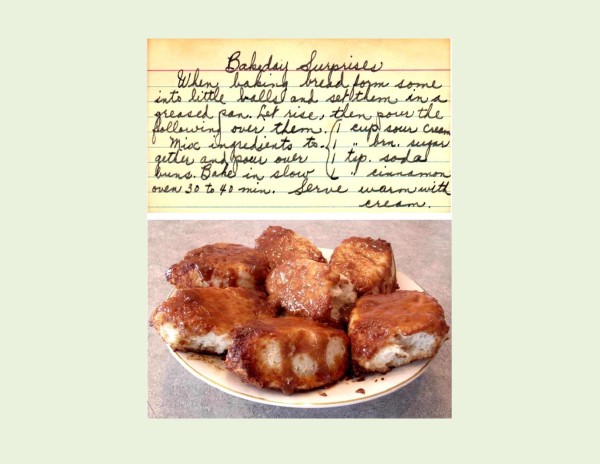
In today’s post, I would like to share a recipe my mother called ‘Bake Day Surprises’. I remember this dessert being so incredibly good. Since she baked bread once a week, an extra treat stemming from that bread dough was something we could always count on. Since there are just the two of us, it’s nice to be able to try and replicate this special dessert without having to make a large pan of them (that we really don’t need, right!)
Print Recipe
Small Batch Caramel Sour Cream Buns
Votes: 1
Rating: 5
You:
Rate this recipe!
|
|
Votes: 1
Rating: 5
You:
Rate this recipe!
|
Instructions
Caramel Sour Cream Sauce
In a small bowl combine all sauce ingredients; pour into a small round baking dish. Set aside.
Bun Dough
In a bowl, combine water , yeast & sugar. Allow to proof for 5 minutes. Add oil, flour, salt & egg. With a fork or a wooden spoon, mix into a shaggy dough.
Turn dough out onto a floured surface & knead for 5 minutes.
Divide the dough into 4 equal pieces & shape into balls. Place balls on top of sour cream sauce mixture in small round baking dish, cover with a towel & let rise for 40 minutes.
-
Bake for about 20-25 minutes. Remove from oven & immediately invert pan over a serving platter. Be VERY CAREFUL that the HOT sauce does not burn your hands when inverting the pan.

I recall my mother’s rice pudding with much fondness. It was a creamy pudding with raisins and a nice cinnamon flavor. Although, as a kid, raisins didn’t really appeal to me, they seemed to belong in this pudding. My father was a ‘meat and potatoes’ kind of man with an inherited love of sweets. I rarely ever remember my mother preparing a meal that didn’t end with some kind of dessert. It didn’t have to be anything elaborate. To this day, I still think a meal isn’t complete without a little sweetness at the end. Not a good thing as we get older.
Rice puddings are found in nearly every corner of the world. Milchreis is the German version, made by cooking short grain rice on the stove top in milk with sugar, cinnamon and vanilla.
Due to the mildness of this pudding, you can change the flavor significantly by just making a few changes such as nutmeg or cardamom instead of cinnamon, adding fresh or dried fruits and/or nuts.
That brings me to rhubarb — I love everything about the plant — how good it tastes, the beautiful huge foliage in the garden and how it can keep on producing all season long. The uses of rhubarb are endless, both sweet and savory.
Bordering one side of my mother’s large country garden grew six or eight rhubarb plants. I can’t even remember all the things she made with it but one thing still remains and that’s my love for it.
Today, January 22, our family celebrates the birthday of my sister, Marilyn. Birthdays were always made to be special as we were growing up. Not so much as to gifts but in regard to the family acknowledgement of ‘your’ day especially food wise.
For something I think holds a special nostalgic memory and to mark the occasion even if we can’t be together, I have prepared a German rhubarb crumble rice pudding.
BRION & I ARE THINKING OF YOU MARILYN & SEND OUR LOVE & BIRTHDAY WISHES.
Print Recipe
German Rhubarb Crumble Rice Pudding
Votes: 1
Rating: 5
You:
Rate this recipe!
|
|
Votes: 1
Rating: 5
You:
Rate this recipe!
|
Instructions
Rice
Place the milk, rice & sugar in a heavy bottomed pot on medium heat & bring to a simmer. Cook 45-55 minutes on medium low, stirring occasionally so bottom doesn't scorch, until it reduces by about half.
When thickened, remove from the heat, let it cool. Pour into a bowl or 4-6 individual custard cups you will serve from. Pudding can be served warm or cover & refrigerate.
Rhubarb Compote
Add rhubarb, sugar & ginger to a small pot. Over medium heat, cover & bring to a simmer. Cook 5 minutes at a simmer until rhubarb has softened but still keeps its shape. Set aside to cool.
Crumble
-
In a bowl mix all the ingredients & bring it together with your fingers or a fork. When fully mixed, spread it on a lined baking sheet & bake for 15-20 minutes, until browned & crispy. Remove & cool.
Serving
Spoon a generous portion of the rhubarb compote on top of the pudding, followed by a generous portion of the crumble mixture.

With only 13 days left until Christmas day there are probably numerous gatherings you will still need to prepare for. Hors d’ oeuvres are part of the holiday party tradition. I think that the best appetizers are ‘finger foods’ that you can eat easily and with very little mess. It seems every culture has its own collection of favorite appetizer recipes which have evolved over the years.
In North America, frozen puff pastry has become the ‘go-to’ when it comes to party fare. Puff pastry is so magical. It looks just like regular dough, but it doesn’t contain yeast, baking powder, or baking soda. Nevertheless, it puffs in the heat of the oven into flaky golden layers. Probably the big plus is that you can buy it frozen and have great success without it being labor intensive.
Not only do puff pastry appetizers make for a chic presentation, but they also make it easy to time your guests’ arrival with taking the appetizers out of the oven if you are serving them hot. Most recipes require a short cooking time, which allows you to pop them in the oven half an hour before your guests arrive and serve a warm appetizer as soon as they walk through the door.
Combining pears, gorgonzola cheese, and red onion in puff pastry appetizers creates a delightful blend of sweet, savory, and tangy flavors. Certain flavor pairings are so underrated and pear and gorgonzola are definitely one of them.
Gorgonzola is an Italian, blue-veined cheese, made from cow’s milk. It can be creamy, firm, or crumbly. Neither Brion nor I like the taste of traditional blue cheese, but we really enjoy the dolce gorgonzola (the milder and creamier version).
This combo of pears, red onion and gorgonzola is very versatile in that you can use it to make appetizers as well as topping for pizza dough.
Print Recipe
Pear, Red Onion & Gorgonzola Tart
Votes: 1
Rating: 5
You:
Rate this recipe!
|
|
Votes: 1
Rating: 5
You:
Rate this recipe!
|
Instructions
Nuts
-
Chop nuts & roast them in a dry skillet until golden brown. Spread them on a plate & allow to cool.
Pastry
Place the sheet of puff pastry on a large piece of parchment paper. Score each edge with a sharp knife about 3/4" in from outer edge making sure not to cut all the way through. Beat the egg & brush the EDGE of the pastry with it. If you prefer, sprinkle a very small amount of sea salt on the EDGE.
Caramelized Onions
Heat 1 Tbsp olive oil in skillet until hot. Add red onion & sprinkle with salt. Cook & stir about 15 minutes or until moisture is evaporated & onion is soft. Reduce heat; sprinkle with vinegar. Cook & stir until golden. Stir in brown sugar; cook & stir until caramel brown in color.
Remaining Fillings
Peel & seed pear. Cut into thin slices. Strip the thyme leaves from the sprigs & crumble gorgonzola.
Assembly/Baking
Brush sour cream over inside of the pastry (NOT on the edge). Top the pastry with pear slices, gorgonzola & the red onion. Sprinkle thyme over all. Sprinkle with freshly ground pepper if you wish.
Bake the tart for about 20 minutes or until golden brown on bottom & edges. Sprinkle with nuts (if using).
Cut in whatever size you wish. Serve for hors de oeuvres or as pizza with a simple tomato-arugula salad.

At Christmas time, the clementine is one of the most popular and plentiful varieties, its tight, glossy skin often accompanied by a sprig of zesty leaves. Many of us have fond memories of when they were stuffed into Christmas stockings with other nostalgic treats.
Most people probably don’t know where this clementine tradition comes from, but the mythical story is rather a charming one. It tells how Saint Nicholas, the 4th century Greek bishop upon whom Santa Claus was modelled, one day heard of a poor man who had failed to find suitors for his three daughters, lacking money for their dowries. Nicholas sought out the man’s house and tipped three sacks of gold down the chimney, where the coins happened to land in the girls’ stockings, which were drying beside the fire. The clementines (or oranges) in our modern Christmas stockings are said to be a symbol of the saint’s generosity. Poverty and desire probably also played a role in fostering the custom in times past, oranges were not only an affordable gift, but also a brief taste of exotic, sunnier climes.
As for the clementine itself, its origins are somewhat uncertain. Oranges are like roses, with endless hybrids having been cultivated over the centuries, each with its own particular shape, scent, texture and taste. The clementine is a mixture of a mandarin and a classic sweet orange, and is said to have been discovered by Clement Rodier, a French monk living in 19th century Algeria, who found it growing in the orchard of the orphanage he ran.
It’s that easy peel factor, along with a lack of seeds, that has catapulted the clementine above old-fashioned oranges in popularity.
Print Recipe
Clementine Kiwi Upside Down Puddings
Votes: 1
Rating: 5
You:
Rate this recipe!
|
|
Votes: 1
Rating: 5
You:
Rate this recipe!
|
Instructions
Topping
-
From parchment paper, cut circles to lay on the bottom of 6 individual custard cups. Divide melted butter between the cups. Sprinkle brown sugar over top the butter. Top with clementine & kiwi slices.
Pudding/Cake
In a small bowl, beat together eggs & sugar until thick; gradually beat in oil. In a small dish, combine flour, baking powder, spices & salt. Stir flour mixture into egg/sugar mixture, then add juice (or milk) & vanilla. Stir ONLY until combined.
Pour batter over fruit in custard cups, dividing it evenly between them. Bake 15-20 minutes or until they test done with a toothpick. Allow cakes to cool for about 5 minutes, then invert onto a rack to finish cooling.
Vanilla/Lime Sauce
In a small saucepan, combine sugar & cornstarch. Add water & bring to a boil, stirring constantly. Cook for a few minutes until sauce has thickened. Remove from heat & add vanilla & lime juice. Stir well & set aside to cool.
Assembly
Divide sauce between 6 individual dessert plates & top with a clementine/kiwi cake. Serve warm or cold.