Chai Liqueur Cinnamon Rolls

The air is chilly, the leaves are turning, the sun is shining, and the skies are blue. Frost has visited and that ‘end of summer’ feel is in the air.

But there’s more to fall flavors than just pumpkin spice. Before there was pumpkin spice, there was chai to keep you warm and cozy all autumn long. You might even recognize some of the flavors in chai as they are similar to pumpkin spice with clove, cinnamon, and cardamom. The classic way to enjoy chai is in tea, but it seems Craft Chai Liqueur is becoming a timeless staple.

I had never really heard about chai liqueur until Brion brought some home one evening to try. In the winter of 2011, Brion and I traveled Turkey for a month. We were meeting our Trafalgar tour group in Istanbul. Arriving a day early gave us time to ‘snoop’ around a bit. Next to our hotel was a ‘Starbucks’, so we went in. When Brion ordered my coffee, they gave me a ‘Pumpkin Spice Chai Latte’ by mistake. That pumpkin chai flavor was just incredible. I have been addicted to it ever since.

We both thought this chai liqueur tasted nice so naturally I was inspired to do some recipe development to see if I could use it in baked goods. There are many recipes using the chai spices such as cinnamon, ginger, cardamom, cloves, nutmeg and anise. I wanted to incorporate the actual liqueur as well as pop up the flavor a bit more.

But first, just a bit about the JAYA CHAI LIQUEUR itself … Created by Faaiza Ramji, a native of Edmonton, Canada, (our home city) JAYA is more than a spirit—it’s a tribute to the cultural icon of chai. With a deep respect for her South Asian heritage, Faaiza was inspired by the way chai has brought people together, whether at bustling street corners or in the quiet warmth of family homes. Every bottle of JAYA is rooted in tradition and history, a modern celebration of the centuries-old ritual of chai.

Alberta-based distillery ‘Field Notes’ is the brainchild of Faaiza Ramji. During a directorial tenure in economic development, she learned the immense value of agriculture in Alberta. Although Canada produces many of the basic ingredients the world relies upon, very few of those ingredients end up as finished products on local shelves, sacrificing GDP, jobs and additional downstream benefits to foreign countries. Greatly influenced by her South Asian heritage—where her grandmother, aunts and mother embraced natural remedies using herbs and spices to aid digestion, boost immunity, and even nourish skin—Faaiza formed a partnership in 2021 with Lindsey Good, a dedicated grower and owner of a 100-year-old farm in southern Alberta. Together, driven to build a complete food ecosystem within the Canadian Prairies by turning more local crops into more finished products the world can enjoy, Ramji and Good planted the seeds for a new kind of Alberta distillery and called it Field Notes. Chai liqueurs are rare in the Canadian market and Jaya Chai Liqueur uses distilled Canadian oats, filtered water, assam tea, Alberta beet sugar and a blend of spices like cardamom and clove for an invigorating, authentic chai flavor.

Edmonton’s distillery scene just got a recent boost, as Field Notes’ Jaya Chai Liqueur won a double gold, given because of its cumulative high score — a 98 out of 100 — from the judges at the 2024 San Francisco International Spirits Competition.

This brings me back to my recipe development which I focused on some chai liqueur cinnamon rolls. They ‘re a little more involved than the classic cinnamon rolls but I think you will find their well worth it.

Print Recipe
Chai Liqueur Cinnamon Rolls
Votes: 1
Rating: 5
You:
Rate this recipe!
Servings
Ingredients
Filling
Chai Cream Cheese Glaze
Servings
Ingredients
Filling
Chai Cream Cheese Glaze
Votes: 1
Rating: 5
You:
Rate this recipe!
Instructions
Dough
  1. Marinate raisins in Chai liqueur overnight, Stir occasionally.
  2. Dissolve yeast in 1/4 cup lukewarm water with 1 tsp sugar. Set aside for 5 minutes.
  3. In a large bowl, sift 1 cup of the flour. Stir in yeast mixture & lukewarm milk. Cover with plastic & let stand in a draft free place until doubled in volume, about 1 hour.
  4. While the dough rises, make the filling. Combine the sugar & spices together in a small bowl and mix well. Set aside.
  5. Punch down firmly & work in beaten egg, ¼ cup sugar, vanilla & pieces of softened butter. Sift the remaining 2 cups of flour with salt & work in 1 ½ cups to form a soft dough. Turn dough onto a lightly floured work surface. Knead in the remaining ½ cup of flour & raisin/liqueur mixture. This becomes a very soft & buttery dough but is not sticky.
  6. Roll dough out into a long rectangle about 16 x 12- inches on a well-floured surface. Spread the 2 Tbsp butter for the filling all the way to the edge of the dough. Sprinkle the sugar mixture over the butter, pressing it down to stick to the butter.
  7. From the long end, roll the dough away from you into a tight roll, sealing the bottom edge down by pinching the dough together.
  8. Use floss or a very sharp knife to cut the dough into 8 even rolls. Place the rolls in an 8-inch spring form pan. Brush rolls with egg wash. Cover the buns loosely with plastic wrap & allow to rise in a warm, draft-free spot until about 1 1/2 times the size. Toward the end of the rising time, preheat the oven to 350 F. & set an oven rack in the middle position.
  9. Bake the cinnamon rolls for about 55 minutes or until they are golden brown and no longer doughy. Remove from oven & allow to cool.
Glaze
  1. Using a mixer, combine the cream cheese, butter, powdered sugar, chai liqueur & milk. Beat on low speed, gradually increasing to high until light and fluffy. Brush glaze evenly over the rolls.

Benedictine Liqueur Christmas Braid

Christmas bread has a lot of different interpretations. The most traditional iterations involve sugar and spice, and often—but not always—yeast, and ultimately have strong cultural associations and country ties. One thing we can all agree on is that Christmas bread is celebratory, whether or not we observe the holiday. From the unleavened matzo of Passover to the German stollen of Christmas, from the British hot cross buns baked on Good Friday to the Russian kolach baked for any special occasion, bread in its many forms brings people together, linking traditions and generations.

The scent of Christmas spices, bread baking, and fresh-cut pine define holiday memories. Generations ago, the rich dough itself – lush with butter, eggs, dried fruit, sugar – relayed a cook’s generosity, her willingness to share the most precious ingredients in her pantry. The time and effort it took to make and bake the Christmas loaves expressed the cook’s devotion and love.

Last year, I was introduced to the liqueur known as Dom Benedictine. After doing much research into this interesting liqueur, I incorporated it in some savory and sweet recipes. We really enjoyed them so this year I was interested in doing a bit of recipe development to create a Christmas bread with it.

The story of Benedictine dates back to 1510 when a Venetian monk of the Abbey of Fécamp, Dom Bernardo Vincelli, created an elixir intended to support good health. It includes a combination of 27 herbs and spices derived from plants from around the globe, including juniper, myrrh, saffron, vanilla, thyme, coriander and more. The liqueur tastes primarily of honey and baking spices, with citrus peel, herb, and stone fruit notes.

So here you have it, my newly created Christmas bread tradition. Hope you can try it and enjoy it as much as Brion & I have.

Print Recipe
Benedictine Liqueur Christmas Braid
Votes: 1
Rating: 5
You:
Rate this recipe!
Servings
SERVINGS
Ingredients
Bread Dough
Lemon Glaze
Servings
SERVINGS
Ingredients
Bread Dough
Lemon Glaze
Votes: 1
Rating: 5
You:
Rate this recipe!
Instructions
  1. Marinate raisins, candied fruit & cranberries in Benedictine liqueur overnight, Stir occasionally.
  2. Dissolve yeast in 1/4 cup lukewarm water with 1 tsp sugar. Set aside for 5 minutes.
  3. In a large bowl, sift 2 cups of the flour. Stir in yeast mixture & lukewarm milk. Cover with plastic & let stand in a draft free place until doubled in volume, about 1 hour. Punch down firmly & work in beaten eggs, 1/2 cup sugar, lemon zest, vanilla & pieces of softened butter.
  4. Sift remaining 3 cups of flour with salt, cinnamon & cardamom & work 2 cups in to form a soft dough. Turn dough onto a lightly floured work surface. Knead in remaining cup of flour & fruit mixture. This becomes a very soft & buttery dough but is not sticky.
  5. Invert the dough onto a lightly floured work surface & dust with flour. Cut the dough into four equal pieces & then stretch & roll each piece into a rope about 20 inches long. Lay the ropes parallel to one another (vertically). Pinch them tightly at the top, then fan them out.
  6. Begin by taking the strand farthest to the right & weave it toward the left through the other strands using this pattern: over, under, over. Take the strand furthest to the right & repeat the weaving pattern again: over, under, over. Repeat this pattern, always starting with the strand farthest to the right, until the whole loaf is braided, Tuck the ends under to give the loaf a finished look.
  7. Carefully transfer the braided loaf to a parchment-lined 13x18-inch baking sheet, brush with egg wash. Cover the loaf loosely with plastic wrap & allow to rise in a warm, draft-free spot until about 1 1/2 times the size, about 1-2 hours. Toward the end of the rising time, preheat the oven to 350 F. & set an oven rack in the middle position.
  8. Gently brush risen dough again with egg wash. Place in an air-bake pan to prevent the bottom crust from browning too much.
  9. Bake 40-45 minutes or until a nice golden brown. Cool on a wire rack. Combine powdered sugar & lemon juice/zest to make glaze. When braid is completely cool, brush loaf with lemon glaze & decorate to your liking.
Recipe Notes
  • To see a more in-depth article on Dom Benedictine Liqueur, check out my blog from December 21/2022 - Benedictine Liqueur Cupcakes.

German Stollen – In the Spirit of Tradition

I realize we are still weeks away from Christmas, but there are some things that are just better if given the time to ‘ripen’ and develop a rich and complex flavor. German stollen, also known as (Weihnachtsstollen or Christstollen) is one of them.

In my previous blog I mentioned that stollen was a close ‘kin’ to fruitcake, but one thing it is not – is fruitcake! Stollen is a yeast bread  that is fortified with a colorful collection of candied fruit, citrus peel, raisins/currants, nuts, spices such as cinnamon, nutmeg, cardamom, mace or cloves, brandy or rum and lots of butter.

The tradition of Christmas stollen dates back to 14th century Germany. The sweeteners in this period were honey and dried fruits; until the 17th century, sugar was a scarce and expensive commodity. For this reason, sweets were only meant for times of great festivity and joy.  Originally it was made without milk or butter because these items were forbidden by the church during Advent. That changed in 1490 when Pope Innocent VIII signed the ‘butter document’ allowing bakers to use butter. It was much later when the use of milk was finally permitted.

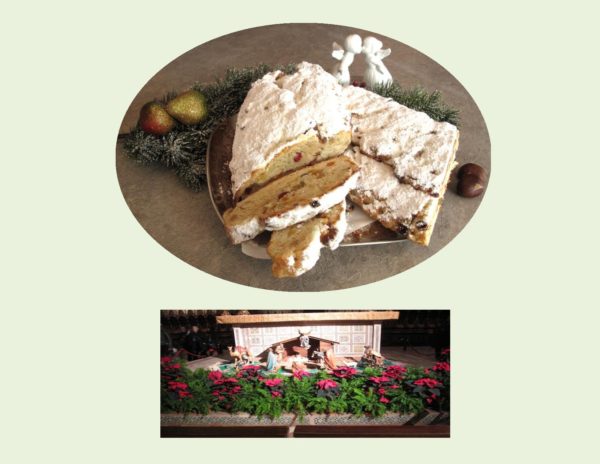
The cake’s distinctive shape, which it retains to this day, is meant to symbolize the Christ child ‘wrapped in swaddling clothes, lying in a manager’. Baked loaves are brushed with butter then cloaked in a thick layer of powdered sugar.

Holiday food traditions are a miraculous mix of time, place, ideology and ingredients. Often times, a single person can be the catalyst for a family culinary tradition. They bring it to the table as a delectable ‘gift’, wrapped with their own cherished memories and life experiences, enriching our holiday celebrations.

When I think of German stollen, a very unique memory comes back to me. One of the few newspapers my folks were interested in and had access to was the ‘Free Press Weekly Prairie Farmer’. It was a small newspaper published by the Manitoba Free Press for the prairie provinces in Canada. The newspaper’s middle section, ‘Home Loving Hearts’, contained ads from people requesting  pen pals  across Canada as well as recipes, ads for patterns of aprons, dresses, pot holders, baby clothes and knitting.

It was here my mother acquired a pen pal by the name of Renate Leitner in about 1956, that lasted for over 20 years, until the time of my mother’s passing. Every Christmas, Mrs. Leitner would send our family a beautiful loaf of German stollen bread in the mail. I remember how we looked forward to receiving it and how good it always tasted. This definitely attests to the durability of this bread.


Print Recipe


German Stollen (Weihnachtsstollen or Christstollen)

If made several weeks in advance it allows it to mellow and soften into a glorious fruit bread.

Votes: 1
Rating: 5
You:
Rate this recipe!

Course Brunch, dessert
Cuisine German

Servings
loaves


Ingredients

Course Brunch, dessert
Cuisine German

Servings
loaves


Ingredients

Votes: 1
Rating: 5
You:
Rate this recipe!


Instructions
  1. Marinate raisins, candied fruit & almonds in rum overnight, Stirring occasionally.

  2. Dissolve yeast in 1/4 cup lukewarm water with 1 tsp sugar. Set aside for 5 minutes.

  3. In a large bowl, sift 2 cups of the flour. Stir in yeast mixture & lukewarm milk. Cover with plastic wrap & let stand in a warm place until doubled in volume, about 1 hour. Punch down dough firmly & work in beaten eggs, 1/2 cup sugar, lemon zest, vanilla & pieces of softened butter.

  4. Sift remaining 3 cups of flour with salt, nutmeg & cardamom & work in 2 cups to form a soft dough. Turn dough onto a lightly floured work surface. Knead in remaining cup of flour mixture to form a smooth and satiny dough without any stickiness. Work in fruit & nut mixture.

  5. Divide dough in half. On a lightly floured surface, pat or roll each portion into an oval shape about 12 x 8 inches (30 x 20 cm) & 3/4 inch (2 cm) thick. Brush each piece with melted butter & fold the dough over lengthwise, almost in half.

  6. Preheat oven to 350 F. Lightly press edges together to seal (brush tops with a beaten egg if you wish). Bake 35-40 minutes or until golden. Cover with foil if loaves are browning to fast. Brush warm loaves with melted butter & dust thickly with powdered sugar. Cool on a rack.
    When completely cool, wrap tightly in foil & keep in a cool place for 2-3 weeks to ripen.


Recipe Notes
  • You can customize your filling ingredients any way you like. For example,  use dried cranberries or cherries instead of raisins -- candied citrus peel or candied ginger instead of citron peel -- your favorite dried fruit instead of apricots. You can even use sweet poppy seed paste or marzipan to fill your stollen -- your choice!
  • Stollen freezes well so it can be made weeks in advance of Christmas.