Roasted Grape, Chicken & Gorgonzola Pizza

Halfway between the two main California metropolises of Los Angeles and San Francisco is Paso Robles Wine Country. Located along California’s famed Central Coast, the Paso Robles winegrape growing region’s climate is perfect for the production of award-winning premium wines. A long growing season of warm days and cool evenings gives rise to vibrantly ripened fruit with dynamic flavor profiles that translate beautifully into a glass of Paso Robles wine.

Over the years, Brion and I have vacationed many times in the Carmel / Monterey area on the Central Coast of California. As a rule, we make Pacific Grove ‘home base’ and from there do numerous day trips. The Paso Robles area, a beautiful scenic drive with rolling hills, vineyards and estate wineries, is always one of our favorite day trips.

Paso Robles was named for its local oak trees, El Paso de Robles, ‘The Pass of the Oaks.’ Today the city’s name is commonly shortened to Paso Robles. Since Brion works for a retail liquor store and is well versed in the wine industry it is always interesting to stop at some of the wineries that produce products he sells. One of these is J. Lohr Vineyards & Wines. The tasting room is a quaint farmhouse style building with views of the vineyards from the tasting room and back patio. When we arrived, we were greeted by a ‘tasting room wine educator’ by the name of Geraldine Honer-Hollstien. She was an extremely knowledgeable person. She gave us unlimited time telling us about anything and everything we wanted to know about the winery. It added so much to our adventure that day.

Fifty years ago, the California Central Coast had not yet emerged as one of North America’s world-class wine-growing regions. With little history or viticultural precedent, planting on the Central Coast was a gamble. One of the handful of early pioneers, Jerry Lohr, was among the first to realize the inherent potential of Monterey and Paso Robles for growing high-quality grapes and producing superb wines.

Jerry Lohr is a farmer at heart who also happened to have a passion for winemaking. Besides the normal infrastructure and financial challenges of starting a new company in the early 1970s, the initial learning curve for wine grape farming in Monterey and Paso Robles was very steep. Unlike France or Italy where they have thousands of years of accumulated knowledge, on the Central Coast, for the most part, there was no track record. Jerry Lohr and a few other producers were having to ‘write the book’ as they went along. 2024 marks fifty years in business for J. Lohr. In 1974, J. Lohr released its first wine. Since that day, the Lohr family and team have helped bring Cabernet Sauvignon from Paso Robles and Chardonnay from Monterey County to global prominence.

Boundless sunshine, rolling hills, beautiful morning fog, endless beaches, a luxurious hospitality sector and, of course, delicious wine. It’s easy to see why the Central Coast of California is unmatched when it comes to enjoying the finer things in life. Wonderful memories!

I’ve added a few pictures I hope you will enjoy.

  • Ranch style J. Lohr winery at Paso Robles
  • Patio overlooking the vineyards
  • Beautiful vineyards
Print Recipe
Roasted Grape, Chicken & Gorgonzola Pizza
Instructions
  1. Preheat oven to 400 F.
  2. Line a baking sheet with aluminum foil & lay grapes in a single layer. Drizzle with olive oil, season generously with salt & toss to coat. Roast grapes for 25-30 minutes, until slightly wrinkled. Remove from oven, lift foil with grapes off & set aside.
  3. Sliver onions, place on baking sheet, sprinkle with a bit of salt, drizzle with oil & roast until soft.
  4. Spread each Naan bread with some garlic mayo. Top with roasted chicken, onions, grapes & sprinkle with crumbled Gorgonzola.
  5. Place pizzas on a baking sheet or pizza pan & bake for about 10-12 minutes or until all ingredients are nicely heated & cheese is melted.
  6. Drizzle with honey & sprinkle with fresh thyme for a garnish.

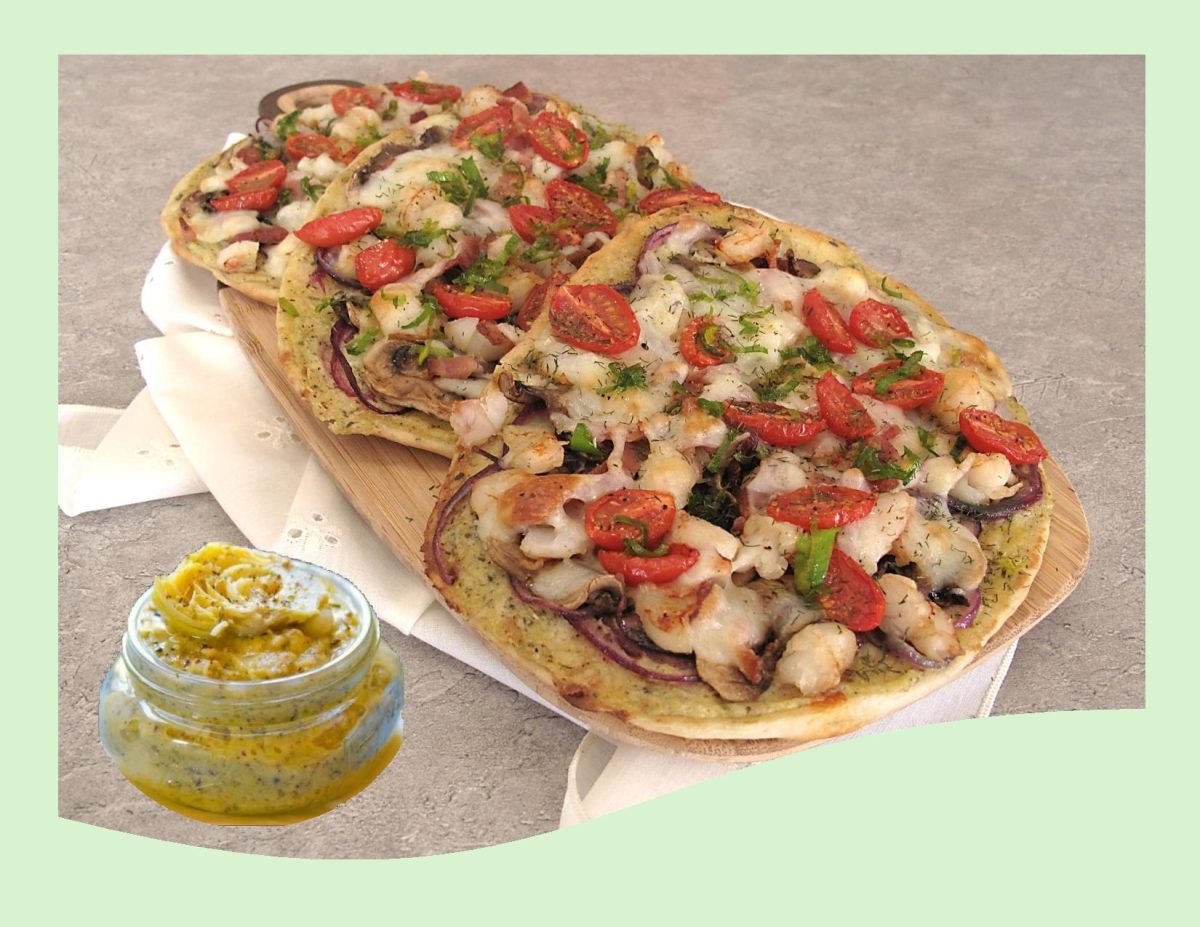
Shrimp Pizza w/ Artichoke & Garlic Sauce

It’s hard to get bored of pizza, but sometimes you want to change things up a bit. In addition to trying new toppings and cheeses, consider using an alternative to tomato sauce on pizza.

Pizza night is a cherished tradition in many households, but sometimes, it’s good to break away from the routine and experiment with new flavors. One of the easiest ways to do this is by trying out different alternative pizza sauces.

The other day Brion & I were in a Winners/Homesense store. Of course, my favorite spot is always the area where they have all the cookware and specialty food items. I saw bottled sauce made with artichokes and garlic. Immediately my thoughts were as to how I could use it. It was quite pricey, so I opted to try and make a copycat version at home.

While tomato sauce has long been associated with traditional pizza, there is a whole new world of flavors waiting to be discovered by breaking from tradition. Tradition of course has its place—there’s a reason classic tomato-topped pizza has been a staple for generations. But there is more to pizza sauce than regular tomato. There are exciting flavors, interesting textures, sweet things, spicy things, cheesy things, even exotic things!

Here are some ideas for making pizza without tomato sauce:

  • White pizza – Make a white sauce with olive oil, garlic, parsley, and a dash of salt and pepper. Spread it on the pizza dough instead of tomato sauce. Top with cheeses like mozzarella, ricotta, or feta, and veggies.
  • Pesto pizza – Spread pesto sauce on the dough instead of tomato sauce. Top with veggies and cheeses.
  • BBQ chicken pizza – Use BBQ sauce as the base instead of tomato sauce. Top with chicken, red onion, cheddar cheese, etc.
  • Mediterranean pizza – Make a tahini sauce base. Top with artichoke hearts, kalamata olives, feta, red onion, etc.
  • Breakfast pizza – Scramble eggs with veggies and meats. Spread it on the dough. Sprinkle with cheeses.
  • Buffalo chicken pizza – Spread buffalo wing sauce on the dough. Top with chicken, blue cheese, mozzarella, celery, onion.
  • Thai pizza – Make a spicy peanut sauce base. Top with chicken, carrot, onion, cilantro, mozzarella.
  • Carbonara pizza – Spread an alfredo sauce base. Top with bacon, onion, Parmesan, egg, parsley.

The best thing about pizza is that there are endless ways to enjoy it. So here you have it … shrimp pizza with artichoke & garlic sauce. Yum!

Print Recipe
Shrimp Pizza w/ Artichoke & Garlic Sauce
Votes: 1
Rating: 5
You:
Rate this recipe!
Servings
Votes: 1
Rating: 5
You:
Rate this recipe!
Instructions
Sauce
  1. Place all ingredients except oil in food processor. With motor running, Add olive oil in a slow stream to make an emulsion. Place in a dish & set aside.
Pizza Toppings
  1. Fry bacon until done but not crisp. Drain on a paper towel then chop into bite-sized pieces. In the same skillet, sauté shrimp until just cooked & remove it from skillet.
  2. Sauté sliced mushrooms & sliced onions until just cooked.
  3. Slice cherry tomatoes in halves & prepare fresh herbs.
  4. Shred mozzarella cheese.
Assembly
  1. Preheat oven to 350 F.
  2. Spread each naan bread with artichoke & garlic sauce.
  3. Top pizzas with onions, mushrooms, shrimp & bacon. Sprinkle shredded cheese over all then dot with halved cherry tomatoes & herbs.
  4. Bake 10-15 minutes or until cheese is bubbly & tomatoes are roasted. Serve.
Recipe Notes
  • You will no doubt have extra artichoke & garlic sauce. Store it in an air-tight container for up to one week. Enjoy it on toasted bread or swirl into cooked pasta.

Reuben Naan Pizza w/ Corned Beef & Dijon Béchamel Sauce

The ‘Reuben’ is a deeply early 20th century American Midwestern creation. Not everyone agrees on the exact recipe for a Reuben, but there are a couple of key components that most seem to agree upon: sauerkraut and Swiss cheese. The meat can be either corned beef or pastrami, the bread can be rye or otherwise, and dill pickle slices can be either added or omitted. The spread is also a point of contention, with some choosing Russian dressing, another choosing Thousand Island dressing and yet another Dijon mustard. 

Enter Dijon béchamel sauce! This Reuben Naan bread pizza is similar to the sandwich except that the spread is Dijon béchamel sauce rather than a dressing. It’s topped with sauerkraut, provolone, Swiss cheese and corned beef. 

Béchamel is a standard white sauce and one of the five ‘mother’ sauces of classical cuisine. Dijon béchamel makes a great alternative to pizza sauce.

Dijon mustard is a traditional mustard of France, named after the town of Dijon in Burgundy, France. When you think of Burgundy you probably think of its world-famous wine, and the region’s wine is part of the reason Dijon mustard was born. Mustard-making became an industry in France’s wine regions because mustard seeds provide essential nutrients to grapevines, so they were planted as a complementary crop. The condiment was then produced in these areas by mixing mustard seeds with wine must, a wine byproduct.

Dijon mustard has always felt like the fanciest mustard for some reason. That’s not to say Dijon is better than other mustards; everyone has their tastes, but compared to yellow mustard or a spicy brown, Dijon has always carried an air of refinement and complexity. Honey mustard is the party crowd-pleaser, and whole grain mustard is the rustic workman, but Dijon is as cosmopolitan at home in a vinaigrette as it is atop a sausage.

By most culinary standards, mustard is an ancient condiment. Before it was made in France, it was grown and used as a spice in Egypt and the ancient Middle East, dating back to almost 3000 B.C.

Still, it took 500 more years for true Dijon mustard to be born. Mustard was made in a variety of ways around France, and over time, vinegar replaced grape must as the common additive. Then in 1856, a citizen of Dijon named Jean Naigeon started using yet another wine product, verjus, (translates to ‘green juice’ in French. It is a middle ground between vinegar and grape juice, made from the juice of unripened wine grapes) in place of vinegar, which gives Dijon mustard its unique heat.

Since July 15, 2009, eighty percent of the mustard seeds used in the manufacture of contemporary Dijon mustard come from Canada. Due to smaller than usual Canadian crop of mustard seeds in 2021, a shortage of Dijon mustard began in France in 2022. The shortfall in Canadian production was caused by a heatwave, attributable to climate change. The shortage has been exacerbated by customers stockpiling.

Nevertheless, I managed to secure some for this unique Rueben pizza!

Print Recipe
Reuben Naan Pizza w/ Corned Beef & Dijon Béchamel Sauce
Votes: 1
Rating: 5
You:
Rate this recipe!
Servings
Votes: 1
Rating: 5
You:
Rate this recipe!
Instructions
Dijon Béchamel Sauce
  1. In a large saucepan over medium heat, melt butter. Add the flour & whisk for 1 minute. Add 1/2 of the milk & whisk until smooth. Whisk in remaining milk. Bring to a boil. Add salt, pepper & nutmeg. Reduce heat & simmer for 10 minutes, stirring occasionally. Whisk in Dijon mustard until combined. Remove from heat & set aside.
Assembly & Baking
  1. Preheat oven to 350 F.
  2. Lay out Naan breads on a baking sheet. Spread sauce over each one liberally.
  3. Arrange corned beef on top of sauce. Sprinkle pizzas evenly with Swiss & provolone.
  4. Bake for 12-15 minutes or until the crust is crispy. Remove from oven & top with caraway seeds & red pepper flakes if you wish.

Summer Vegetable & Shrimp Pizza

CELEBRATING HERITAGE DAY!

In 1974, the first Monday of August was made an official provincial holiday to recognize and celebrate the varied cultural heritage of Albertans. Businesses can chose whether or not to recognize the day as a general holiday, which most do.

The Heritage Festival held in our city of Edmonton, Alberta Canada is a three-day event to sample delicious food, see creative performances and celebrate Canada’s multiculturalism. Thousands of visitors come to enjoy the tastes, smells and sounds of different nations around the world.

Even though many people will take in the day’s events and cultural food at the festival, some chose to pack a picnic lunch and take a drive somewhere just to relax.

I am posting a summer veggie & shrimp pizza that should work real well with that idea.

Print Recipe
Summer Vegetable & Shrimp Pizza
Instructions
  1. In a skillet, fry bacon until almost done. Remove to paper towel.
  2. Add zucchini, onion & garlic to skillet with bacon drippings & sauté for 2 minutes. Transfer to a plate. Increase heat slightly & add 1/2 tsp. of oil. Add shrimp & cook for 1 minute, turning halfway through. Transfer to a plate. Cut cooked corn kernels off of the cobs.
  3. Preheat oven to 375 F.
  4. Brush Naan breads with olive oil & sprinkle with salt, pepper & Parmesan cheese. Top with zucchini, onions, garlic, shrimp, corn, bacon bits & mozzarella cheese.
  5. Bake until cheese is bubbling & naan bread is 'toasted', about 7-8 minutes. Allow pizza to rest for 5 minutes, then cut into 8 slices. Sprinkle with basil & parsley. Serve

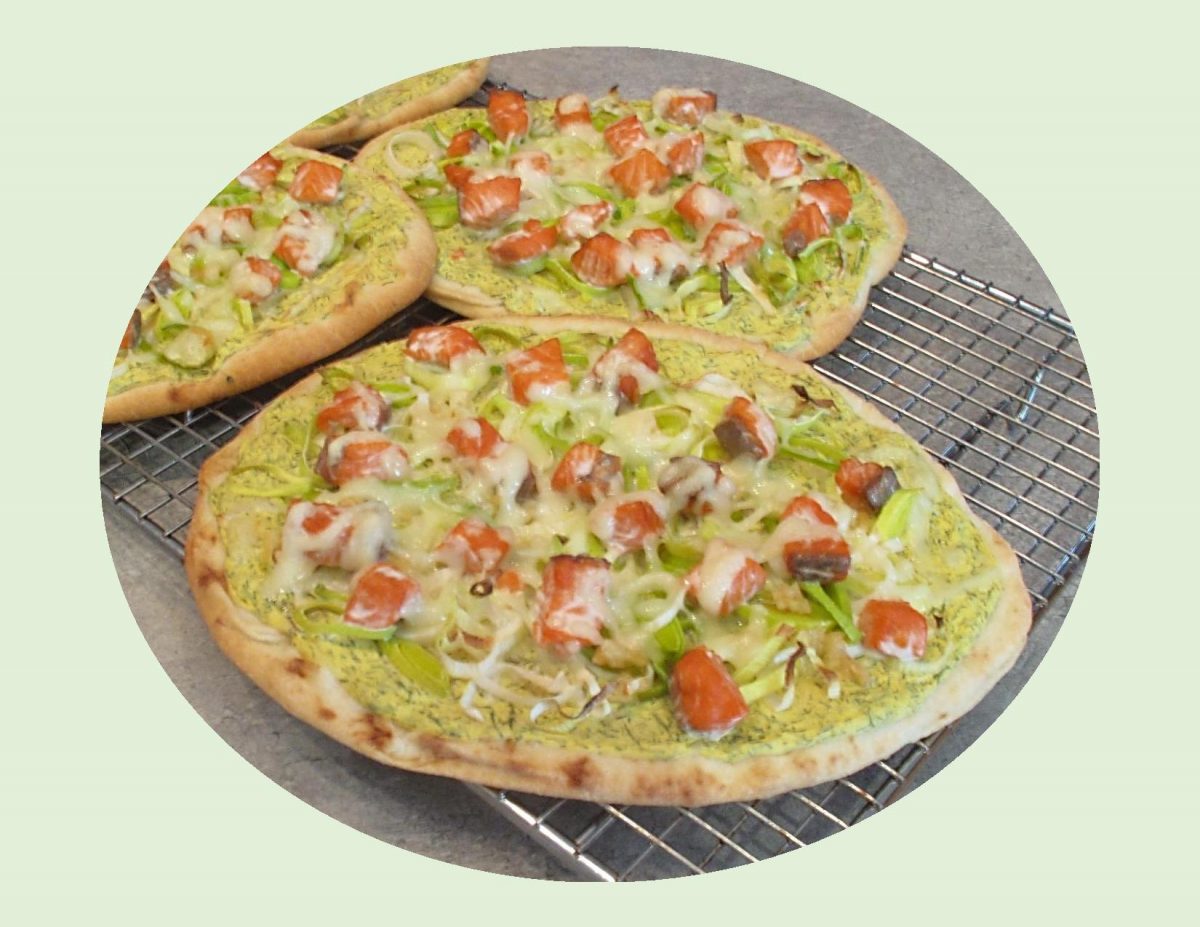
Salmon & Leek Naan Pizza

The Naan which is known for its soft and fluffiness and original flavour also led to other types of it being created.

Different types of Naan also became popular depending on them either being stuffed or coated with specific toppings. The many varieties include:

  • Plain Naan – simplest form which is brushed with ghee or butter
  • Garlic Naan – topped with crushed garlic and butter
  • Kulcha Naan – has a filling of cooked onions
  • Keema Naan – includes a filling of minced lamb, mutton or goat meat
  • Roghani Naan – sprinkled with sesame seeds
  • Peshawari Naan and Kashmiri Naan –  filled with a mixture of nuts and raisins including pistachios
  • Paneer Naan – stuffed with a filling of cheese flavored with ground coriander and paprika
  • Amritsari Naan – stuffed with mash potatoes and spices 
Print Recipe
Salmon & Leek Naan Pizza
Instructions
  1. In large skillet, heat oil over medium heat. Add leeks and garlic; season with salt and pepper. Cook, stirring often, until leeks are softened, about 5 minutes. Remove skillet from heat; let cool slightly.
  2. Meanwhile, in small bowl, combine sour cream, dill, mustard and lemon zest. Season with salt and pepper.
  3. Preheat oven to 425°F. Line 2 baking sheets with parchment paper. Place naan on prepared baking sheets. Evenly spread sour cream mixture on naan, leaving 1/2-inch border. Top with leek mixture, salmon and Swiss cheese. Bake until edges of naan are lightly browned and salmon is cooked through, 10 to 12 minutes. Sprinkle with dill fronds, if desired.