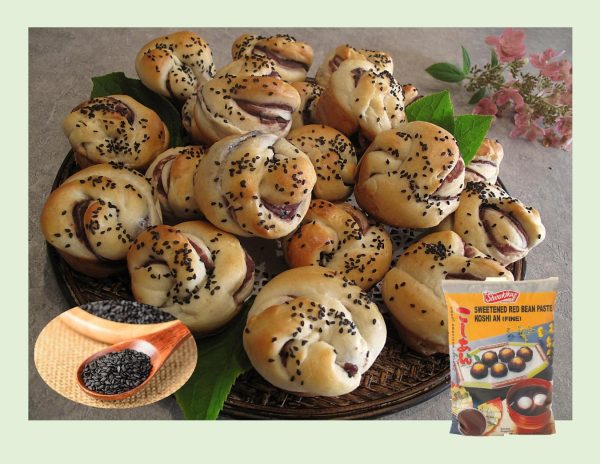
Sweet Red Bean Twists

Red bean bread is a Chinese bakery classic, the quintessential Asian bread. Be it Chinese, Japanese, Korean, or just about any other Southeast Asian and East Asian countries, this bread is a staple. The bread is light, fluffy, slightly sweet and filled with creamy sweet red bean paste.

In many Asian cultures, beans such as red beans, mung beans and black beans are commonly used in desserts. This tradition likely developed due to the availability of beans as a staple food, as well as the natural sweetness and creamy texture they can add to dishes when cooked and sweetened. Beans are also high in protein and fiber, making them a nutritious addition to desserts. Over time, the use of beans in desserts has become a cherished part of Asian culinary traditions, offering a unique and delicious alternative to more common dessert ingredients.

Red bean paste also called adzuki bean paste or anko is prepared by boiling the beans, then mashing or grinding them. At this stage, the paste can be sweetened or left as it is.

Over the years I have used another interesting vegetable known as a purple yam in many breads and desserts which puts me very much in mind of the sweet bean taste. The purple yam is cooked and sweetened like the red bean paste and has a similar texture. It is called Ube halaya and in the Philippine culture it to is a cherished staple.

One of the nice things I found with the red bean paste is if you’re not interested in making your own from scratch it is readily available at the Asian grocery stores in refrigerated packages or tinned. I know red bean isn’t exactly for everyone, but it’s hard to just ignore how well it goes with the Asian fluffy bread. 

Today I’m making some red bean twists with my version of a ‘milk’ bread. For the filling this time, I purchased a tinned chunky red bean paste. It all came together quite nicely and tasted so good!

Print Recipe
Sweet Red Bean Twists
Votes: 1
Rating: 5
You:
Rate this recipe!
Course dessert
Cuisine Chinese
Servings
SERVINGS
Ingredients
Course dessert
Cuisine Chinese
Servings
SERVINGS
Ingredients
Votes: 1
Rating: 5
You:
Rate this recipe!
Instructions
  1. In a small bowl, dissolve yeast & 1 tsp sugar in lukewarm milk. Let stand for 5 minutes to allow yeast to activate. In a large bowl, whisk together 2 Tbsp sugar, melted butter, sour cream & egg. Add yeast mixture, stirring to combine.
  2. In another bowl combine flour & salt. Add flour mixture, 1 cup at a time, combining with wet mixture. Once all the flour has been added, knead dough for about 2 minutes until smooth & elastic consistency. Place dough in a greased bowl & cover with plastic wrap & a towel. Allow to rise in a draft free place until doubled in bulk, about an hour.
  3. Punch the risen dough down & divide the dough into 3 equal parts. Lay a piece of parchment paper over the removeable bottom of a 10-inch tart pan on your work surface. Place first portion of the dough on the parchment paper & roll or press out dough the size of the bottom of the tart pan. Carefully spread the circle with half of the bean paste. Roll out the second portion the same size & transfer with your rolling pin to top of the first portion. Carefully spread it with the remaining bean paste.
  4. Roll out the third portion of dough to the same size & place it on top of the other two layers. Pinch the dough around the outer edge to seal. Place a small glass in the center & press down. Cut from outside edge just to the glass, forming 12 wedges.
  5. Remove the glass. Twist each wedge 3-4 times. Tuck edge under. Place bottom of tart pan ( with parchment paper & twists) inside tart pan ring. Cover with plastic wrap & a towel. Allow to rise for about 15-20 minutes.
  6. Preheat oven to 350 F.
  7. Lightly brush twists with a bit of egg wash & sprinkle with black sesame seeds before baking. Bake 25-30 minutes or until golden brown. Remove from pan to a wire cooling rack.
Recipe Notes
  • When you purchase red bean paste, make sure the ingredients do not include maltose. The type that contains maltose is for making mooncakes. It is quite sticky, and it is hard to work with when making red bean bread. 

Sweet Red Bean Buns/ Anpan

Many people are often surprised to hear that beans can be enjoyed as dessert. But ‘anko’, a paste made from red beans called ‘azuki’, is a staple in traditional Japanese confectionery, and has been enjoyed by Japanese people for centuries. Anko, or sweet red bean paste, is the equivalent of chocolate in the western world. 

The origin of red bean paste dates back to the Heian period when Chinese travelers visited Japan with recipes for steamed buns. Japan adopted the recipe and incorporated meat and vegetables; however, Buddhist priests were unable to eat the meat-filled buns, so they opted for a substitute of boiled azuki beans. The beans only began to be sweetened during the Muromachi period when Dutch traders started importing sugar to Japan.

Anpan is a sweet roll that was first made in 1874 by a samurai named Mr. Kimura. He lost his job due to the dissolution of the samurai as a social class back in Meiji period. During that time, Japan was becoming more westernized, and bakeries started to appear. His new job was as a baker.

Soon after Mr. Kimura founded the well-known bakery called ‘Kimuraya’, which still exists today. Kimura created a bread that was more suited to Japanese tastes. He replaced the traditional Japanese red bean mochi (a Japanese rice cake made from short-grain glutinous rice) with western bread instead of mochi and it is here where anpan, the traditional soft Japanese bread roll filled with red bean paste, was first invented.  

Anpan, derived from anko red bean paste, and pan, taken from the French word for bread (pain), is undoubtedly one of Kimuraya’s most famous products, and one of the most popular types of bread in Japan. Like true artisans, their original recipe has not changed since their first conception. Kimuraya have also not patented their recipe, allowing other bakers to make the same product as they please.

You can find anpan in bakeries and convenience stores all throughout Japan. Anpan is almost always filled with azuki bean paste in varying textures. Some are smooth, and others are chunky. Zunda beans (green beans) and white soybeans are common fillings. Other non-azuki bean paste flavors are pumpkin, chocolate, and cream, to name a few.

Red Bean paste comes in many shapes and forms, but one thing is constant: the ingredient is a special and meaningful component of different East Asian cultures. With its creamy texture, red bean paste is suitable for a multitude of desserts. Its flavor is sweet and savory at the same time, with notes of chocolate and walnuts.

Just for fun, I thought I would try making some anpan buns to see if we would like them. Of course, what’s not to like …. there sweet and soft!!

Print Recipe
Sweet Red Bean Buns
Votes: 1
Rating: 5
You:
Rate this recipe!
Servings
Ingredients
Sweet Red Bean Filling
Servings
Ingredients
Sweet Red Bean Filling
Votes: 1
Rating: 5
You:
Rate this recipe!
Instructions
  1. In a small bowl, dissolve yeast & 1 tsp sugar in lukewarm milk. Let stand for 5 minutes to allow yeast to activate. In a large bowl, whisk together 1/4 cup sugar, melted butter, sour cream & egg. Add yeast mixture, stirring to combine.
  2. In another bowl, combine flour & salt. Add flour mixture, 1 cup at a time, combining with wet mixture. Once all flour has been added, knead dough for about 2 minutes until smooth & elastic consistency, Place dough in a greased bowl & cover with a towel or plastic wrap. Allow to rise in a warm place until doubled in bulk, about an hour.
  3. Lightly butter 2 muffin pans using only 20 cups total.
  4. Punch the risen dough down & transfer to a lightly buttered work surface. Divide the dough into 20 equal portions with about 50 grams each. Take one portion of the dough, shape it round, flatten it with a rolling pin, put a ball of red bean paste and seal it properly. Shape the ball, use a rolling pin to flatten (not too forceful or it will break the dough) it into a rectangular shape, use a sharp knife to cut 4 lines in the middle of the dough about ½-inches apart.
  5. Roll up, starting at the longest side of dough, twist & attach ends together. Place each bun in a muffin cup.
  6. Brush egg wash over tops of buns & sprinkle with sesame seeds. Cover buns with a tea towel & allow to rise for about 30 minutes or until doubled in size.
  7. Preheat oven to 350 F.
  8. Bake for 20 minutes or until golden in color. Remove from oven. Take buns out of pans & cool on wire racks.
Recipe Notes
  • If you prefer your bun dough a bit sweeter use 1/4 cup as opposed to 2 Tbsp as I did.