Polish Hamburgers

Polish Hamburgers could be described as a cross between a meatball and an actual hamburger. These tender burgers have unique flavors of mushroom, garlic, and dill simmered in a rich gravy creating a savory comfort food that is best served over mashed potatoes, steamed bread dumplings, buttered egg noodles, or rice.

Klotlety or Klupskies, also known as Polish burgers, are a classic dish originating from Poland. Every Polish family has their own unique recipe and way to prepare them, making it a dish that is both a culinary tradition and a source of family memories. Typically, they are made with ground pork and beef, onions, eggs, bread, and milk along with spices and seasonings.

You may notice the traditional recipes for these hamburgers have some unique ingredients such as dill and nutmeg. Although that may seem a bit unusual to you, the nutmeg adds another layer of flavor to the gravy while the dill adds some brightness. Frying is one common preparation method, but you can also bake them.

Today, Polish hamburgers can be found in various forms served in the traditional way with mashed potatoes and gravy or they can be used for a more North American-style hamburger on a bun, with dill pickles, sliced tomatoes, onions, cheese, sauces, and other toppings. 

These hamburgers taste great the next day for lunch or as a nice picnic meal.

Print Recipe
Polish Hamburgers
Votes: 1
Rating: 5
You:
Rate this recipe!
Course Main Dish
Cuisine Polish
Servings
Votes: 1
Rating: 5
You:
Rate this recipe!
Instructions
Patties
  1. In a large bowl, combine the meat, crackers, eggs, onions, green peppers, milk, herbs & seasonings. Do NOT OVERMIX. One of the main reasons recipes like meatloaf, burgers and meatballs are not good is due to over mixing the meat mixture. When you make these Polish hamburgers, you want to make sure to combine the ingredients but do not over mix them or your burgers will cook up too dense & hard.
  2. Prepare a cookie sheet with foil & form mixture into 10 patties that are about the size of your hand and about 2 inches thick. These patties may be wetter than your usual meatballs or hamburgers.
  3. Allow the patties to rest at room temp for about 30 minutes so they have time to bind.
  4. When the patties have rested for about 30 minutes heat 2 - 3 Tbsp of butter in a large deep skillet. When the butter is warm, add the minced garlic and give it a swirl in the butter. Prepare a plate with some paper towels to keep near the stove where you will be frying your patties.
  5. Carefully remove patties & place them in your skillet. Allow the patties to cook for about 5 to 7 minutes on the first side before carefully flipping. You want to get a nice sear on each side. When they are well seared on both sides, remove them from the skillet & place on the prepared paper towel dish. Fry remaining burgers getting a nice sear on all.
Mushroom Gravy
  1. When you are done frying all the burgers, add the rest of the butter, then add the mushrooms to the hot skillet. Allow the mushrooms to brown. Add the Worcestershire sauce. Use a spatula to scrape up the meaty bits from the bottom of the pan as the Worcestershire sauce loosens them.
  2. Give the mushrooms about five minutes to simmer in the Worcestershire sauce. Next add the beef broth & cream of mushroom soup, whisking until smooth.
  3. Now, add the burgers BACK to the pan of gravy you just made. They should have shrunk while cooking so you should have room for them all. Make sure they are submerged in the gravy & bring the pan to a simmer.
  4. Reduce heat, cover with a lid & allow to simmer for 30 minutes. You may want to rearrange the burgers halfway through simmering to make sure they all get a chance to be submerged in the gravy.
  5. After 30 minutes, make room in the center of the pan & add a heaping Tbsp of sour cream, whisking until combined into all of the gravy. Serve your hamburgers on top of mashed potatoes or a steamed bread dumpling and top with gravy and a sprinkle of dill.
  6. Serve hamburgers on top of mashed potatoes, steamed bread dumplings, buttered egg noodles, or rice and top with gravy and a sprinkle of dill.
Recipe Notes

One of the main reasons recipes like meatloaf, burgers and meatballs are not good is due to over mixing the meat mixture.

Salmon Parcels

The perfect summer meal, a go-to dish to impress your guests and save time in the kitchen. Salmon parcels are also known as ‘salmon wellington’ or ‘salmon en croute’. Wellingtons, including the famous Beef Wellington are specifically baked in puff pastry which is a multi-layered pastry as opposed to something flatter like a pie dough. Puff pastry goes through a process called lamination, which involves rolling, folding and chilling the pastry multiple times to achieve that flaky consistency. Of course, you can defer not to make your own pastry and use store bought puff pastry with an amazing results!

The origin of salmon Wellington dates back to Tudor England (mid 1400s to early 1600s). Beef Wellington was an incredibly popular dish among the higher classes. Less wealthy groups began to experiment with other types of protein that were more plentiful and cheaper, like salmon or chicken. 

My variation of ‘Salmon Parcels’ includes zucchini as well as parmesan and Boursin cheese. The recipe makes four so for Brion & I, we enjoy two for dinner and I freeze two for another time.

Print Recipe
Salmon Parcels
Votes: 1
Rating: 5
You:
Rate this recipe!
Course Main Dish
Cuisine Canadian
Keyword salmon parcels
Servings
Votes: 1
Rating: 5
You:
Rate this recipe!
Instructions
  1. Preheat oven to 400 F. Line a baking sheet with parchment paper.
  2. In a large skillet over medium heat, heat oil until shimmering. Add onion, garlic, & a generous pinch of salt & cook, stirring occasionally, until onion is translucent, about 5 minutes. Add zucchini & sauté for another 5 minutes. Stir in Boursin cheese, parmesan & dill. Cook, stirring frequently, until cheeses are melted & combined, about 2 minutes. Stir in panko breadcrumbs & Old Bay seasoning. Cook, stirring, until mixture is thickened, about 2 minutes more; season with salt & pepper to taste.
  3. Rinse salmon under cold water, then pat dry with paper towels. Place sheet of puff pastry on a cutting board & roll out slightly. Lay on a piece of parchment paper & cut into 4 equal pieces. Arrange a piece of salmon in the center of each. (There should be about 1/2" dough on 2 sides of the salmon.) Season salmon with salt. Spoon filling mixture over salmon, making sure it stays in the center of fish; smooth in an even layer.
  4. Using parchment paper, roll each piece into a log shape. Remove paper, flip seam side down & transfer to a parchment-lined baking sheet. Fold in pastry on ends to enclose filling. Brush all over with egg wash.
  5. Bake salmon until pastry is golden brown & an instant-read thermometer inserted into thickest part of salmon registers 140°, 25 to 35 minutes. Transfer salmon parcels to a platter & serve with a dill sauce if you prefer..

Salmon Wellington

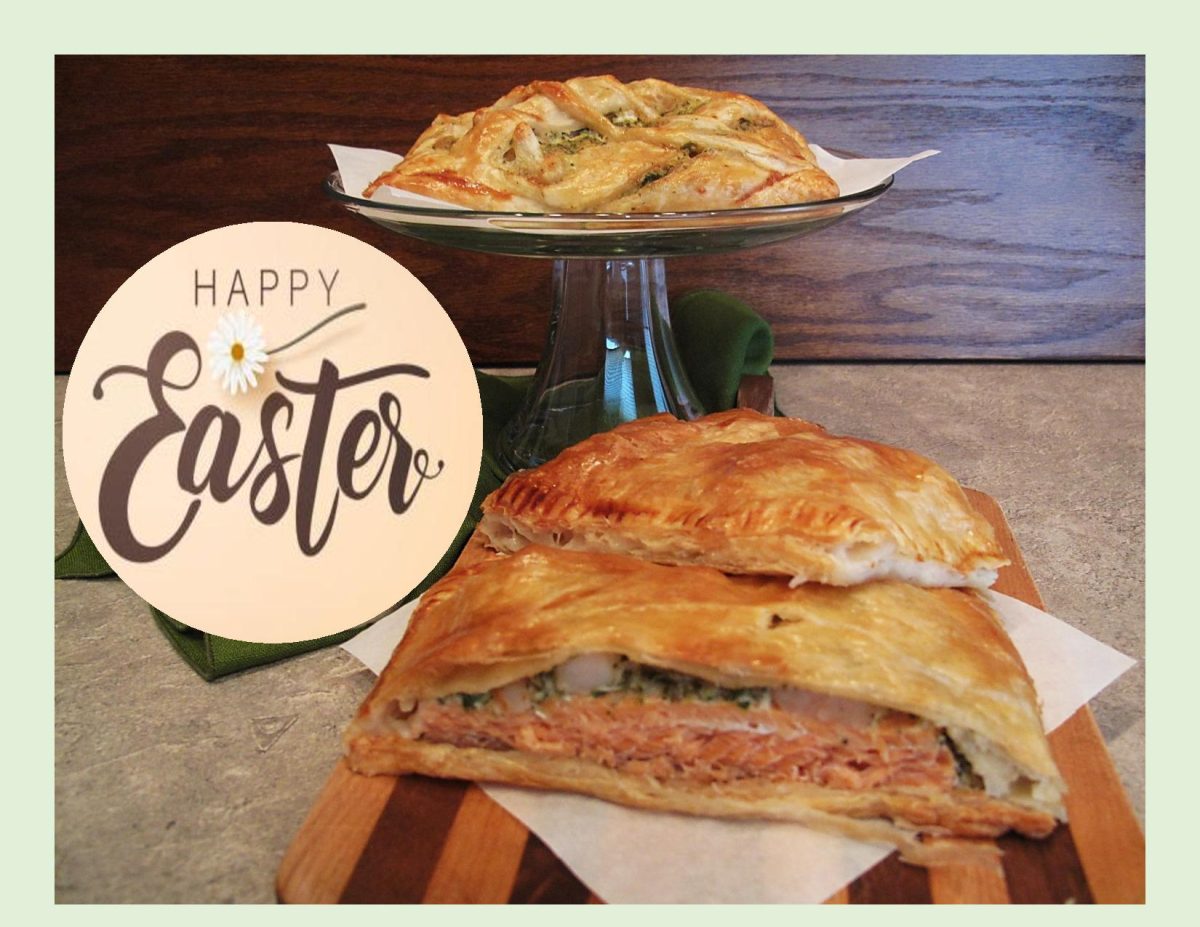
HAPPY EASTER!

Easter is here and Salmon Wellington is the perfect holiday meal! The richness of the mushroom duxelles, pairs perfectly with the hearty salmon fish fillet and scallops and the buttery puff pastry just takes this dish to the next level.

Mushroom duxelles is an intensely flavored combination of finely chopped mushrooms, shallots, and fresh herbs such as thyme or parsley that are slowly cooked to a paste-like consistency. French in origin and named after the marquis d’Uxelles, this mushroom condiment is traditionally used in the preparation of beef Wellington, but it can also be used to flavor soups and sauces as well as to fill omelets and ravioli. 

Wellington fillet as we know it today was first made famous by the American chef and star Julia Child, who introduced the filet de bśuf en croûte, the French crust beef fillet, as ‘Filet of Wellington Beef’ during her TV show ‘The French Chef’, on the 1965 New Year’s Eve episode. From that day on, the recipe began to appear in various recreational circles in North America, as well as being taken up in the most important cookbooks.

A Salmon Wellington is a copycat version of the popular English ‘Beef Wellington’. Because puff pastry takes about 20 minutes to bake (salmon takes 12-15 minutes), keep the salmon refrigerated until you’re ready to assemble. Starting with cold salmon ensures it doesn’t overcook. To prevent the bottom from getting soggy, pat dry the salmon thoroughly before assembling. Also, make sure to cut slits on the puff pastry once assembled to allow the steam to escape. Don’t open the oven until ready since puff pastry needs full consistent heat to bake into flaky layers.

You’ll be so impressed when it’s time to take it out of the oven because it just looks amazing. However, you’ll be more impressed with how it tastes. Just like an elegant and flavorful fish pie!

Print Recipe
Salmon Wellington
Votes: 1
Rating: 5
You:
Rate this recipe!
Course Main Dish
Cuisine French
Servings
SERVINGS
Votes: 1
Rating: 5
You:
Rate this recipe!
Instructions
Mushroom Duxelles
  1. In a food processor, pulse the mushrooms to a roughly diced consistency,15-20 seconds. In a saucepan, melt 2 Tbsp butter over medium-high heat. Add mushrooms, a heavy pinch of salt & pepper, shallots, garlic, rosemary & thyme. Sauté until moisture from the mushrooms has evaporated, about 15 minutes. Transfer to a bowl & set aside.
Scallop Filling
  1. In a small bowl, combine the scallops (or shrimp), cream, onions, parsley, dill, garlic, pesto, salt & pepper. In another small bowl, beat egg white on medium speed until soft peaks form; fold into scallop mixture.
Assembly
  1. Preheat oven to 400 F. Line a 15 x 10 x 1-inch baking sheet with parchment paper.
  2. On a lightly floured surface, roll each pastry sheet into a 12 x 10-inch rectangle. Cut each sheet into FOUR- 6 x 5-inch rectangles. Divide mushroom mixture evenly & spread over 4 pieces of pastry leaving a 1/2-inch border.
  3. Center the salmon pieces on top. Next, top each salmon piece with a quarter of the scallop filling.
  4. Top each with a pastry rectangle & crimp to seal. With a sharp knife, cut several slits in the top to let steam escape. Place on the baking sheet & brush with egg wash. Bake for 20-25 minutes or until a thermometer reads 160 F.
Dill Cream Sauce
  1. While salmon is baking, mix all sauce ingredients & refrigerate until serving time.

Greek Spanakopita Pasta

January is kind of a different month — all the holiday hoopla is done for another year, in our part of the country its fairly cold, bringing on the winter ‘blaas’. I have numerous friends that say they find themselves feeling a bit ‘down’ at this time. That being said, It seemed the perfect time to be a ‘mental traveler’. I’d like to share an experience Brion & I had which was totally amazing in 2010.

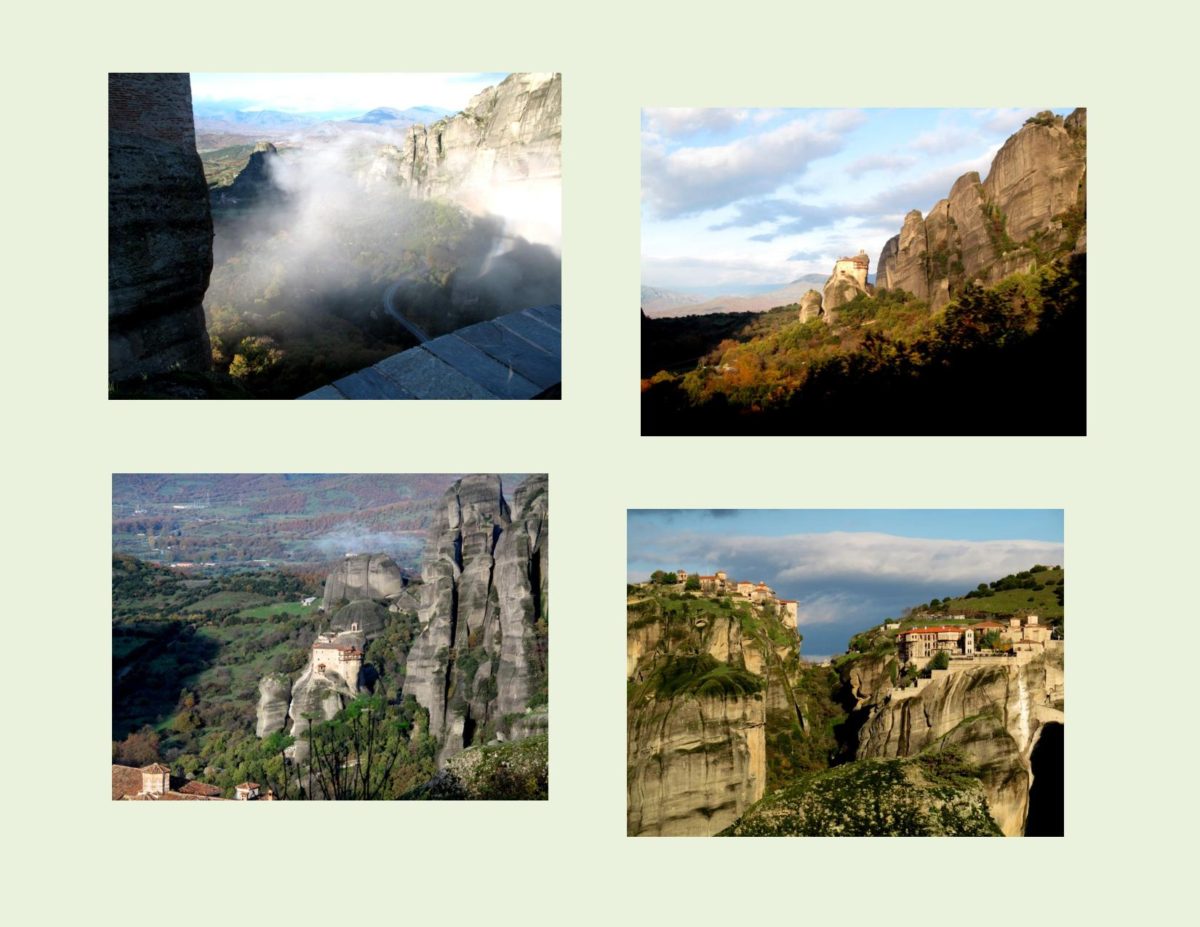
Your day begins in central Greece. A misty fog blankets the Kalambaka Valley as the tour takes you to your morning destination.

Here, in the shadow of the Pindus Mountains and just beyond the town of Kalambaka, massive gray colored pinnacles rise out of the valley towards the sky. Over thousands of years, this landscape has been sculpted by wind and water into a strange and breathtaking sight. Perched miraculously on the tops of these pinnacles are monasteries. The area is called METEORA   and literally means ‘columns in the sky’.

The sandstone peaks were first inhabited by Byzantine hermits in the 11th century, who clamored up the rocks to be alone with God. Though it is unknown how the first hermits reached the tops of these vertical rock faces, it is likely that pegs were hammered into tiny gaps in the rocks. Around 1382 the first monastery was built. By the 1500’s, 24 monasteries were built on these sheer cliffs, but by the 19th century most had fallen to ruin.

Because there were no steps, the main access to the monasteries was by means of a net that was hitched over a hook and hoisted up by rope and a hand cranked windlass to winch towers over hanging the chasm. Monks descended in nets or on a retractable rope ladders up to 40 meters long to the fertile valley below to grow grapes, corn and potatoes.

The natural rock buildings blend so evenly with the scenery, they are hard to spot at first. Only the red tile roofs give them away. Centuries of weather have caused natural streaking of the rock which acts as a camouflage. In the 1920’s, roads, pathways and stairs were built to make today’s remaining six monasteries more accessible as they are now largely dependent on tourist donations.

Inside the walls of these monasteries, life goes on as it has for more than 900 years. Wine is still made in giant oak vats where the monks climb in with bare feet to crush grapes. Most of the carpentry and masonry tools are hand made in the same style as their ancestors. Terracotta pots/bowls are fired by hand pumped bellows on a furnace. Traditional icons are painted using hand ground pigments bonded with egg yolk to make tempera paint that was common in the Middle Ages.

Among the existing monasteries is a convent called Saint Stephen’s that was built in 1798. The occupying nuns are courteous and friendly, but no visitor gets past them with bare shoulders or knees. Novices holding piles of blue aprons and capes meet the visitors at the gate. Anyone not meeting the exacting dress code must don the local sackcloth or be turned away.

To experience this rare geographical phenomenon is something you will not forget easily. If you have the opportunity, be sure to take it. In the meantime, I hope you have enjoyed this mental journey I have taken you on. Check out a few more pictures I’ve added in the recipe section of the blog.

Now, in keeping with the food part of the blog, I made a savory  GREEK SPANAKOPITA PASTA  meal. Easy, quick and tasty.

Print Recipe
Greek Spanakopita Pasta
Votes: 1
Rating: 5
You:
Rate this recipe!
Course Main Dish
Cuisine Greek
Servings
SERVINGS
Course Main Dish
Cuisine Greek
Servings
SERVINGS
Votes: 1
Rating: 5
You:
Rate this recipe!
Instructions
Pasta
  1. Cook pasta in salted boiling water 8-10 minutes, until al dente. Drain & set aside.
Cheese Sauce
  1. In a heavy saucepan over medium heat, heat the milk until hot but not boiling. Combine flour & butter in another saucepan. Whisk until the mixture has gently bubbled for 2 minutes, being careful not to brown the flour.
  2. Begin to add the hot milk to the flour mixture a little at a time while whisking vigorously. Continue to add the milk until it is fully incorporated. Bring the mixture to a boil, reduce heat to low; simmer, stirring constantly, until it thickens, 6-8 minutes ( it will resemble heavy cream). Crumble the feta cheese & add to hot sauce, whisking until smooth. Add dill & pepper; stir. Remove from heat & let cool.
  3. Preheat oven to 375 F. Squeeze water from frozen, thawed spinach. Toss the pasta, cheese sauce, spinach, ricotta & garlic in a large bowl until well combined. Taste to see if any more salt & pepper is needed.
  4. Place in a casserole dish & top with Parmesan Cheese. Bake for 20-30 minutes, until cheese browns a little.
Recipe Notes
  • If you prefer to make this a day ahead of baking, cover well & refrigerate.
  • If you do not care for feta cheese you can substitute 285 grams of either Gorgonzola or mozzarella in place of the 140 grams of feta.

Coquilles St. Jacques

Today, July 25th is my sister Loretta’s birthday. The sibling bond is thought to be one of the most important and longest relationships in our lives. No other peer relationship involves a shared upbringing, shared genes and shared secrets. In childhood, an older sister is an admirable guide to the adolescent world. As we grow older, it is so wonderful to be able to reminisce about events or times you both recall even though to everyone else they are boring. Life events often change the dynamics of many sibling relationships. Thank you, Loretta for being such an amazing sister who has enriched my life in too many ways to count.

I chose this meal for today’s blog not only because Loretta is a seafood lover but from what I have read, it is also ‘St James Day’.

It seems, when you look for any food history that surrounds this meal there isn’t a lot available. The most repeated story is that a knight was saved from drowning by St. James. The knight emerged from the water covered with shells. Coquille St. Jacques translates as the shell of St. James with the origin dating back to the Middle ages.

Classically served in a scallop shell, this special dish consisted of scallops in a creamy wine sauce, topped with breadcrumbs or cheese and browned under a broiler. Scallops, because of their delicate, subtle nature, make a fine marriage with any number of foods and seasonings.

For our meal (in Loretta’s honor), I have used a seafood blend, mashed potatoes and a Gruyere/Parmesan topping. I wish you were here Loretta, to enjoy it with us.

OUR FAMILY CELEBRATES YOU WITH LOVE & AFFECTION ON YOUR DAY!

Print Recipe
Coquilles St. Jacques
Votes: 1
Rating: 5
You:
Rate this recipe!
Course Lunch, Main Dish
Servings
Ingredients
Course Lunch, Main Dish
Servings
Ingredients
Votes: 1
Rating: 5
You:
Rate this recipe!
Instructions
Mashed Potatoes
  1. Cook potatoes in salted boiling water until fork tender. Drain & transfer to a bowl; add butter, milk, salt & pepper. Using a hand mixer, whip potatoes, cover & set aside.
Sauce
  1. Drizzle a tiny bit of oil in a saucepan over medium heat. Add onion, garlic, salt & pepper & cook until tender-crisp, about 3-4 minutes. Add flour & whisk until well combined with onions & garlic. Pour the milk slowly while whisking constantly, making short pauses from time to time to whisk until sauce becomes nice & smooth, then start pouring again. Once the milk has been added, whisk in the Dijon mustard, basil paste, dried dill & parsley. Stir in clams & set aside.
Seafood
  1. Drizzle a medium saucepan with a bit of olive oil. Saute mushrooms until liquid evaporates, set aside. Add a few more drops of olive oil to the saucepan, add the scallops & cook without moving for about 1 minute. Flip the scallops over & continue cooking until they form a nice crust on that side. Remove from pan & set aside.
  2. Add the shrimp to the pan & quickly saute them until they just turn pink & opaque, not much more than a minute. Remove from pan & set aside. Add the salmon to the pan & cook until it just turns opaque, about a minute or two. Add the salmon to the reserved sauce & stir in. Set aside.
Topping
  1. Grate cheese & place in a small dish. Add Panko breadcrumbs, parsley & melted butter. Combine well.
Assembly & Baking
  1. Preheat oven to 375 F. Place Place a scallop in the center of each individual oven safe shell; surround with four of the shrimp. Cover with sauce, dividing it equally between each shell. Give the potatoes a quick stir & place them in a large pastry bag equipped with a star tip. Pipe a border around the filling; sprinkle topping mix over filling. Place in oven for about 15-20 minutes until golden & bubbly. Serve immediately. Nice to serve with garlic bread.

Dinner ‘En Croute’

Today, November 24, our neighbors to the south are celebrating Thanksgiving. Over the years, Brion and I have been in the USA numerous times on this occasion and enjoyed the food and holiday atmosphere very much. Today’s blog post acknowledges the American holiday with some special meal choices.

At the heart of a memorable dinner is the main entree, so why not make it just a bit more special by serving it  ‘En Croute’.  In the culinary arts, the term en croute (pronounced ‘on Kroot’) indicates a food that has been wrapped in a pastry dough and then baked in the oven. Traditionally the type of pastry used was a simple dough called pate pastry. Today, puff pastry  is frequently used for most en croute recipes.

The key to preparing items en croute is that however long it takes to cook the pastry until it is golden brown is how long the item will spend in the oven. Some of the best choices are beef tenderloin, salmon or a brie cheese, due to the fact they require less time to cook.

In the 1950’s and 60’s, Beef Wellington or as the French called it, ‘Boeuf en Croute’, became very popular. It was an elegant meal, using a beef tenderloin covered with liver pate and wrapped in pastry. My first introduction to this meal was a much more low key  version. It was simply achieved by making a nicely seasoned meatloaf, wrapping it a basic pastry and baking it. My mother would serve it with a tomato soup sauce. Definitely good but not quite the elegance of the true en croute entrees.

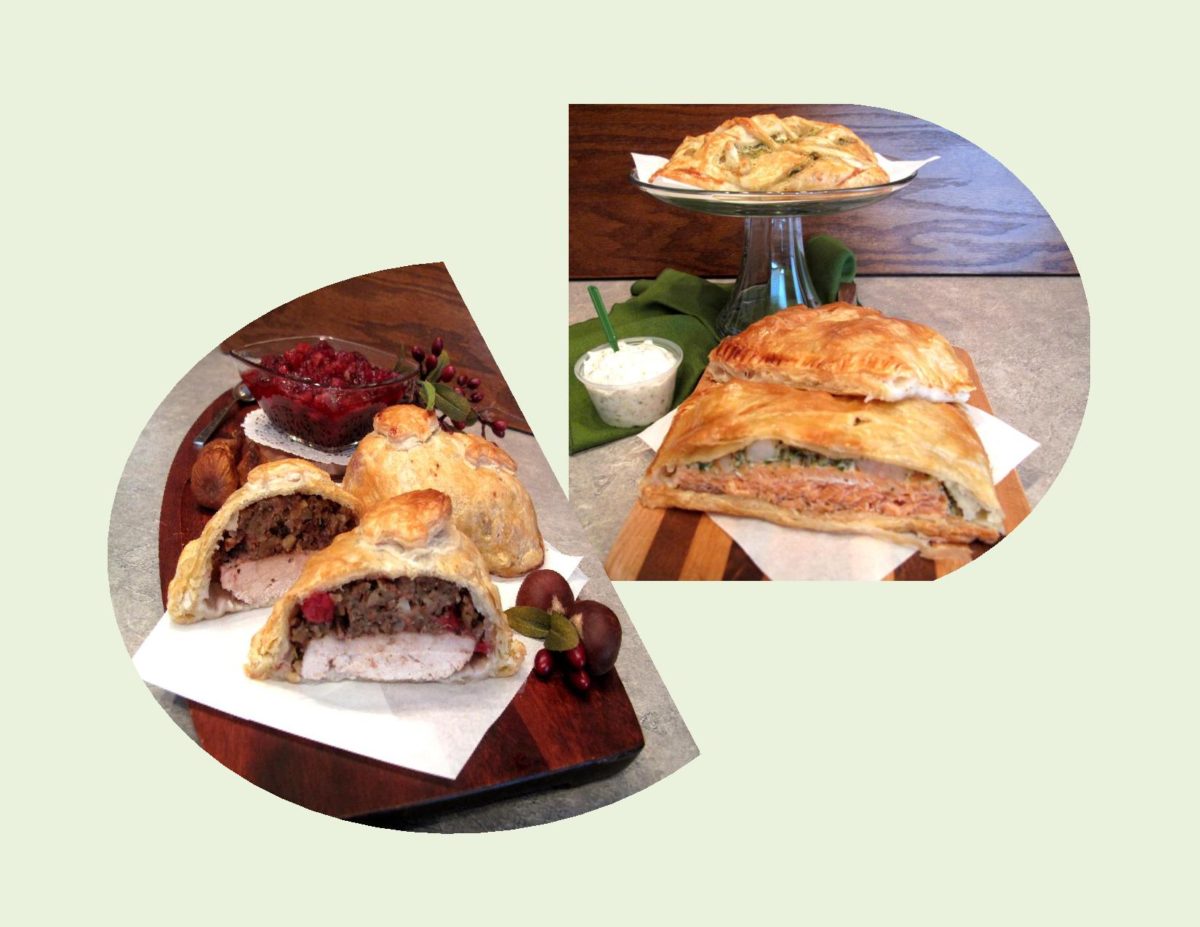
Two favorites of mine are variations of the classic ‘boeuf en croute’. One uses boneless turkey breast topped with a cranberry, hazelnut stuffing and baked in a tender puff pastry then served with a citrus-fig cranberry sauce. The other one is a seafood en croute using fresh salmon. The salmon is topped with shrimp or scallops in a seasoned egg/cream mixture and baked in puff pastry. A dill cream sauce is served to compliment this entree. Having a few alternatives to change out your traditional holiday meals always keeps it interesting.


Print Recipe


Turkey / Seafood 'en Croute'

Alternative ideas for those special occasions.

Votes: 1
Rating: 5
You:
Rate this recipe!

Course Main Dish
Cuisine French

Servings

Course Main Dish
Cuisine French

Servings

Votes: 1
Rating: 5
You:
Rate this recipe!


Instructions
Turkey en Croute
  1. Saute garlic & onions in olive oil & butter 1-2 minutes. Add bread crumbs; toss until they begin to brown slightly. Add hazelnuts, thyme, cranberries, salt & pepper. Add only enough turkey stock to make stuffing hold together.

  2. Place the first pastry sheet on a parchment lined baking sheet. Place turkey breast along the center line of the pastry sheet. Brush the edges of the pastry with egg wash. Place stuffing on top of the turkey. Place the second pastry sheet over the turkey & stuffing. Trim the edges to form an oval shape. Save the trimmings in the fridge.

  3. Bring the edges of the dough together & seal by pinching them. Roll the dough from the bottom layer over the top layer & press down all the way around the perimeter of the pastry. This creates a tighter seal. Brush egg wash over the entire surface of the pastry. Decorate, cutting leaf shapes from trimmed pastry & score leaf veining into them with the tip of a sharp knife. Cut four 1/2" slots in the top of the pastry to let steam escape. Chill for 20 minutes or longer in the fridge before baking. This helps the pastry to puff.

  4. Bake at 400 F. for about 15-20 minutes then reduce the heat to 350 F. Use a meat thermometer to make sure that the center has reached at least 170 F. to be sure the turkey is completely cooked, about 35-45 minutes longer. Let rest for 10 minutes before cutting into servings.

Citrus - Fig Cranberry Sauce
  1. Simmer all ingredients together slowly for 30-40 minutes or until the cranberries are fully cooked & the mixture reduces & thickens to a jam-like consistency. Stir the sauce often as it simmers. Remove the star anise (if using). Store in a plastic container in refrigerator until serving time.

Seafood en Croute
  1. On a lightly floured surface, roll each pastry sheet into a 12 x 10-inch rectangle. Cut each sheet into four 6 x 5-inch rectangles. Place a salmon fillet in center of four rectangles.

  2. In a small bowl, combine the shrimp (or scallops), cream, onions, parsley, dill, garlic, pesto, salt & pepper. In another small bowl, beat egg white on medium speed until soft peaks form; fold into shrimp mixture. Spoon about 1/4 cup over each fillet.

  3. Top each with a pastry rectangle & crimp to seal. With a sharp knife, cut several slits in the top to let steam escape. Place on a 15 x 10 x 1-inch parchment lined baking sheet; brush with egg wash. Bake at 400 F. for 20-25 minutes or until a thermometer reads 160 F.

Dill Cream Sauce
  1. Mix all ingredients & refrigerate until serving time.


Recipe Notes
  • The original recipe source for the Cranberry Hazelnut Turkey & Citrus Fig Cranberry Sauce can be found at rockrecipes.com
  • The cranberry sauce uses star anise or extract but feel free to omit it if you do not care for that flavor.
  • The Seafood en Croute recipe is one that is featured on tasteofhome.com  which has always been my favorite 'go-to' recipe company forever.